


Blog

HR Compliance After an Acquisition: What Every Business Owner Needs To Know
HR Compliance After an Acquisition: What Every Business Owner Needs To Know


The moment a business acquisition closes, the compliance clock starts ticking, and it does not care how prepared you were. According to an EY study, 47% of employees leave within the first year following a merger or acquisition, with that number climbing to 75% within three years. That is not just a culture problem. It is a compliance, liability, and business continuity problem rolled into one. Most acquirers spend months poring over financial due diligence, but far fewer invest equivalent energy into the HR side of the deal. The ones who skip it tend to discover why they shouldn’t have within the first 90 days.
This guide is written for business owners, operators, and HR leaders who have recently closed an acquisition or are preparing to close one. It covers the specific HR compliance obligations you have inherited, which ones are time-sensitive, how to conduct a post-acquisition HR compliance audit, and what to do when the gaps turn out to be bigger than your internal team can handle. You did not create these problems. But you own them now, and the path forward starts with knowing exactly what you are responsible for.
Why HR Compliance Becomes Urgent the Moment a Deal Closes
When you acquire a company, you do not just acquire its revenue, its customers, or its intellectual property. You acquire its people, its policies, its practices, and its liabilities. Every shortcut the previous owner took, every form that was never filed, every worker who was quietly misclassified: all of it transfers to you the moment the ink dries.
The urgency depends partly on how the deal was structured. In a stock acquisition, you are purchasing the entity itself, which means you inherit virtually all existing liabilities, including employment-related ones. In an asset acquisition, you are purchasing specific assets, and while liability exposure is narrower, it does not disappear entirely. Courts and regulators have consistently held that successor employers can be liable for the prior owner’s employment violations, particularly when the workforce stays intact and the business continues operating in a recognizable form.
Inherited liability is the concept that catches most acquirers off guard. It means that the previous owner’s unpaid overtime exposure, lapsed COBRA notices, incomplete I-9 records, and misclassified contractors are now sitting on your books. You did not create these problems, but regulators will not care about that distinction. They will care about whether the violations are ongoing under your watch.
The first 30 to 90 days after close represent the highest-risk window. This is when compliance gaps are most likely to surface, when employees are most anxious and most likely to file complaints, and when regulators are statistically more likely to scrutinize a business undergoing a transition. It is also the period when the previous owner’s HR practices (or lack thereof) become painfully visible.
Here is the uncomfortable truth: in many small and mid-sized acquisitions, the previous owner’s HR practices were never documented, never audited, and in some cases never legal. Before you can fix inherited problems, you need to know what they are, which is why a thorough HR compliance audit should be the first item on your post-close agenda.
The 7 HR Compliance Areas You Need To Audit Immediately
Think of this as your inherited compliance inventory. These are the seven domains where problems are most commonly discovered after an acquisition and where the legal and financial consequences tend to be the most severe. Not every acquired company will have issues in all seven areas. But most will have issues in more of them than the acquirer expected.
1. Employee Classification (W-2 vs. 1099)
Worker misclassification is one of the most common and most expensive inherited liabilities in any acquisition. Small and mid-sized companies frequently classify workers as independent contractors when they should be W-2 employees, often to avoid payroll taxes, benefits obligations, or overtime requirements. The previous owner may have done this knowingly or out of ignorance. Either way, the exposure is now yours.
The Fair Labor Standards Act (FLSA) and the IRS economic reality test both provide frameworks for determining whether a worker is properly classified. If the acquired company has contractors who work set hours, use company equipment, report to a manager, and perform core business functions, those relationships are likely misclassified.
The consequences are significant: back wages, unpaid overtime, tax penalties, benefits liability, and potential class action exposure if the misclassification was systematic. If the acquired company operated across state lines, the complexity multiplies, because states like California, Massachusetts, and New Jersey apply stricter classification standards than the federal government.
What to do first: Pull every active contractor agreement. Map each relationship against the IRS 20-factor test and the DOL’s economic reality test. Flag any relationship where the worker functions like an employee in everything but name.
2. I-9 and Work Authorization Records
Every employer in the United States is required to complete and retain a Form I-9 for every employee, verifying their identity and work authorization. This is not optional, and there is no grace period for acquired companies. If the previous owner never completed I-9s, completed them incorrectly, or failed to retain them, you are now holding that liability.
This is one of the most common gaps we see when stepping into a newly acquired company. Small businesses in particular tend to treat I-9 compliance as an afterthought, and the documentation is often incomplete, improperly stored, or missing entirely.
Immigration and Customs Enforcement (ICE) can audit I-9 records at any time, and penalties range from $252 to $2,507 per violation for first offenses, with significantly higher fines for repeat or knowing violations. In a company with 50 employees and no I-9 documentation, the exposure adds up fast.
What to do first: Audit every I-9 on file within the first 30 days. For missing or incomplete forms, work with legal counsel to determine which errors are correctable and which require re-verification. Do not backdate forms. Document your remediation process thoroughly.
3. Wage and Hour Compliance
Wage and hour violations are among the most financially damaging inherited liabilities because they can extend back years and affect entire classes of employees. The most common issue: employees who are paid a salary and treated as exempt from overtime when they do not actually meet the FLSA exemption criteria.
Under the FLSA, employees must meet specific duties tests and salary thresholds to qualify as exempt from overtime. If the acquired company classified administrative assistants, inside sales reps, or junior managers as exempt without verifying that they meet the duties test, you may be sitting on years of unpaid overtime exposure.
Beyond exemption status, review pay practices at the state level. Minimum wage rates vary significantly by state and even by municipality. Meal and rest break requirements differ across jurisdictions. Final paycheck timing rules are state-specific and carry penalties for noncompliance.
What to do first: Pull payroll records for all salaried employees. Verify that every exempt classification meets both the salary threshold and the duties test under federal and applicable state law. Review hourly employees’ records for proper overtime calculation, particularly if the acquired company used averaging or other non-compliant methods.
4. Benefits Continuation and COBRA Obligations
What happens to the acquired company’s benefits plans at close depends on the deal structure, but the compliance obligations are strict regardless.
In a stock acquisition, existing benefit plans typically continue, and you assume responsibility for administering them. In an asset acquisition, the seller’s plans usually terminate, which triggers COBRA notification requirements for every covered employee. COBRA notices must be sent within specific timeframes, and the penalties for missing those deadlines are severe: up to $110 per day per affected individual, plus potential excise taxes under the Internal Revenue Code.
Beyond COBRA, examine whether the acquired company was compliant with the Affordable Care Act (ACA). If the company had 50 or more full-time equivalent employees and failed to offer minimum essential coverage, there may be outstanding penalty exposure under the employer mandate.
If you are changing or terminating benefits plans as part of the integration, employees must receive adequate notice. The specific notice requirements depend on the type of plan, the state, and whether the change constitutes a material reduction in benefits.
What to do first: Identify every active benefits plan. Determine whether COBRA obligations have been triggered. Verify ACA compliance for the prior plan year. If benefits are being transitioned, build a communication timeline that meets all federal and state notice requirements.
5. Employee Handbook and Policy Alignment
The acquired company’s employee handbook, if one exists, may be outdated, legally noncompliant, or in direct conflict with your own policies. In many small acquisitions, there is no handbook at all, which means employees have been operating without documented policies on harassment, leave, discipline, or termination.
Key policies to review immediately include anti-harassment and anti-discrimination policies, at-will employment language, leave policies, arbitration agreements, and confidentiality or non-compete clauses. Each of these carries legal weight, and inconsistencies between the acquired company’s policies and your own can create confusion, liability, or both.
The multi-state dimension makes this even more complex. A single handbook written for one state will not cover the requirements of employees in other jurisdictions. States like New York, Colorado, and Illinois have specific handbook requirements around topics like paid leave, pay transparency, and sexual harassment training that must be addressed at the state level.
Understanding the people strategy in M&A context here is critical. Handbook alignment is not just a legal exercise. It is one of the first tangible signals acquired employees receive about what life will look like under new ownership.
What to do first: Obtain the existing handbook (or confirm that none exists). Compare it against current federal and state requirements for every jurisdiction where acquired employees work. Identify gaps, conflicts, and missing policies. Determine whether you will extend your existing handbook to the acquired workforce or create a unified document.
6. Leave Law Compliance (FMLA, State-Level Leave, ADA)
Acquisitions frequently push companies over regulatory headcount thresholds that trigger new compliance obligations. The Family and Medical Leave Act (FMLA) applies to employers with 50 or more employees within a 75-mile radius. If the acquired company’s headcount, combined with yours, crosses that line, you are now subject to FMLA requirements for the combined workforce.
State-level leave laws add another layer. Many states have their own family leave, paid sick leave, and parental leave statutes with lower headcount thresholds than FMLA. If the acquired company had employees in states where you previously did not operate, you may have inherited leave obligations you have never had to manage before.
The Americans with Disabilities Act (ADA) applies to employers with 15 or more employees and requires reasonable accommodations for qualified individuals with disabilities. Review whether the acquired company had any pending accommodation requests, interactive process documentation, or ADA-related complaints. Unresolved accommodation issues do not disappear at close.
What to do first: Calculate combined headcount by location. Determine which federal and state leave laws now apply to the combined organization. Review any pending leave requests or accommodation processes inherited from the acquired company.
7. Multi-State Employment Law Exposure
If the acquired company had employees in states where you did not previously operate, you have just inherited a new set of compliance obligations that may be entirely unfamiliar to your team. This is one of the most underestimated risks in any acquisition, especially for acquirers who previously operated in a single state.
State-specific requirements vary dramatically across areas including paid sick leave, pay transparency and salary disclosure, non-compete enforceability, final paycheck timing, state income tax withholding, workers’ compensation coverage, and harassment training mandates. A company operating in Texas that acquires a business with employees in California, New York, and Illinois has just inherited three of the most complex state employment law environments in the country.
The evolving compliance burden facing HR teams is growing, not shrinking. New wage laws, AI regulations in hiring, and expanding data privacy mandates mean that the compliance landscape in any given state is more complex today than it was even two years ago. Inherited gaps in multi-state compliance are riskier now than they have ever been.
What to do first: Map every state where acquired employees are located. For each state, identify the employment law requirements that differ from your home state. Prioritize states with the most employees and the most complex regulatory environments. Build state-specific addenda for your employee handbook and ensure payroll, tax withholding, and benefits administration are set up correctly in every jurisdiction.
The Employee Experience Side of Compliance
Compliance is not just about avoiding fines and lawsuits. It is also about what acquired employees experience in the first 90 days under new ownership and whether they decide to stay.
Research shows that over 33% of acquired employees leave post-acquisition in cases of acqui-hires, and that number climbs when the transition feels chaotic, opaque, or poorly managed. Unclear HR policies accelerate that exit. When benefits change without explanation, when the handbook disappears, when no one can answer basic questions about PTO accrual or reporting structure, employees read those signals clearly. They interpret them as a sign that the acquisition was not well thought through and that their role in the new organization is uncertain.
Here is the part that most compliance-focused content misses: in the early integration phase, the compliance experience IS the employee experience. The way you handle Day 1 onboarding, benefits enrollment, policy communication, and payroll continuity tells acquired employees everything they need to know about whether this acquisition was worth joining.
Consider what the first week looks like from an acquired employee’s perspective. They may not know who their manager is. Their benefits may be in limbo. Their email might have changed. They may have heard rumors about layoffs. Into that uncertainty, the signals you send through HR processes carry enormous weight.
This is where attracting and retaining talent intersects directly with compliance. You paid a premium to acquire this workforce. Every employee who walks out the door because the transition was mishandled represents a direct loss on the investment thesis. Compliance done well is not just risk mitigation. It is a retention strategy.
Practical steps to protect the employee experience during integration:
-
Communicate early and often. Before Day 1, send a welcome communication that addresses the most common employee concerns: Will my benefits change? Who do I report to? Is my job safe?
-
Maintain payroll continuity. Nothing erodes trust faster than a missed or incorrect paycheck. Ensure payroll runs without interruption through the transition.
-
Designate a point of contact. Acquired employees need a named person they can go to with questions. Do not make them guess.
-
Be transparent about what is changing and what is not. If benefits are being transitioned, explain the timeline and the reasons. If policies are being updated, provide the new handbook and walk through the key changes.
-
Listen. Conduct pulse surveys or informal check-ins within the first 30 days. The data you collect will tell you where the integration is working and where it is breaking down.
How To Conduct a Post-Acquisition HR Compliance Audit
A post-acquisition HR compliance audit is not the same as a routine annual review. It is a targeted, time-sensitive assessment of an organization you did not build, using documentation you did not create, to identify liabilities you did not know existed. The stakes are higher, the timeline is compressed, and the margin for error is smaller.
Here is a six-step framework designed specifically for the post-acquisition context.
Step 1: Gather All HR Documentation
Before you can assess anything, you need to see everything. Request and collect the following from the acquired company:
-
Personnel files for all active employees
-
Offer letters and employment agreements
-
I-9 forms and work authorization records
-
Payroll records (at least 24 months)
-
Benefits enrollment records and plan documents
-
Independent contractor agreements
-
The employee handbook (all versions)
-
Organizational chart and reporting structure
-
Any pending complaints, investigations, or legal matters
-
Workers’ compensation claims history
-
Training records (harassment, safety, compliance)
If documentation is missing or incomplete, that is itself a finding. Document what you requested, what you received, and what was unavailable.
Step 2: Map the Workforce
Build a complete picture of who works for the acquired company and how they are classified.
-
Full-time vs. part-time vs. contractor: Verify the classification of every worker.
-
Geographic distribution: Identify every state (and municipality, where relevant) where employees are located. This is your multi-state compliance exposure map.
-
Headcount thresholds: Calculate combined headcount to determine whether new regulatory obligations have been triggered. Key thresholds include 15 employees (ADA, Title VII), 20 employees (ADEA, COBRA), 50 employees (FMLA, ACA employer mandate), and 100 employees (WARN Act, EEO-1 reporting).
This workforce map becomes the foundation for every compliance assessment that follows.
Step 3: Identify Compliance Gaps by Risk Level
Not all compliance gaps carry the same level of urgency. Use a risk-tiered framework to prioritize your findings:
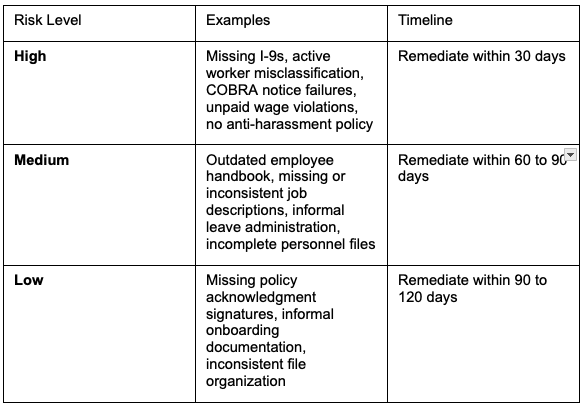
High-risk items are those that carry immediate legal exposure, active regulatory penalties, or the potential for employee complaints. These get addressed first, without exception.
Step 4: Prioritize and Execute Remediation
Build a written remediation plan that assigns an owner, a deadline, and a deliverable to every identified gap. This is not a wish list. It is a project plan with accountability.
For high-risk items, remediation should begin within the first week of the audit and be completed within 30 days. For medium-risk items, target 60 to 90 days. Low-risk items can be folded into the broader integration timeline.
A compensation analysis should be part of this phase, particularly if the acquired company’s pay structure differs significantly from yours. Compensation equity is a compliance dimension, not just a retention one. Pay disparities between legacy employees and acquired employees can create legal exposure under the Equal Pay Act and state pay equity laws.
Step 5: Align Policies Across the Combined Organization
Once the immediate compliance gaps are addressed, turn your attention to policy alignment. Determine which handbook will govern the acquired workforce going forward. If you are extending your existing handbook, ensure it covers every state where acquired employees are located. If you are creating a unified document, build in state-specific addenda from the start.
Communicate changes clearly and compliantly. Some policy changes require advance notice under state law or existing employment agreements. Do not assume you can implement new policies overnight. Walk acquired employees through the key changes, explain the reasoning, and give them a reasonable timeline to review and acknowledge the updated policies.
Step 6: Establish Ongoing Compliance Monitoring
A post-acquisition audit is a point-in-time assessment. It tells you where things stand today. But compliance is not a one-time event. It is an ongoing operational responsibility that requires systems, ownership, and cadence.
Set a schedule for future audits: annually at minimum, quarterly for high-growth or multi-state organizations. Assign clear ownership for compliance monitoring in the combined organization. And invest in the right HR technology stack to make compliance sustainable at scale. The right HRIS, payroll platform, and document management system can automate much of the monitoring that would otherwise fall through the cracks.
Internal HR Team vs. External HR Partner: Which Is Right Post-Acquisition?
One of the first decisions you will face after closing an acquisition is whether your existing HR team can handle the compliance workload or whether you need outside help. This is not a question with a universal answer, but it is one worth thinking through honestly.
Your Internal HR Team
If you have an internal HR function, they bring institutional knowledge, existing relationships, and immediate access to your company’s systems and records. They understand your culture, your policies, and your leadership team’s priorities.
But internal HR teams are typically staffed for steady-state operations, not for the temporary surge in complexity that an acquisition creates. Your HR generalist who manages benefits, onboarding, and employee relations is now being asked to simultaneously audit an unfamiliar company’s I-9 records, evaluate multi-state compliance exposure, reconcile two different payroll systems, and integrate a workforce that did not choose to work for you. That is not a capacity problem. It is a structural one.
Internal teams may also have blind spots. If your own HR practices have never been externally audited, you may be extending your existing gaps to the acquired workforce without realizing it.
An External HR Partner (Fractional or Consulting)
An external HR partner brings specialized expertise in post-acquisition integration, an objective perspective on inherited gaps, and the ability to move quickly with a clear mandate. They have no political capital at stake, no pre-existing relationships to navigate, and no competing priorities. Their entire focus is on assessing what you have inherited and building a remediation plan.
The trade-off is onboarding time. An external partner needs access to documentation, introductions to key stakeholders, and context about the deal structure and integration goals. For smaller acquisitions, the cost of external support may also be a consideration, though it should be weighed against the cost of undetected compliance exposure.
The honest assessment: Most internal HR teams are not equipped to handle a post-acquisition compliance audit on top of their existing responsibilities. This is not a criticism of their capability. It is a recognition that acquisitions create a temporary, intense demand for specialized expertise that exceeds what a steady-state HR function is designed to provide.
The most effective approach we have seen is a hybrid model: an external partner leads the compliance audit and remediation plan while the internal team focuses on employee communication, culture integration, and day-to-day operations. This keeps your people focused on what they do best while ensuring that the compliance work gets the dedicated attention it requires.
For acquirers evaluating their options, it is worth understanding the difference between fractional HR vs. PEOs. A fractional HR partner embeds with your team and operates as an extension of your leadership. A PEO takes on co-employment responsibilities, which can add complexity in an acquisition context where you are already sorting out employment relationships.
Real-World Proof: What Post-Acquisition HR Support Looks Like
Theory is useful. Seeing it in practice is better. Here are two examples of how Ampleo HR has stepped into organizations facing the exact challenges described in this article.
Rapid Deployment in a High-Growth Healthcare Company
When Comprehensive Mobile Care needed dedicated HR support, Ampleo HR embedded as a partner within 48 hours. The company was growing fast, and its HR function had not kept pace. Ampleo HR shifted the organization from reactive, firefighting-mode HR to proactive people operations, building the compliance infrastructure, processes, and documentation that a scaling company needs to operate confidently. This is exactly what the first weeks after an acquisition look like: rapid assessment, immediate stabilization, and a clear path toward sustainable operations.
Building HR Infrastructure From the Ground Up
A Mental Health Company came to Ampleo HR with virtually no formal HR infrastructure in place. Ampleo HR built it from scratch: compliance processes, compensation bands, recruitment systems, and the foundational policies that every employer needs. For acquirers who discover that the company they just purchased had little to no HR function, this is the playbook. You cannot fix what was never built. Sometimes the work is not remediation. It is construction.
Both of these engagements reflect the core Ampleo HR model: right-sized support that matches the moment. Whether you need a full outsourced HR department, targeted expertise to extend your existing team, or a defined project with a clear finish line, Ampleo HR scales to fit.
Beyond HR: Ampleo’s Full Suite of Acquisition Support
HR compliance is often the most urgent post-acquisition priority, but it is rarely the only one. Ampleo HR is part of a larger family of services under Ampleo. Beyond HR, there is also support for finance, marketing, turnaround, valuation, and sales tax. So if a business needs help in multiple areas, we have got people for that too. Most acquisitions surface challenges across multiple business functions, and having a single network that can address them reduces the coordination burden on your leadership team.
Now That You Know: Here’s What To Do Next
The compliance obligations outlined in this guide are not theoretical. They are sitting inside the company you just acquired, waiting to be discovered, documented, and resolved. The question is not whether inherited HR liabilities exist. The question is whether you find them before a regulator, an auditor, or a departing employee does.
Your next move depends on where you are in the process.
If you have not closed yet:
You still have time to build HR due diligence into your pre-close process. Request HR documentation as part of your diligence package. Identify compliance gaps before they become your liability. Bring in an HR expert to review what you are inheriting. The cost of a pre-close HR assessment is a fraction of the cost of remediating problems you did not know you were buying.
If you closed recently (within 90 days):
Start with the high-risk items this week, not next quarter. Audit I-9 records. Review worker classifications. Confirm COBRA obligations have been met. Verify that payroll is running compliantly in every state where acquired employees are located. Build your remediation plan now and assign owners to every open item. The longer you wait, the more exposure compounds. Remember: 47% of acquired employees leave within the first year. Every week of uncertainty pushes that number higher.
If you are past the 90-day window:
It is not too late, but the urgency is real. Conduct a formal HR compliance audit of the combined organization now. If you have been operating with inherited HR practices you have not reviewed, you may be carrying liabilities you do not know about. The risks do not shrink with time. They accumulate.
Regardless of where you stand, here is what we know from working with companies through exactly this process: the acquirers who move fastest on HR compliance are the ones who retain more talent, face fewer surprises, and build stronger organizations on the other side of the deal. The ones who treat HR integration as an afterthought spend the next 12 months cleaning up problems that could have been contained in the first 30 days.
Ampleo HR’s fractional HR team has guided companies from the first 48 hours post-close through full employee lifecycle integration. Whether you need a rapid compliance audit, a dedicated partner to lead the integration, or simply an objective set of eyes on what you have inherited, Ampleo HR delivers right-sized HR support exactly when you need it.
If you are not sure where to start, start with a conversation. Talk with an HR expert today!
FAQs
Share
Table of Contents