






Finance

Insights
Finance Insights and Resources
Practical guidance for building the financial function your business needs, from fractional CFOs who've done the work: cash flow, forecasting, raising capital, and the numbers that drive better decisions.


How to Forecast Cash Flow [5 Reasons You Need One Today]
I had a business finance professor that often repeated the mantra, “cash is king!” Whether your business is large or small, growing or declining, not-for-profit or for-profit, cash is the lifeblood of your business. Growing businesses must consider whether they have enough cash to support growth plans. Declining businesses use a cash forecast to ensure it is not trading while it is insolvent. Seasonal businesses must predict how much inventory they can afford to purchase to prepare for an upcoming peak. To be sure, cash management is critical for all businesses. Unfortunately, many business owners fail to forecast cash and are surprised when they have a business aneurysm : E.g. they don’t have enough cash in their bank account (or capacity under their operating line) to pay suppliers or make payroll.
Why Create a Cash Forecast?
Business owners should forecast cash flows for the following five reasons:
1. To create an early warning system.
A business owner that can predict that a cash shortfall is coming has many more options and time to address it than a business owner that gets surprised by a cash crunch.
2. To identify problems with customers.
Preparing a forecast can help a business owner learn which customers are paying their debts timely and which are not.
3. To ensure the business can pay suppliers and employees.
Suppliers who don’t get paid will soon stop supplying the business. And worse, employees that don’t get paid will stop showing up for work!
4. To comply with requirements by lenders.
Many lenders require borrowers to provide cash flow reports, to ensure the business is liquid.
5. To control the way cash is expended.
Many business owners are surprised by the number of ways cash leaves their business. For instance, some business owners are surprised by the amount of travel and entertainment expenses made by employees through company-issued credit cards. Cash forecasts alert the business owner to the ways cash is expended and can assist in managing them.
How is a forecast created and managed?
Cash forecasting does not need to be highly scientific or overly complex. I often tell clients it’s as easy as kitchen-table budgeting, and when implemented right, can take less than 30 minutes to manage each week. A proper cash forecast is built as follows:
- Determine the frequency you will update and review the cash forecast. Companies in fast-changing environments or teetering on solvency should forecast cash weekly with a 13-week horizon. Stable companies can manage with monthly forecasts and should look forward at least six months.
- Enter the current beginning cash balance of your company’s cash account(s) into a spreadsheet. Or, if your company operates under a line of credit, enter the line availability. This number should be net of any outstanding checks that have not yet been presented.
- Forecast all expected cash disbursements for each period, paying close attention to wages, payroll taxes, and so forth. For the closest weeks, use the accounts payable aging report to determine which bills will be paid and when. For later weeks/months where bills have not yet been received, make estimates based on historical actuals, your knowledge of the business, etc. Make estimates for non-trade disbursements too such as capital expenditures, sales, and use taxes, interest payments, credit card, and debt service payments, and so forth.
- Using a similar process, forecast and total all expected cash receipts for each week (or month).
- Cash receipts will include receivables expected to be collected by week (or month) from customers. For short-term forecasts, work from the accounts receivable aging report. For each open account, list when each invoice will be paid and insert it into the forecast.
- Other expected cash receipts should also be forecast, such as asset sale proceeds, insurance settlements, vendor rebates, advertising coop receipts, and so forth.
- Subtract total disbursements from total receipts to compute the net change in cash week-over-week (or month-over-month).
- Add or subtract the net change in cash from the beginning cash balance to compute the ending cash balance each period. Roll the ending cash balance from the first period to the beginning cash balance of the second period and repeat.
Business owners should track actual performance against the forecast weekly or monthly to learn what cash receipts were expected to be collected, but were not, what unexpected disbursements were made, and what the company’s short-term liquidity position is. If there are ever any periods where the ending cash balance (or line availability) is forecast to go negative, the business owner needs to either identify additional sources of cash; accelerate collections; or delay disbursements.
It’s been twenty years for me since my finance professor crowned cash as king. Since then, I’ve consulted with dozens of business owners with unique sets of challenges and opportunities, but each has had a common goal to maximize cash. The business owners that have implemented the principles and practices above have grown, improved, and recovered their businesses. My professor was right. Cash really is king.

What Metrics Are You Looking At?
Information overload. We all feel it and yet we spend much of our waking hours with our eyes glued to either a 27, 13, 10, 6, or 5-inch screen hoping to find additional information that is both new and interesting for ourselves or useful for our businesses.
According to research performed by Forbes contributor, Bernard Marr, information creation and information access is growing at a staggering rate. Consider the following:
- More data has been created in the past two years than in the entire previous history of the human race.
- By 2020, we will have over 6.1 billion smartphone users globally (overtaking basic fixed phone subscriptions).
- Within five years there will be over 50 billion smart connected devices in the world, all developed to collect, analyze and share data.
- By 2020, at least a third of all data will pass through the cloud (a network of servers connected over the Internet).
- For a typical Fortune 1000 company, just a 10% increase in data accessibility will result in more than $65 million in additional net income.
With information growing at an ever-increasing rate company leaders can start to feel overwhelmed when faced with the question of which company data KPIs should they be paying attention to and how they use these KPIs to measure the health of their businesses.
In the business world, it is common to hear terms such as Big Data, Business Intelligence (BI), Data Analytics , and Business Executive Dashboards. What do these terms mean and how does the typical small to medium-sized business (SMB) leverage these tools?
At their core, all of these terms are synonymous and are used to describe the leveraging of technology to access and visually display a company’s data KPIs that will help interpret data points and subsequently prompt some sort of action. Yes, that’s a mouthful but consider the dozens of business metrics company leaders need to be following in order to make timely decisions and build the appropriate strategy.
A pet peeve of many company leaders as it relates to their KPIs is that they can never seem to drill down into their company’s data points to identify trends either because the data isn’t readily accessible or it is significantly out of date by the time they finally get it. The last thing a business leader neither needs nor wants is another spreadsheet with a pivot table to pour over.
The term Executive Dashboard originated from the automobile dashboard that shows the key operating gauges of a car. In fact, when you think about it, Executive Dashboards are used in much the same way as automobile dashboards. Under the hood of your vehicle, there are literally hundreds of processes that impact the performance of the vehicle. The automobile dashboard gauges in your car tell you things like:
- •Rate of Speed
- •Gas MPG
- •Engine Temperature.
- •Gas Tank Level
- •GPS Directions
An Executive Dashboard functions like the gauges in your car but will reveal business KPIs in “real-time” like:
- Revenue MTD, vs. Target, Growth Rate YOY
- Profitability MTD, QTD, YTD
- New Customers Acquired/Geography
- Cash Flow Forecast
- Cost Per Lead – Click Through Rate – Conversion Rate
- Many More
Simply displaying a company’s KPIs on a large monitor in the hallway or via an app on your phone is not enough to build an analytic culture within a company. Harvard Business Review contributor, Shvetank Shah, touched on this in his article titled, “Good Data Won’t Guarantee Good Decisions.” Mr. Shah states that “ Companies that want to make better use of the data they gather should focus on two things: training workers to increase their data literacy and more efficiently incorporate information into decision making, and giving those workers the right tools.”
Sounds like good advice to me.

Managing Cash via Working Capital Optimization
Here is a trick question for you: Which is more important – Profitability or positive Cash Flow?
For those of you thinking, “Wait, how are they different in the first place?”…just keep reading.
As you think about that question, consider that 82% of entrepreneurial businesses fail because of poor cash management!
I would never suggest that profitability concerns should be secondary to cash concerns, but understand that profit doesn’t pay bills, cash does.
Remember that Profit does not necessarily equal Cash Flow. They can be, and frequently are, significantly different, the main difference usually coming from working capital.
Working Capital
Working capital can simply be defined as the cash you have put to work in your business. What is the cash “working on”? Good question. Typically there are three areas:
- Granting your customers short-term loans (aka Accounts Receivable)
- Paying for all that stuff in your warehouse (Inventory)
- Short-term loans your vendors have given you (Accounts Payable).
Optimizing your working capital doesn’t have to be complicated. How well you have it optimized is always a function of how well you understand how cash moves through your business in the first place.
Cash Management
By asking two questions I’ve found I can get an immediate and reliable representation of how good a company’s cash management practices are. I ask:
- “What is your cash balance right now and how much do you need in the next 3 months?”…and if you don’t know this, either figure it out or go to stressballs.com and place your order now, don’t laugh…it’s a real site.
- “How many days faster or slower do you pay your vendors than you collect from your customers?”
Their answers reveal whether the company understands cash management blocking and tackling. Great cash management principles and basic refreshers can be found at Inc.com, Entrepreneur.com and CFO.com, ranked in my perceived order of simple to sophisticated.
Once you’ve got the concepts, we always recommend doing two things: One, prepare a 13-week forecast, and two, relentlessly attack working capital.
Here are some thoughts on optimizing working capital.
Accounts Receivable
It is your money. Go get it. There are myriad strategies (see above links), but never NEVER assume all your clients will simply pay you on time. Be proactive…reach out.
Inventory
Look out into the warehouse. If you see any inventory…there is probably an opportunity for improvement. Typically you need technology to help optimize your inventory levels. QuickBooks or similar are adequate in some cases, but often you need something more robust like Fishbowl. You don’t want to enter it twice. Get Fishbowl and integrate them seamlessly.
Accounts Payable
Ensure you’re paying your bills appropriately. Ask your vendors for terms.
Study the concepts, prepare and execute your plan.

An “Expanded” Definition of Accredited Investor.
By a somewhat surprising margin (347 – 8), the US House of Representatives overwhelmingly approved legislation that would expand the definition of an accredited investor. Under current rules, a person must have a net worth of $1 million, not including the value of a home, or make $200,000 or more annually.
On Thursday, Investment News reported, “The legislation would allow anyone who has a securities license or who has professional knowledge and experience related to a specific security to participate in private placements [even if they don’t meet the current definition of an accredited investor]. The latter description would apply, for instance, to a doctor who wants to invest in a medical-device manufacturing startup. The bill’s author, Rep. David Schweikert, R-Ariz., cast the measure as an effort to democratize investing in emerging companies. “In America today, some of the greatest investment opportunities are available only to those who meet a certain wealth threshold,” Mr. Schweikert said on the House floor. “With passage [of his bill], Congress took a step towards expanding investment opportunity to include hard-working Americans with sophisticated professional experience. In today’s hyper-efficient economy, that expansion opportunity is a key part of driving economic growth.” The lawmaker hopes the decisive House action will encourage his Senate colleagues to take up the bill or a similar measure. Mr. Schweikert is talking to members of the Senate Banking Committee.”
At Ampleo formerly Advanced CFO, we believe that this is a good first step to provide more people the opportunity to invest directly in private business creation, however, we also remain cautious and will advise our clients to be very careful about accepting money from this new cadre of investors (assuming the legislation passes the US Senate and is signed into law by President Obama) just as we have advised them to be careful and well informed before jumping into crowdfunding. We also believe that this is a trend that started with the new rules around crowdfunding and isn’t likely to end so as an entrepreneur who needs to get sufficient capital to fully develop your product and scale your business, you can’t afford to ignore or be ignorant of the opportunity or the current legal and regulatory developments in this area.
As more people are legally able to invest in private businesses without the cost and effort of preparing and filing volumes of disclosures and forms for a private placement in which you are able to sell to non-accredited investors, we believe that the businesses accepting the money will become more and more exposed to liability and lawsuits if things don’t go as well as they plan. I am not attempting to provide legal advice or opinions, just the best advice I can base on my years of experience in private, financing transactions.
In summary, I recommend that you: 1) get informed; 2) seek and listen to qualified advisors; 3) proceed with caution. If you have questions or wish to discuss how these new developments may apply to your business, please reach out for a free consultation!

What is Operating Cash Flow?
You may have heard of cash flow, but what exactly is operating cash flow? While cash flow is the net amount of cash moving in and out of a business, operating cash flow is something different. Operating Cash Flow (OCF) is a measure of the amount of cash generated by a company’s normal business operations. Since it adjusts for liabilities, receivables, and depreciation it is a more accurate measure of how much cash a company has generated than other measures of profitability such as net income.
Why is operating cash flow important?
No matter how you choose to measure cash flow, it is still important. Cash flow (and OCF) is what helps companies expand, launch new products, pay dividends, and even reduce debt.
Without positive cash flow, a company doesn’t have as much flexibility. They may have to borrow money, or in the worst case – go out of business. Having a negative cash flow is acceptable at times, but should not become a habit. If the negative cash flow can be attributed to temporary expansion costs, then that is fine. If the negative cash flow is because of a poor investment or other mistakes that won’t correct themselves, then your business may be in trouble.
How do you calculate operating cash flow?
Generally, a statement of cash flows breaks out into three different categories per period: cash flows from operations, cash flows from investing activities, and cash flows from financing activities. OCF is calculated using the following formula:
Operating Cash Flows = Net Income + Non-cash Expenses (Usually Depreciation Expenses) +/- Changes in Working Capital
How does operating cash flow relate to the big picture?
In the end, OCF reveals how much cash is generated from the core operations of your business. This is very important to the overall health of your business and the larger picture of cash flow. OCF is just one part of cash flow, and it is typically a big part of what makes your company profitable.
There is a lot more to cash flow and operating cash flow, but the essentials remain. To be a profitable business, you must have a positive cash flow. If you are not positive, then don’t delay in looking for ways to solve this problem. This begins by looking at your OCF, analyzing a cash flow statement, and making plans for the future. Wherever your company is financially, it is important to look towards the future, free up cash to invest in growth, and be ready for any hard times that may come your way.

What is Cash Flow?
Cash flow. The reason you’ve heard it over and over again in business is because it is key to the survival of every business. Cash flow is the net amount of cash moving in and out of a business. So why exactly is it important and how can learning more about it help your business?
Cash flow is more specific than a single number; it is made up of many variables, each contributing to the positive or negative cash flow of a business. A positive cash flow is a sign that a company’s assets are increasing, enabling the company to pay off debts, return money to shareholders, and provide a buffer against future challenges. Negative cash flow is a sign that a company’s assets are decreasing. Overall cash flow is a good sign of the quality of a company’s income and is a good judge of how prepared a company is for the future.
Being able to manage your cash flow is perhaps more important than knowing what cash flow is. Cash flow management is the process of monitoring, analyzing, and adjusting the cash flow of your business. Many different businesses fail due to the poor management of cash flow. If your business consistently spends more than it earns, then this is a problem that needs to be addressed. There are several different ways to overcome a cash flow problem, including, a cash flow analysis, developing proper strategies, a cash injection, and other financing options.
Cash flow analysis is best performed by looking at your cash flow statement. The cash flow statement is one of the most important statements for your business. This document is a listing of cash flows that occurred during a specific accounting period. In addition to the cash flow statement, a cash flow forecast is a projection of future cash projections. When you look at your cash flow statement, you may find a need to create a cash flow forecast. This can help your business stay profitable and prepared for the future.
There is a lot more to cash flow and cash flow analysis, but the essentials remain. To be a profitable business, you must have a positive cash flow. If you are not positive, then don’t delay in looking for ways to solve this problem. This begins by looking at your cash flow statement, performing a cash flow analysis, and making plans for the future. Wherever your company is financially, it is important to look towards the future, free up cash to invest in growth, and be ready for any hard times that may come your way.

5 Tips for Presenting to Executives
We, as CFOs, regularly think about our priority of assisting the CEO to do her job better. CEO’s have very full plates. They are always looking for people they can trust to get things done. With trying to do so many things at once, the last thing she needs is a finance person telling her all of the problems her company has. The CEO needs to know about the problems, but just as importantly needs someone to offer her solutions. The following 5 tips on how to present to Executives really ring true.
- Get to the point. Executives don’t have time for the long version.
- Talk about problems and solutions winning in the marketplace. CEOs are thinking 3 years in the future.
- Sell the vision before sharing data. They simply won’t listen to the data otherwise.
- Lead with stories, not data. Data bores them.
- Don’t be afraid of executives, be afraid for them. Your job is to alleviate their fears and make their jobs easier.
The 5 points really will help you with your presentations and just your overall communications with CEOs and executives you deal with on a daily basis.

Why You Need a CFO, not Just an Accountant
January is named after the Roman God Janus. Janus is depicted with two faces, one pointing forward and the other back and is symbolic of the process of change — gazing backward at the recent past while staring intently into the new improved future.
As I meet with CEOs I frequently invoke the image of Janus to help them understand the role of finance in an organization. It also must be capable of looking forward and backward at the same time. For many accountants trained in record keeping, they’ve got the looking back part of the job nailed. However, rarely do we find accountants who are both accurate in their perceptions and descriptions of past performance and have the rarer ability to look forward and assist meaningfully with financial strategy.
This ability to do both is the key factor for success for any CFO. You may call them controller, Vice President of Finance, or CFO, but as CEO, you should ask yourself whether you have both in your senior-most financial leader.
A timely measure of the CFO’s ability to do both is how well they assist you in connecting your current performance to your strategy to your forward-looking operating plan. The last few months of the year are the time when many organizations are reflecting on past performance and developing their next year’s operating plan or budget. A critical component of any budgeting cycle is how well it connects to your overall strategic plan. The CFO should be the person ensuring linkage, otherwise, he or she is simply an accountant.
To put it simply, this virtuous planning cycle should begin with refreshing your overall strategy and identifying the 5-6 most critical factors you must achieve in the next period to move effectively toward achieving your strategic priorities. Larry Bossidy, a mentor of mine from my Honeywell days, often said,
“Every company has a half a dozen or so critical issues which if left unaddressed will keep the business from reaching its full potential.”
Once these critical success factors are defined, you can build a proper operating plan or budget around it. Creating a budget without linkage to these critical success factors means you’re sending your team off to execute against a plan without real direction. What a waste of time. Remember that your budget should be just ‘year one’ of your strategic plan and not simply a rolled-up budget of what individuals on your team want to accomplish, which we see frequently.
Keep in mind these principles work even for startups, but the cycles should be compressed. A one-year cycle may well be a 3 or 6-month cycle.
There are other differences between an accountant and a CFO as well.
- Accountants often report based on tax or GAAP without regard to how the information could be better presented internally for decision-making purposes.
- Accountants often aren’t the best communicators or don’t understand interpersonal dynamics
If you’re feeling a little like you, as a business leader, need to understand more about the nature of an accountant versus a CFO, here are a couple of brief articles describing the difference.
Why You Need a CFO, Not Just an Accountant, by Benjamin Osei Mireku.
The Difference between a CFO and a Controller
Or, if you are entering a planning cycle, I strongly recommend you read Bossidy’s book, “Execution: The Discipline of Getting Things Done.” Many of the principles he discusses are also summarized in this article in Strategy & Business.

Access to Capital
THE BEST OF TIMES, THE WORST OF TIMES
This variation of the well-recognized phrase applies not only to Dickens’ comparison of the conditions in London and Paris in his classic novel A Tale of Two Cities but also to a comparison of the two vastly different “markets” present in the startup ecosystem in Utah (and nationwide).
On one extreme, some technology companies are growing at double and triple-digit rates, raising mounds of equity at insanely high valuations and basking in the attention and adoration of the national business news media. A select few have even magically transformed themselves into bona fide “unicorns”, with $1 billion-plus valuations and celebrity status that rivals or exceeds that of the State’s top performers or professional athletes. These businesses have little trouble attracting top talent, even within the disciplines that are in high demand and hard to find, with their offers of higher-than-average comp plans, valuable stock options, free meals, flexible schedules, and numerous other perks.
At the other end exist myriad entrepreneurs with talent, great ideas, passion, and a burning desire to be a successful business owner, even the next unicorn. If you ask them what they need, most will reply with one word, “capital” – the fuel to propel their “rocket” into orbit. History, however, teaches that there is more lacking than just capital. The truth is that many suffer from “unconscientious incompetence” (Chuck Coonradt’s apt moniker for “they don’t know what they don’t know”) and in some cases; they aren’t willing to acknowledge it or ask for help. Without the right acumen and experience, the capital (almost regardless of the amount) will not lead to success – rather it will lead to a series of starts, stops, pivots, and strategy & product modifications until there is too little left to fund a successful strategy that may have been discovered in the preceding months/years of trial and error.
In the middle are businesses that actually have a product, are gaining or are trying to gain customer traction, and have a reasonably clear pathway to growth and profitability. However, like the would-be startup entrepreneurs, many will tell you that they lack the capital to take their business to the “next level” but by now, many have realized that they need help and are looking for the talent to augment their team, but here again, capital comes into play because in many cases they cannot afford all of the talents that they need when they need it.
The lure of entrepreneurism and the imagined success has spawned multiple incubators, accelerators, shared office spaces, and entrepreneur groups promising training, mentorship, business acumen, and access to capital among other things to improve the chances of success for a small cost and, in some cases, a bit of your company’s equity. We’re not being critical of these groups, in fact, we think that they can offer real value but they typically are not the “end all” solution for start-up success – especially for those businesses slogging through the “middle” stages of the spectrum.
So now we ask, what is an entrepreneur to do? Great question and one for which we don’t claim to have all of the answers but we do have a few ideas based on our observations over the years.
First and foremost, in my humble opinion, the attitude of the entrepreneur is key. One of the ways to quickly evaluate one’s attitude is to observe how she/he views challenges or constraints – they can either be seen as the roadblock that we cannot overcome without outside help (i.e., capital) or they can stimulate us to achieve more and can be an impetus for a better outcome by framing how we view them. I read a great example of this recently in a story about Audi’s desire to win LeMans.
“In the mid-2000s, Audi’s focus was on winning the 24 Hours of Le Mans, but the engineering teams, like their competitors, had already focused on the speed of their cars and conducted endless wind tunnel experiments to create vehicles so fast they exerted two tons of downward thrust. Rather than frame the challenge in terms of speed, the question posed by the chief engineer was “How can we win Le Mans with a car that can go no faster than anyone else’s?” That question couldn’t be answered with wind tunnel experiments. Instead, the engineers realized that it is possible to win Le Mans in those circumstances if you pull into the pits less often, and the solution they found was diesel technology. The resulting R10 TDI went on to win the 2006 24 Hours of Le Mans, and was the first diesel vehicle ever to win the race.”
Let’s relate the reframing process to a typical startup’s constraint or challenge of having insufficient capital to engineer and manufacture or program a “minimal viable product (MVP)”. If we only look at the problem as a lack of capital, we may never find a solution. On the other hand, if the problem is reframed as, “how do we achieve MVP status without extra capital?” it opens our eyes to other opportunities such as strategic partnering with another company, using equity to compensate a freelance programmer, learning to code during my off hours and relying on other lean startup concepts to find a way to “bootstrap” to a solution.
I call this kind of attitude being “scrappy” and we love scrappy entrepreneurs. I’ve worked with many of them – Rick Alden (Skullcandy), Jason Ellis (Spring Mobile), Greg Warnock (vSpring / Mercato), Dusty Zundel (Signature Products Group), Michael Sneddon (MultiLing), Paul Allen (Ancestry.com) and Jeff Kearl (Stance) to name a few. All of them faced seemingly insurmountable challenges at some point during the early stages of their businesses, including a lack of sufficient capital to grow the business. The common thread is that each of them found creative ways to reframe and overcome the constraints and ultimately, built highly successful businesses with their teams.
The experiences of these and other successful current and former clients have taught us that entrepreneurs/founders control more than they usually realize and you don’t always need outside capital to solve your problems (Spring Mobile, Signature Products Group, and MultiLing did not raise outside capital until they had achieved significant growth and profitability and if/when they did, it was to accelerate growth).
The next (and final for this post) essential attribute is humility (aka the antithesis of pride). By this, I mean the ability and willingness to admit when you are wrong or have made a mistake or when you don’t know what to do and to ask for help. This singular character trait gives an entrepreneur (or employee or partner, etc.) immediate credibility in our book and is essential for me to consider any kind of partnership (hiring, investing, etc.) Such entrepreneurs are not afraid to expose their weaknesses, and look for ways (and people) to solve their constraints that they are not able to do on their own. They surround themselves with people who are smarter and better than they are in specific areas and by doing so, they encourage everyone to make suggestions and try new and unusual solutions. As a result, they spend less time traveling down dead-end strategies and less money to achieve their ultimate goals.
If you’ll do a little research on many of the businesses described in the first paragraph, we believe you will find at some point in the entrepreneur’s journeys – either in this business or in a previous life – they found themselves on the “crowded, other end” but found a way to navigate to their current success by overcoming their obstacles and constraints. Even they will tell you that the entrepreneurial path is not easy and it is not for everyone. But by learning to reframe the challenges that you will inevitably face and by having or developing the attributes of scrappiness and humility, we believe that your chances of success will be greatly increased.

The Right CFO for Early Stage Financing – An Entrepreneur’s Checklist for Raising Early Stage Capital
Are you hoping to secure capital to properly fund your business? If so, you need to know how to prepare to maximize your opportunity for success. Obtaining financing is a complicated process, but below are elements that the right CFO can help identify and execute to successfully raise early-stage capital.
Understand short-term and long-term financial needs of the company
While insufficient funds may prevent your company from realizing its true growth potential, raising too much capital too soon may generate costs that far outweigh the benefits intended for financing growth. Thus, an accurate understanding of the short and long-term needs of the company, based on accurate and timely financial information and modeled projections, is essential to successful early-stage financing.
Provide accurate forecasts of revenue, market share, and margins
Adequate financial information is also crucial in obtaining financing. Timely and accurate reporting of key financial and non-financial information tells lenders and investors that your company understands its business model and is able and ready to act on key information to keep the business on track. Advanced planning is important to avoid financial statements becoming the impediment to a successful capital raise.
In addition, accurate forecasts of revenue and related costs can provide a roadmap for determining the now and future value of your company. An accurate forecast will have major consequences for your company and its current and future investors. A valuation set too low devalues the existing investors’ equity and overly dilutes their ownership percentage. On the other hand, a valuation that is set too high may cause investors and observers to doubt the company’s credibility, make it difficult for initial investors to sell their holdings and exit, and make it difficult for the company to deliver on its projections.
Have clear milestones for development
Creating a business plan with clear milestones for development is also crucial to your company’s progression and attracting the right investors. Your company’s business plan is often the first and only introduction to a potential investor. It must drive the assumptions and the direction of your company’s projected financial activity. The milestones described in your business plan need to be clear and achievable.
Understand competition and market trends
As recent history has shown, the markets for public and private equity can change dramatically in a very short time. Your company needs to ensure that team members understand the current market trends. All potential consequences should be weighed when making decisions related to forming an entity and seeking an equity partner.
Understand the financing options available
Obtaining financing is not a one-size fits all operation. There are several sources of equity capital available, including angel investors, private equity firms, strategic partners, and the newly surfaced social investors commonly known as “crowdfunding.” It is also important to understand applicable statutory and regulatory schemes affecting each kind of financing. For example, Jumpstart Our Business Startups Act (JOBS Act) was enacted in 2012 and provides private companies with additional avenues to raise capital without registration with the SEC. Understanding the ins and outs of available financing options is essential to increasing the company’s chances of successful financing.
Focus on the team
Finally, it is vital that your company focus on developing a quality team to carry out these important objectives as well as to attract investors. Your company must show investors and lenders that its team has the experience and knowledge to manage the investment wisely with a high probability of generating the desired ROI. Having highly-qualified, experienced team members who have demonstrated success will go a long way to helping the company secure the investor’s trust and then their money.

One Smart Way to Manage Cash
Pre-orders. I know what many of you may be thinking…’that won’t work in my business.’ And while that may be right in some cases, we are seeing more and more business launch, or cover cash shortages, with pre-order strategies. For example, Johnny Cupcakes, a pop-culture t-shirt company, uses the occasional pre-order strategy when they notice a quick trend they want to take advantage of, but which they’d not seen coming. They can secure the order while the idea is hot, but before they’ve secured the product. You can see Johnny discuss this in this 1-minute clip on Inc.
One client of ours is using the pre-order strategy to launch his company. The founder had a brilliant idea but simply did not have the resources to launch quickly and secure market share without taking capital from somewhere. His solution was to create a killer product video with a working prototype that went viral. Several million dollars later, and before he’d begun production, he had great product feedback, the capital he needed to launch, and significant attention from future investors. He opted for a direct model rather than certain sites of growing popularity like Kickstarter. However, Kickstarter can be an effective tool for launching products.
The authors of a book called The Entrepreneurs Guide to Finding Your First Customers share some of the advantages and strategies of pre-selling in one of their chapters. Their 5-step formula for pre-selling includes the following:
- Product co-creation: customers, real-paying customers and not just those that suggest that they’ll buy, are an invaluable source of feedback. They, in the act of purchasing, are providing validation of the product. However, these evangelists are frequently also willing to engage in a dialogue with you and give you great insight into the product and why they bought it.
- The Early Investor Narrative: while you won’t give your first customers an equity stake, you can convince them that they’ll receive early adopter benefits. As an example, you can offer early adopter discounts.
- Scarcity: as you limit availability, whether real or artificially created, through a period of time in which they can order or a limited amount, you will create an urgency to buy.
- Social Proof: Generating some social proof will maximize the effectiveness of the pre-sell campaign. Find a ‘big name’, or generate chatter through a variety of social strategies. Then utilizing social proof effectively will assist in convincing the buyer to buy.
- Status Indicator: a status indicator is some social reward that will indicate to the social sphere in which your buyer lives that they were “first”. Most do not buy only for a status indicator, but a special badge in your product forum or a t-shirt is a motivator to get a buyer across the line in many cases.
There are a few cautionary items to consider around pre-selling as well.
- This should be intuitive, but don’t take a customer’s money, unless you’re sure you can deliver a product. This is a surefire way to end up in significant legal trouble.
- A pre-sell, by its nature, is not a sale – as defined by generally accepted accounting principles. You haven’t delivered the product, so it isn’t a sale. It shouldn’t be shown as a sale on your income statement.
- Unless you have a working prototype, your campaign will likely be perceived as a fund-raiser, rather than a pre-sale, and therefore less effective.
Pre-selling can be a terrific strategy for raising early funds in a product life-cycle, or for taking advantage of a current trend ahead of your ability to deliver, or simply for generating cash during seasonal cycles of your business. If you stop and think creatively about your business, you may find there are hidden opportunities for pre-selling that can generate needed capital.

Stock Options 101
Consider joining a startup offering stock options…or considering offering them to your employees? Not all startups use stock options as an incentive for employees and officers, but if you are thinking about the possibility, here are a few basic questions you should ask and consider before jumping in.
Questions to ask:
- Do I trust this team? Is it the right company?
- What is my percentage ownership?
- What is the market rate for salary and equity compensation?
- Do I need a lawyer or accountant to review my option grant?
- What is the vesting schedule?
- What are the tax implications?
Discussion
1. The Team
As with any investment, the capabilities of the team are crucial. Have they done this before? Do they have a track record of turning startups into profitable companies? Are they trustworthy? The team must feel they can trust one another and those at the helm.
2. Ownership
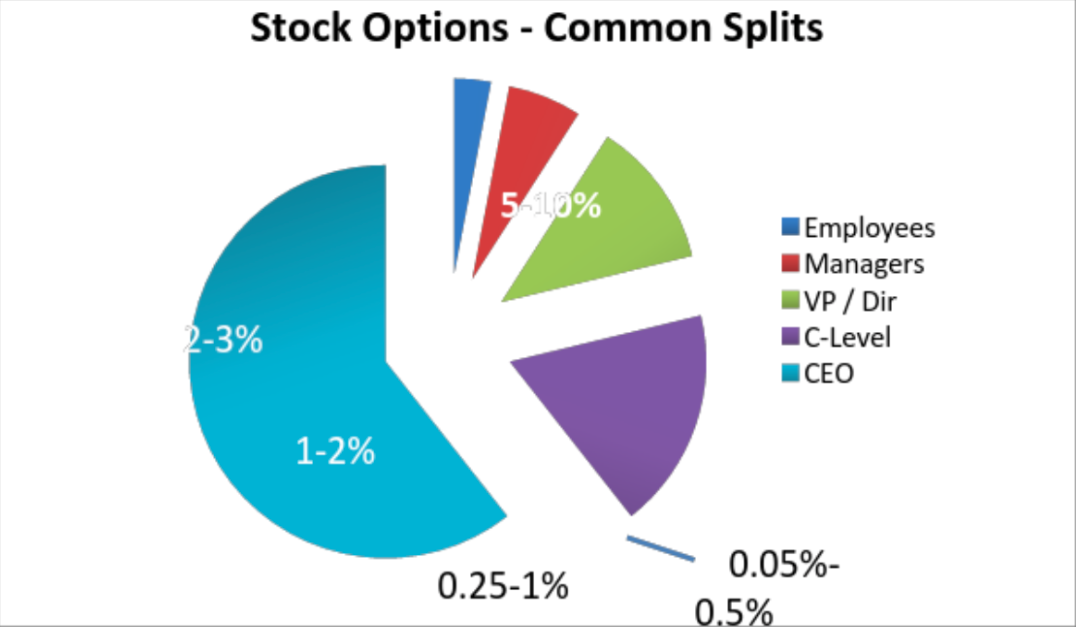
Most companies split up ownership when they take on their first outside money. At that time a stock option pool will be set up as an incentive for executives and employees. The pool is frequently between 10% and 20% of the company. Here is a table of common splits within that pool:
3. Value
The value of the stock options has to be established by an outside third party according to IRS rule 403(b). In some instances, the company will establish the value of the stock, but it has to reflect fair market value. If a company has had a financing transaction with an outside party, the economics of the deal can be used to set a value stake in the ground.
4. Tax and Legal Help
If you are receiving a stock option you really should talk to your tax advisor about how it can impact your tax situation. Those offering options should encourage recipients to seek appropriate advice. There are a lot of potential tax implications for the employee, especially if they are receiving ISO (incentive stock options) versus NSO (Non-statutory Options). ISO’s have some very favorable tax implications, but they should understand long-term capital gain versus ordinary income.
5. Vesting
Most options vest over a period of time. Vesting means employees actually receive the right to the option. The company may grant options, but if it vests over 3 to 5 years, the recipient really doesn’t have the right to exercise those options unless they stay at the company over the entire vesting period. Common vesting schedules are 3-year vesting where you earn 1/3 per year. Often a “cliff” is employed, where the recipient doesn’t vest in anything unless they remain with the company for 1 year and then they vest a full year’s worth of options, with ongoing monthly vesting thereafter.
6. Taxes
ISO’s are not taxable to the employee until the options are sold. NSOs are compensation to the employee or consultant when granted. ISO’s can be exercised as they vest and that will begin the long-term capital gains clock ticking, but it is often hard for employees to exercise the option and actually pay for the stock, so often they are exercised when a company has a liquidity event. The resulting tax implication then is a function of being ordinary income instead of capital gains. Consider carefully whether the options are tied to milestones. If they are, the options then become contingent compensation and tax consequences are incurred as the options vest. Consider whether options can be exercised early. This starts the long-term gain clock ticking early and the recipient vests in the stock over time. They can also make an IRS 83b elections, which allows for some significant tax savings. Again, however, it is recommended that all parties talk to their tax advisor.
Conclusion
Stock options are a great incentive for employees in companies that are:
- Growing
- Have the possibility of stock values becoming significant
- A likely liquidity event in the future
Equity compensation encourages each employee to act like an owner if it is managed properly by using them to align everyone’s interests in the future of the company.