



Real advice from people who've done the work.
Advice grounded in experience from the experts inside 13,000+ businesses.
Everything we publish comes from people who are actually doing this work. You won't find generic business advice here. You'll find specific, useful content from finance leaders, HR directors, marketing experts, and turnaround specialists who bring real experience to businesses like yours.




All Insights
Explore by Category

The Complete Acquisition Integration Checklist
You’ve signed the papers. The deal is done. And this is precisely the moment when most acquisitions begin to fail. Not because the financials were wrong, but because the people side of integration never got the attention it deserved. Studies show that 83% of deals fail to deliver any discernible business benefit, and the root cause is almost always the same: a rushed or neglected integration process that treats HR as an afterthought. The truth is, HR blind spots during an acquisition don’t just create inconvenience. They create turnover, compliance exposure, and cultural fractures that can quietly unravel the value you just paid for.
This guide is the acquisition integration checklist you actually need. It covers every phase from pre-close preparation through the critical first 100 days, with a specific focus on the people operations layer that most checklists gloss over. You’ll get a clear, phase-by-phase framework for stabilizing your workforce, aligning compensation and culture, locking in key talent, and avoiding the compliance landmines that catch under-resourced teams off guard. Whether you’re a CEO running your first acquisition or an operator managing integration with a skeleton crew, this is built to help you move fast, protect your people, and make the deal actually work.
Why Most Acquisition Integrations Fail (And It’s Not The Financials)
There’s a persistent myth in the M&A world that deal failure is a financial problem. That the model was off, the valuation was too aggressive, or the synergies were overstated. And sure, those things happen. But the deals that truly unravel after close almost always fail for the same three reasons, and none of them show up on a balance sheet.
People Attrition
The single most predictable and most preventable failure mode in any acquisition is losing the people who made the target company worth buying in the first place. According to an EY study, the average employee turnover after a merger hits a 47% turnover rate within the first year, climbing to 75% within three years. That’s not a rounding error. That’s the institutional knowledge, client relationships, and operational continuity of the acquired business walking out the door. And it happens because no one made a deliberate plan to keep them.
Cultural Friction
Culture is not a soft topic. It’s an operational one. When two companies come together with different decision-making styles, communication norms, and expectations around accountability, friction is inevitable. The question is whether you manage it or let it manage you. Research shows that companies actively managing cultural integration achieve 67% deal success rates compared to just 33% for those that neglect it, and they realize synergies 18–24 months earlier. Treating culture as a structured workstream, not a soft afterthought, is the difference between a deal that compounds and one that collapses.
Operational Ambiguity
After the close, there’s a dangerous window where nobody is quite sure who owns what. Who approves hiring? Who handles a compliance question? Who communicates policy changes? When decision rights are unclear, everything slows down. Managers hesitate. Employees disengage. And the HR technology stack that worked fine for one entity becomes a tangled mess when you’re trying to run two organizations through it without a migration plan.
The good news is that all three of these failure modes are predictable. And if they’re predictable, they’re preventable. That’s what the rest of this checklist is designed to help you do.
Before Day 1: The Pre-Close Integration Checklist
This is Phase 0, the work that happens before the deal officially closes. It’s also the phase that most buyers skip entirely, either because they’re consumed by the transaction itself or because they assume integration planning can wait until the ink is dry. It can’t. The quality of your first 100 days is largely determined by what you do in the weeks before Day 1.
Stand Up Your Integration Team
Someone needs to own integration. Not as a side project. Not as an item on a CEO’s already overloaded task list. As a defined responsibility with clear authority.
Start by identifying your integration lead. This could be an internal operator, an external advisor, or a fractional resource. What matters is that they have the bandwidth and the mandate to drive the process. From there, build out what’s often called an Integration Management Office, or IMO. In plain terms, this is the small group of people who make decisions, communicate those decisions, and resolve conflicts when functional teams disagree.
Assign functional owners across HR, Finance, IT, Operations, and Legal. Each owner should know exactly what they’re responsible for delivering in the first 100 days. If you don’t have the internal bench to staff this, that’s not a failure. It’s a signal that you need outside support, and the sooner you acknowledge it, the better your integration will go.
Conduct A People Audit
Before you can stabilize the workforce, you need to understand it. Pull the org charts for both entities and lay them side by side. Where are the overlaps? Where are the gaps? Who holds institutional knowledge that would be devastating to lose?
Flag your flight risks early. These are typically high-performers in the acquired company who have options, know their value, and are already fielding recruiter calls. Review existing employment agreements, non-competes, and benefits structures so you’re not blindsided by obligations or restrictions after close.
This isn’t a theoretical exercise. It’s the foundation for every people decision you’ll make in the first 100 days.
Assess Compliance Exposure
Compliance gaps are among the most expensive surprises in any acquisition, and they’re almost always hiding in the acquired entity. Before close, conduct a thorough HR compliance audit of the target company. Review payroll practices, benefits administration, I-9 documentation, and state-specific employment requirements, especially if the acquired company operates across multiple jurisdictions.
Identify any open employee relations issues, pending litigation, or unresolved complaints. Confirm the classification of all contractors versus employees, because misclassification liability transfers with the deal. The goal here is not to find reasons to walk away. It’s to know exactly what you’re inheriting so you can address it on your terms, not on a regulator’s timeline.
Days 1 Through 30: Stabilize First, Optimize Later
The first 30 days after close are not the time for big moves. They’re not the time to restructure, rebrand, or rationalize headcount. The priority in this window is stabilization: of people, of systems, and of trust. Every decision you make in this phase should answer one question: are we keeping things running while we figure out the path forward?
People Stabilization
Silence is the enemy of a smooth integration. In the absence of clear communication, employees fill the void with worst-case scenarios. Rumors spread. Resumes get updated. Your best people start taking calls from recruiters.
Communicate early and often. Within the first week, announce the integration team and the interim reporting structure. Be transparent about what you know, what you don’t know yet, and when employees can expect more information. Honesty about uncertainty is always better than false precision.
Then get personal. Identify your top 10 to 20 key employees across both entities and engage them directly. Not through a mass email. Through a conversation. Let them know they matter to the combined organization, and back that up with specifics about their role going forward. Confirm compensation and benefits continuity in writing so there’s no ambiguity about what’s changing and what isn’t.
HR And Payroll Continuity
Nothing erodes trust faster than a payroll disruption. Ensure that payroll runs without interruption on the acquired entity’s existing system until a formal migration plan is in place. Rushing a payroll cutover in the first 30 days is a recipe for errors, missed payments, and unnecessary anxiety.
Confirm benefit plan continuation or issue COBRA notifications as applicable. Review PTO policies across both entities and decide early whether you’ll align them immediately or grandfather existing accruals for a transition period. These details may seem administrative, but to employees, they’re deeply personal. Getting them right signals competence and care. Getting them wrong signals chaos.
Governance And Decision Rights
Ambiguity about authority is one of the fastest ways to stall an integration. Within the first two weeks, publish an interim org chart. It doesn’t need to be perfect. It needs to exist. Even a rough version reduces anxiety and gives people a framework for how decisions get made.
Clarify who has hiring and firing authority during the transition period. Establish a weekly integration standup with your functional leads to surface issues early, track progress, and maintain momentum. Investing in a solid team structure during this phase pays dividends for every phase that follows.
This is exactly the kind of stabilization work that Listen Technologies needed when they went 18 months without internal HR leadership. When Ampleo HR stepped in, compliance gaps were surfaced within weeks. The lesson is clear: Day 1 through 30 HR stabilization is not optional. It’s the foundation everything else is built on.
Days 31 Through 80: Align Systems, Culture, And Compensation
With the immediate fires contained and the basics stabilized, this phase is about building the integrated operating model. You’re moving from “keep things running” to “build something better.” And the most important workstreams in this phase are the ones that most integration plans treat as afterthoughts: culture, compensation, and systems.
Culture Integration As A Workstream
Culture integration doesn’t happen by accident, and it doesn’t happen by sending a company-wide email about “shared values.” It happens through deliberate, structured effort.
Start with listening sessions. Bring together employees from both entities in small groups and ask open-ended questions about how work gets done, how decisions are made, and what behaviors are rewarded versus tolerated. You’re not looking for complaints. You’re looking for patterns that reveal where the two cultures align and where they diverge.
From there, define the combined culture in concrete behavioral terms. Not aspirational statements on a wall, but observable behaviors. How do we run meetings? How do we give feedback? How do we handle disagreement? Identify culture carriers on both sides, the people who naturally model the behaviors you want to see, and elevate them. Give them visibility and voice in the integration process.
Most importantly, address cultural friction points openly. Pretending they don’t exist doesn’t make them go away. It just pushes them underground where they do more damage.
Compensation And Benefits Alignment
Uncertainty about pay is one of the top drivers of post-acquisition attrition. Employees who don’t know where they stand financially start looking for employers who will give them clarity.
Begin with a thorough audit of compensation structures across both entities. Look for inconsistencies in pay bands, bonus structures, equity programs, and benefits. A detailed compensation analysis at this stage will surface gaps that need to be addressed before they become retention problems.
Develop a plan to harmonize pay bands over a defined timeline. You don’t need to solve everything in 30 days, but you do need a roadmap that employees can see and trust. Build your approach on a clear compensation strategy that accounts for market data, internal equity, and the specific talent dynamics of your combined organization.
Then communicate the roadmap. Proactively. Employees don’t need every detail finalized. They need to know that someone is working on it, that the process is fair, and that they’ll be informed along the way.
HR Systems And Data Migration
Two companies means two sets of HR systems, two sets of employee records, and two sets of processes that probably don’t talk to each other. This phase is when you evaluate HRIS compatibility and define the target state.
Decide which system will be the system of record going forward. Map out the data migration timeline, including employee records, payroll history, benefits enrollment, and performance documentation. And prioritize data integrity above speed. A fast migration that introduces errors into employee records creates problems that compound for months.
If the acquired company was running on spreadsheets or a patchwork of disconnected tools, this is also the moment to assess whether a new platform is needed entirely. The goal is a single, unified system that supports the combined organization, not a duct-taped version of two legacy setups.
Days 81 Through 100: Lock Value And Build Forward
By Day 81, the reactive phase of integration should be behind you. The payroll is running. The org chart is published. The cultural listening sessions have surfaced the real dynamics. Now the work shifts from stabilization to value creation. This is where you start building the organization you actually acquired the company to become.
Talent Development And Retention Programs
You’ve identified your high-potential employees. Now invest in them. Create development paths that show them a future in the combined organization, not just a role that survived the transition. This could mean stretch assignments, leadership development programs, or cross-entity mentorship pairings that build relationships between the two legacy teams.
If you haven’t already, this is the time to activate retention bonuses or stay agreements for critical roles. The first 80 days bought you time. Days 81 through 100 are when you convert that time into commitment.
Building a motivated workforce after an acquisition requires more than just keeping people on the payroll. It requires giving them a reason to stay and a vision worth investing in.
Hiring For Integration Gaps
By this point, the gaps in your org chart should be clearly visible. Some roles were eliminated intentionally. Others were vacated by attrition. And some gaps only became apparent once you started operating as a combined entity.
Begin filling those gaps deliberately. Use the integration experience to refine your hiring criteria. You now have a much clearer picture of what the combined culture actually looks like, not just what you hoped it would look like. Hire for that reality. Focus on attracting the right talent who will thrive in the organization as it exists today, not just the one you’re still building toward.
Integration Retrospective
Before the first 100 days close, conduct a structured retrospective with your integration team. This is not a victory lap. It’s a learning exercise.
Document what worked, what didn’t, and what you’d do differently next time. Be honest about where the plan broke down and where you got lucky. Establish ongoing integration KPIs that extend beyond Day 100: employee attrition rate, engagement scores, time-to-productivity for new hires, and synergy realization against your original deal thesis.
The retrospective is also a signal to the organization. It tells employees that leadership takes this process seriously, that feedback matters, and that the company is committed to getting better, not just getting through it.
The HR Integration Checklist: A Quick-Reference Summary
Below is a condensed, phase-by-phase checklist of the key HR and people operations action items covered in this guide. Bookmark it. Print it. Share it with your integration team. This is the reference you’ll come back to at every stage.
Phase 0 (Pre-Close)
-
[ ] Stand up integration team with a dedicated HR lead assigned
-
[ ] Complete a people audit and flag flight-risk employees
-
[ ] Review the compliance posture of the acquired entity
-
[ ] Confirm employment agreements and benefit obligations
-
[ ] Identify role overlaps, gaps, and contractor classifications
Days 1 Through 30 (Stabilize)
-
[ ] Communicate the integration plan to all employees within the first week
-
[ ] Confirm payroll and benefits continuity in writing
-
[ ] Publish an interim org chart and decision-rights framework
-
[ ] Personally engage the top 10 to 20 key employees
-
[ ] Establish a weekly integration standup with functional leads
Days 31 Through 80 (Align)
-
[ ] Launch culture listening sessions with employees from both entities
-
[ ] Audit and begin harmonizing compensation structures
-
[ ] Define the HR systems migration plan and timeline
-
[ ] Communicate the compensation roadmap to employees
-
[ ] Identify and elevate culture carriers across both organizations
Days 81 Through 100 (Lock Value)
-
[ ] Activate talent development programs for high-potential employees
-
[ ] Fill identified org chart gaps with deliberate, culture-informed hiring
-
[ ] Launch retention bonuses or stay agreements for critical roles
-
[ ] Conduct an integration retrospective and document learnings
-
[ ] Establish ongoing integration KPIs for attrition, engagement, and synergy
This is the kind of rapid, structured HR deployment that Ampleo HR delivered for Comprehensive Mobile Care, where an HR partner was embedded within 48 hours and 20 to 40 hours of executive time were reclaimed per week. The checklist works. But it works best when someone with experience is driving it.
When You Don’t Have An In-House Integration Team
Here’s the reality most acquisition guides won’t acknowledge: the majority of small and mid-market acquirers don’t have a dedicated integration team. They have a CEO who’s also managing day-to-day operations, maybe a COO wearing four hats, and an HR function that’s either a single generalist or nonexistent.
Integration is a full-time job. But it rarely gets full-time attention. And that’s where things start to slip. Compliance reviews get deferred. Payroll migrations get rushed. Key employee conversations don’t happen because nobody has the bandwidth to have them. The warning signs are predictable: a compliance gap surfaces that should have been caught in week one. Payroll errors create distrust. A top performer resigns because no one told them what their role would look like going forward. Managers start flagging that they’re overwhelmed, or worse, they stop flagging anything at all.
This is exactly the scenario where fractional HR support makes the most sense. Not as a luxury, but as a practical solution for a resource-constrained team facing a time-sensitive, high-stakes process.
What does fractional HR look like during an integration? It’s an experienced HR leader who embeds with your team, takes ownership of the people operations workstream, and executes alongside you. They run the compliance audit. They lead the compensation analysis. They facilitate the culture listening sessions. They ensure payroll continuity while you focus on customers, operations, and the strategic vision for the combined business. And when the integration stabilizes, the engagement can scale down or transition into ongoing support, whatever the business needs.
The key is recognizing early that you need help. If your team is already stretched before the deal closes, the integration won’t magically create more capacity. Planning for pre-deal integration support is one of the smartest investments an acquirer can make.
Ampleo HR is part of a larger family of services under Ampleo. Beyond HR, there’s also support for finance, marketing, turnaround, valuation, and sales tax. So if a business needs help in multiple areas after an acquisition, and most do, we’ve got people for that too.
What to Do With This Checklist
You have the framework. Now the question is whether it stays in a browser tab or becomes the operating plan that actually protects your deal.
Here are three moves you can make this week:
-
Identify your integration lead today. Whether that’s an internal operator or a fractional resource, someone needs to own the people side of this deal before close. Not after. Not “when things settle down.” The data is clear: companies that start integration planning before the deal closes realize synergies 18–24 months earlier than those that wait. Every week without a dedicated lead is a week where compliance gaps go undetected, flight-risk employees go unengaged, and cultural friction builds without anyone managing it.
-
Run a people audit in the next 30 days. Start with the org chart and employment agreements of the acquired entity. Map role overlaps and gaps. Flag the five to ten employees whose departure would hurt the most, and build a plan to retain them before a recruiter does it for you. Remember, 47% turnover in the first year is the average. You don’t want to be average.
-
Get your compliance posture assessed. If the acquired company has been operating without a dedicated HR function, there are gaps. Payroll practices, I-9 documentation, contractor classifications, state-specific requirements. These liabilities transfer with the deal, and they don’t wait for you to find them on your own timeline. A thorough HR compliance audit before or immediately after close is one of the highest-ROI activities in any integration.
Here’s what we know from doing this work: the acquisitions that deliver real value are not the ones with the best financial models. They’re the ones where someone took ownership of the people side early, moved with urgency, and brought the right expertise to the table at the right time.
That’s what Ampleo HR does. We embed experienced HR leadership with your team to run the compliance audits, lead the compensation analysis, facilitate the culture work, and keep payroll running while you focus on the strategic vision for the combined business. No long-term contracts required. No full-time overhead. Just right-sized, expert HR support exactly when the stakes are highest.
If you’re preparing for a deal, in the middle of one, or realizing 30 days in that your team is already stretched too thin, now is the time to bring in support.

Salary Benchmarking for CPG Roles: A Practical Guide for HR Leaders
The CPG industry contributes $2.5 trillion to the U.S. economy, supports 22.3 million jobs, and is projected to nearly double in size over the next decade. That kind of growth creates fierce competition for talent across every function, from supply chain and R&D to brand management and sales. Yet most CPG companies are still making compensation decisions based on gut instinct, outdated offers, or whatever a recruiter mentioned six months ago. If you’re not actively benchmarking salaries against the market, you’re either overpaying where you don’t need to or, more likely, losing candidates and high performers to competitors who are.
This guide is built to fix that. You’ll learn what salary benchmarking actually looks like in a CPG context, why the industry’s unique dynamics make it especially critical, and how to build a practical, repeatable process for keeping your compensation competitive. We’ll walk through current salary data across key CPG roles, a step-by-step framework for conducting benchmarking effectively, and the trends reshaping what “competitive pay” means in this space right now. Whether you’re building a compensation structure for the first time or pressure-testing one that hasn’t been updated in two years, this is your starting point.
What Is Salary Benchmarking, and Why Does It Matter in CPG?
Salary benchmarking is the process of comparing your organization’s compensation for a given role against what the broader market is paying for that same role. It uses external data from industry surveys, compensation databases, and sector-specific research to determine whether your pay rates are competitive, lagging, or leading. Think of it as a compensation analysis that gives you a clear, data-backed picture of where you stand relative to the companies you’re competing with for talent.
In the CPG world, this matters for a few specific reasons.
The industry is large and fragmented. CPG spans categories from food and beverage to personal care, household goods, and nutraceuticals. Compensation norms vary significantly across these sub-sectors, and a “market rate” for a brand manager at a food company may look very different from the same role at a supplement brand. Without benchmarking, you’re guessing which market you’re actually competing in.
Growth is being driven by pricing, not volume. According to McKinsey, CPG sales have grown approximately 4% since 2019, but more than 90% of that growth came from price increases, not volume gains. That dynamic creates real margin pressure, which in turn makes every compensation decision more consequential. Every dollar spent on payroll needs to be strategic, not reactive.
Talent is scarce and mobile. CPG roles require a specific mix of consumer insight, operational discipline, and category knowledge. When qualified candidates are hard to find, losing one to a competitor because of a $10,000 salary gap is an expensive mistake. And the cost isn’t just the salary delta. It’s the recruiting spend, the lost productivity, and the institutional knowledge that walks out the door.
The bottom line: salary benchmarking isn’t a nice-to-have exercise for CPG companies. It’s the foundation of every smart hiring decision, every retention conversation, and every compensation dollar you spend.
What Are Typical Salary Ranges for CPG Roles?
Before you can benchmark effectively, you need a baseline. Here’s a snapshot of where compensation currently stands across CPG broadly:
-
The average hourly pay for a CPG company job in the U.S. is $57.57 per hour, with a range spanning from $30.05 to $84.38 depending on role, seniority, and function.
-
The average CPG sales salary sits around $56,329 per year (approximately $27.08/hour), though this varies widely by region, company size, and product category.
These are broad averages. Useful as a starting point, but not sufficient for making real compensation decisions. In practice, CPG pay varies significantly across several dimensions:
-
Function: Sales, marketing, supply chain, R&D, and finance all carry different pay norms. A supply chain director and a marketing director at the same company may sit in entirely different compensation bands.
-
Seniority level: Entry-level coordinators, senior directors, and C-suite executives occupy entirely different tiers. Benchmarking a “manager” title without accounting for scope will produce misleading data.
-
Sector: Nutraceuticals and wellness CPG, for example, are seeing above-average salary growth due to consistent industry expansion and aggressive talent competition. General food and beverage may follow different patterns.
-
Geography: Roles in major metro markets like New York, Chicago, and Los Angeles typically command a premium over national averages. Remote-first companies add another layer of complexity, since you may be competing with employers in higher-cost markets even if your HQ is in a lower-cost city.
-
Company size and stage: A scaling DTC brand will price talent differently than a legacy CPG conglomerate. A $20M company and a $2B company are not fishing in the same talent pool, and their compensation structures shouldn’t look the same.
The takeaway: national averages give you a directional reference point, but effective benchmarking requires layering in role-specific, sector-specific, and geography-specific data. Without that granularity, you’re making decisions based on numbers that don’t actually reflect your competitive landscape.
How to Conduct Salary Benchmarking for CPG Roles
Benchmarking isn’t a one-time event. It’s an ongoing process that, when done well, becomes the backbone of your entire compensation approach. Here’s a practical framework for getting it right.
Define the Role Clearly Before You Compare
Job titles in CPG are notoriously inconsistent. A “Brand Manager” at one company may own a $50M P&L with a team of six. At another, they’re executing creative briefs and reporting to a director. Before pulling any external data, document the role’s actual scope: responsibilities, direct reports, budget ownership, decision-making authority, and required experience.
You’re benchmarking the job, not just the title. If you skip this step, every data point you pull afterward will be unreliable.
Identify the Right Data Sources
Reliable CPG salary data comes from a mix of sources, and no single source tells the whole story:
-
Industry-specific salary guides from executive search firms or trade publications focused on CPG sub-sectors
-
Compensation databases such as Mercer, Radford, or Willis Towers Watson, which offer robust, survey-based data
-
Public aggregators like ZipRecruiter, Glassdoor, or LinkedIn Salary Insights, which are useful for directional data but less reliable for precision
-
Peer benchmarking through HR networks, industry associations, or informal conversations with compensation leaders at comparable companies
For niche CPG segments like nutraceuticals, better-for-you, or functional food, lean heavily on sector-specific sources. General databases often undersample these categories, which means the data may not reflect the actual market you’re competing in.
Segment by the Right Variables
Don’t compare apples to oranges. When pulling benchmark data, filter by:
-
Industry sub-sector (food and beverage vs. personal care vs. supplements)
-
Company revenue band (a $20M brand and a $2B company attract different talent at different price points)
-
Geography (adjust for cost-of-labor differences, not just cost-of-living)
-
Seniority and scope (a VP title at a 50-person company and a VP title at a 5,000-person company are not the same job)
The more precisely you segment, the more useful your benchmarks become. Broad, unfiltered data creates a false sense of confidence.
Build or Refresh Your Compensation Bands
Once you have market data, map it against your internal pay structure. Identify roles where you’re below the 50th percentile of market (a common retention risk), roles where you’re above the 75th (a potential inefficiency), and roles where your pay is competitive.
This is where you create or update compensation bands: defined pay ranges for each role or role family that give managers a structured framework for offers, raises, and promotions. Bands bring consistency. They prevent the scenario where two people doing the same job are paid wildly different amounts because they were hired six months apart in different market conditions.
Building those bands is part of a broader compensation strategy that connects pay to your business goals, your talent philosophy, and your growth trajectory. The benchmarking data is the input. The bands are the output. The strategy is what ties them together.
Benchmark Regularly, Not Just When You’re Hiring
The most common mistake: companies benchmark salaries only when they’re trying to fill a role. By then, you may already be behind the market. Worse, you may discover that the salary you budgeted for a role is 15% below what candidates expect, forcing you to either scramble for approval or lose the hire.
Build a cadence. Annually at minimum. Semi-annually if you’re in a fast-moving talent market or a high-growth phase. The companies that treat comp and benefits as a living system rather than a static spreadsheet are the ones that consistently win talent battles without overspending.
CPG Compensation Trends Worth Watching
The CPG talent market isn’t static. Several trends are reshaping what competitive compensation looks like right now, and if your benchmarking process doesn’t account for them, your data will be stale before you finish the analysis.
Salaries are rising in high-growth segments. In nutraceuticals and wellness CPG specifically, steady employment growth of 2.7% annually is driving rising salaries across the board as companies compete aggressively for experienced talent. If you’re in one of these segments and haven’t adjusted your pay ranges in the last 12 months, you’re likely behind.
Benefits are becoming a differentiator. Remote work flexibility, mental health coverage, and non-traditional benefits are increasingly cited as deciding factors in candidate decisions, particularly for mid-level and senior roles where base salary differences between offers may be modest. Total rewards matter more than ever, and companies that lead with “competitive salary” but offer a thin benefits package are losing candidates to employers who think more holistically.
Specialized roles command a premium. Functions like regulatory affairs, formulation science, DTC marketing, and supply chain analytics are in short supply relative to demand. These aren’t roles where you can post a job and wait for 50 qualified applicants. Companies that haven’t adjusted compensation bands for these specialized positions are seeing elevated turnover and extended time-to-fill.
Price-driven growth is narrowing the margin for error. As noted earlier, CPG growth has been largely price-led. That puts pressure on headcount costs, making it even more important that compensation decisions are precise. You can’t afford to overpay across the board, and you can’t afford to underpay in the roles that drive the most value. Benchmarking is what helps you tell the difference.
What Happens When You Skip Benchmarking
The consequences of neglecting salary benchmarking in CPG are predictable and costly:
-
Offer rejections from candidates who’ve done their homework and know your number is low
-
Retention loss when high performers quietly realize they’re underpaid relative to peers at competing brands
-
Internal inequity when newer hires are brought in at market rates while tenured employees fall behind, creating a fast track to disengagement and resentment
-
Reactive scrambling during periods of rapid growth, when you’re trying to hire quickly without a structured framework and end up making inconsistent offers that create problems down the line
These aren’t hypothetical risks. They’re the patterns that play out every quarter at companies that treat compensation as an afterthought.
On the other side, the Mental Health Company case study from Ampleo HR’s own work illustrates what structured compensation infrastructure can do. After building compensation bands and recruitment processes from the ground up, time-to-fill dropped to just 25 days and applications more than tripled from 17 to 54 in a single hiring cycle. That’s the difference between guessing and building a system.
The Role of HR Infrastructure in Benchmarking Success
Salary benchmarking doesn’t exist in isolation. It works best when it’s embedded in a broader HR infrastructure, one that connects compensation to workforce planning, recruitment, and retention strategy. Benchmarking tells you what to pay. Infrastructure tells you how to operationalize that knowledge across every hire, every promotion, and every annual review.
For CPG companies that are scaling quickly or entering new categories, that infrastructure often doesn’t exist yet. Leaders are making compensation decisions based on intuition, last year’s offers, or whatever a recruiter told them once. That’s where the gaps form. And those gaps compound: inconsistent pay leads to inequity, inequity leads to turnover, turnover leads to rushed hiring, and rushed hiring leads to more inconsistent pay.
Building that infrastructure means investing in a few core elements:
-
Job architecture: A clear, documented framework that defines role levels, responsibilities, and how roles relate to each other across the organization
-
Compensation bands: Structured pay ranges for each role or role family, grounded in current market data
-
A benchmarking cadence: A recurring process for refreshing your data and adjusting bands as the market moves
-
Aligned hiring processes: Offer guidelines, approval workflows, and recruiter training that ensure your compensation philosophy actually shows up in the offers you extend
This is the work of people strategy, not just people administration. And when it’s done well, it connects seamlessly to the full employee lifecycle, from recruitment to payroll and everything in between.
The companies that attract and retain top CPG talent aren’t just the ones that pay the most. They’re the ones that have built the systems to pay intentionally, consistently, and in alignment with where the business is headed.
Beyond HR: The Broader Ampleo Support System
Compensation decisions don’t happen in a vacuum. They intersect with financial planning, go-to-market strategy, and the overall health of the business. That’s why it helps to have more than just HR expertise in your corner.
Ampleo HR is part of a larger family of services under Ampleo. Beyond HR, there’s also support for finance, marketing, turnaround, valuation, and sales tax. So if a business needs help in multiple areas, we’ve got people for that too.
For CEOs and founders who are realizing that compensation is just one piece of a much larger puzzle, having access to senior HR support alongside financial and operational expertise means you can address interconnected challenges without stitching together a patchwork of disconnected consultants. One ecosystem. Multiple disciplines. All aligned around helping your business scale.
What to Do Next
Here’s the practical reality: if you lead HR, people ops, or a CPG business and you don’t have a documented benchmarking process, that’s the first thing to fix. Not next quarter. Now.
Start with the roles that matter most. Your highest-impact positions. Your hardest-to-fill functions. Any role where you’ve seen recent turnover or where offers have been rejected in the last six months. Pull external data, compare it to what you’re paying, and identify the gaps. Then build the bands.
If you already have some version of this in place, the question is whether it’s current. CPG compensation has shifted meaningfully over the past two years. A benchmarking exercise from 2022 or even 2023 may not reflect what candidates are seeing in the market today. And in segments like nutraceuticals and wellness, where salaries are climbing at 2.7% annually, even a 12-month-old data set can leave you exposed.
The companies that win the CPG talent war aren’t the ones with the biggest budgets. They’re the ones with the best systems. They benchmark regularly, build compensation bands grounded in real data, and connect pay decisions to a broader workforce planning strategy that evolves as the business grows. That’s the difference between reacting to the market and staying ahead of it.
Ampleo HR works directly with CPG companies and other growing businesses to build compensation frameworks that are grounded in current data, aligned with business goals, and sustainable as the organization scales. Whether you need a full compensation overhaul, a targeted benchmarking sprint, or fractional HR leadership to put the right infrastructure in place, we bring the expertise and the execution.
If your compensation strategy needs a reset, or a starting point, the next step is simple. Talk with an HR expert today!

Ampleo Acquires Crunchfirm, Expanding Venture-Stage Finance Capabilities
Ampleo has officially acquired Crunchfirm, a full-stack finance firm serving VC-backed startups nationwide, and we couldn’t be more excited about what this means for the founders and operators we serve.
Crunchfirm has spent years embedded inside high-growth companies, handling everything from strategic CFO work and financial modeling to cap table management, investor reporting, and day-to-day accounting. Their team of 20 finance professionals spans 10 US states with additional team members in the Philippines and India, giving them the reach and flexibility to move at startup speed.
For Ampleo Finance clients, this means a stronger bench with specialists who have worked inside the venture ecosystem. For Crunchfirm’s existing clients, it means the same team they know, now backed by everything Ampleo offers across finance, HR, marketing, sales tax, business valuation, and turnaround and restructuring.
This is Ampleo’s seventh acquisition in less than two years and a deliberate step toward becoming the most comprehensive embedded leadership and execution platform for growing businesses in the country.
Read the full press release here: https://www.prnewswire.com/news-releases/amplo-acquires-crunchfirm-deepening-fractional-finance-capabilities-for-venture-backed-startups-302776867.html?tc=eml_cleartime

HR Compliance After an Acquisition: What Every Business Owner Needs To Know
The moment a business acquisition closes, the compliance clock starts ticking, and it does not care how prepared you were. According to an EY study, 47% of employees leave within the first year following a merger or acquisition, with that number climbing to 75% within three years. That is not just a culture problem. It is a compliance, liability, and business continuity problem rolled into one. Most acquirers spend months poring over financial due diligence, but far fewer invest equivalent energy into the HR side of the deal. The ones who skip it tend to discover why they shouldn’t have within the first 90 days.
This guide is written for business owners, operators, and HR leaders who have recently closed an acquisition or are preparing to close one. It covers the specific HR compliance obligations you have inherited, which ones are time-sensitive, how to conduct a post-acquisition HR compliance audit, and what to do when the gaps turn out to be bigger than your internal team can handle. You did not create these problems. But you own them now, and the path forward starts with knowing exactly what you are responsible for.
Why HR Compliance Becomes Urgent the Moment a Deal Closes
When you acquire a company, you do not just acquire its revenue, its customers, or its intellectual property. You acquire its people, its policies, its practices, and its liabilities. Every shortcut the previous owner took, every form that was never filed, every worker who was quietly misclassified: all of it transfers to you the moment the ink dries.
The urgency depends partly on how the deal was structured. In a stock acquisition, you are purchasing the entity itself, which means you inherit virtually all existing liabilities, including employment-related ones. In an asset acquisition, you are purchasing specific assets, and while liability exposure is narrower, it does not disappear entirely. Courts and regulators have consistently held that successor employers can be liable for the prior owner’s employment violations, particularly when the workforce stays intact and the business continues operating in a recognizable form.
Inherited liability is the concept that catches most acquirers off guard. It means that the previous owner’s unpaid overtime exposure, lapsed COBRA notices, incomplete I-9 records, and misclassified contractors are now sitting on your books. You did not create these problems, but regulators will not care about that distinction. They will care about whether the violations are ongoing under your watch.
The first 30 to 90 days after close represent the highest-risk window. This is when compliance gaps are most likely to surface, when employees are most anxious and most likely to file complaints, and when regulators are statistically more likely to scrutinize a business undergoing a transition. It is also the period when the previous owner’s HR practices (or lack thereof) become painfully visible.
Here is the uncomfortable truth: in many small and mid-sized acquisitions, the previous owner’s HR practices were never documented, never audited, and in some cases never legal. Before you can fix inherited problems, you need to know what they are, which is why a thorough HR compliance audit should be the first item on your post-close agenda.
The 7 HR Compliance Areas You Need To Audit Immediately
Think of this as your inherited compliance inventory. These are the seven domains where problems are most commonly discovered after an acquisition and where the legal and financial consequences tend to be the most severe. Not every acquired company will have issues in all seven areas. But most will have issues in more of them than the acquirer expected.
1. Employee Classification (W-2 vs. 1099)
Worker misclassification is one of the most common and most expensive inherited liabilities in any acquisition. Small and mid-sized companies frequently classify workers as independent contractors when they should be W-2 employees, often to avoid payroll taxes, benefits obligations, or overtime requirements. The previous owner may have done this knowingly or out of ignorance. Either way, the exposure is now yours.
The Fair Labor Standards Act (FLSA) and the IRS economic reality test both provide frameworks for determining whether a worker is properly classified. If the acquired company has contractors who work set hours, use company equipment, report to a manager, and perform core business functions, those relationships are likely misclassified.
The consequences are significant: back wages, unpaid overtime, tax penalties, benefits liability, and potential class action exposure if the misclassification was systematic. If the acquired company operated across state lines, the complexity multiplies, because states like California, Massachusetts, and New Jersey apply stricter classification standards than the federal government.
What to do first: Pull every active contractor agreement. Map each relationship against the IRS 20-factor test and the DOL’s economic reality test. Flag any relationship where the worker functions like an employee in everything but name.
2. I-9 and Work Authorization Records
Every employer in the United States is required to complete and retain a Form I-9 for every employee, verifying their identity and work authorization. This is not optional, and there is no grace period for acquired companies. If the previous owner never completed I-9s, completed them incorrectly, or failed to retain them, you are now holding that liability.
This is one of the most common gaps we see when stepping into a newly acquired company. Small businesses in particular tend to treat I-9 compliance as an afterthought, and the documentation is often incomplete, improperly stored, or missing entirely.
Immigration and Customs Enforcement (ICE) can audit I-9 records at any time, and penalties range from $252 to $2,507 per violation for first offenses, with significantly higher fines for repeat or knowing violations. In a company with 50 employees and no I-9 documentation, the exposure adds up fast.
What to do first: Audit every I-9 on file within the first 30 days. For missing or incomplete forms, work with legal counsel to determine which errors are correctable and which require re-verification. Do not backdate forms. Document your remediation process thoroughly.
3. Wage and Hour Compliance
Wage and hour violations are among the most financially damaging inherited liabilities because they can extend back years and affect entire classes of employees. The most common issue: employees who are paid a salary and treated as exempt from overtime when they do not actually meet the FLSA exemption criteria.
Under the FLSA, employees must meet specific duties tests and salary thresholds to qualify as exempt from overtime. If the acquired company classified administrative assistants, inside sales reps, or junior managers as exempt without verifying that they meet the duties test, you may be sitting on years of unpaid overtime exposure.
Beyond exemption status, review pay practices at the state level. Minimum wage rates vary significantly by state and even by municipality. Meal and rest break requirements differ across jurisdictions. Final paycheck timing rules are state-specific and carry penalties for noncompliance.
What to do first: Pull payroll records for all salaried employees. Verify that every exempt classification meets both the salary threshold and the duties test under federal and applicable state law. Review hourly employees’ records for proper overtime calculation, particularly if the acquired company used averaging or other non-compliant methods.
4. Benefits Continuation and COBRA Obligations
What happens to the acquired company’s benefits plans at close depends on the deal structure, but the compliance obligations are strict regardless.
In a stock acquisition, existing benefit plans typically continue, and you assume responsibility for administering them. In an asset acquisition, the seller’s plans usually terminate, which triggers COBRA notification requirements for every covered employee. COBRA notices must be sent within specific timeframes, and the penalties for missing those deadlines are severe: up to $110 per day per affected individual, plus potential excise taxes under the Internal Revenue Code.
Beyond COBRA, examine whether the acquired company was compliant with the Affordable Care Act (ACA). If the company had 50 or more full-time equivalent employees and failed to offer minimum essential coverage, there may be outstanding penalty exposure under the employer mandate.
If you are changing or terminating benefits plans as part of the integration, employees must receive adequate notice. The specific notice requirements depend on the type of plan, the state, and whether the change constitutes a material reduction in benefits.
What to do first: Identify every active benefits plan. Determine whether COBRA obligations have been triggered. Verify ACA compliance for the prior plan year. If benefits are being transitioned, build a communication timeline that meets all federal and state notice requirements.
5. Employee Handbook and Policy Alignment
The acquired company’s employee handbook, if one exists, may be outdated, legally noncompliant, or in direct conflict with your own policies. In many small acquisitions, there is no handbook at all, which means employees have been operating without documented policies on harassment, leave, discipline, or termination.
Key policies to review immediately include anti-harassment and anti-discrimination policies, at-will employment language, leave policies, arbitration agreements, and confidentiality or non-compete clauses. Each of these carries legal weight, and inconsistencies between the acquired company’s policies and your own can create confusion, liability, or both.
The multi-state dimension makes this even more complex. A single handbook written for one state will not cover the requirements of employees in other jurisdictions. States like New York, Colorado, and Illinois have specific handbook requirements around topics like paid leave, pay transparency, and sexual harassment training that must be addressed at the state level.
Understanding the people strategy in M&A context here is critical. Handbook alignment is not just a legal exercise. It is one of the first tangible signals acquired employees receive about what life will look like under new ownership.
What to do first: Obtain the existing handbook (or confirm that none exists). Compare it against current federal and state requirements for every jurisdiction where acquired employees work. Identify gaps, conflicts, and missing policies. Determine whether you will extend your existing handbook to the acquired workforce or create a unified document.
6. Leave Law Compliance (FMLA, State-Level Leave, ADA)
Acquisitions frequently push companies over regulatory headcount thresholds that trigger new compliance obligations. The Family and Medical Leave Act (FMLA) applies to employers with 50 or more employees within a 75-mile radius. If the acquired company’s headcount, combined with yours, crosses that line, you are now subject to FMLA requirements for the combined workforce.
State-level leave laws add another layer. Many states have their own family leave, paid sick leave, and parental leave statutes with lower headcount thresholds than FMLA. If the acquired company had employees in states where you previously did not operate, you may have inherited leave obligations you have never had to manage before.
The Americans with Disabilities Act (ADA) applies to employers with 15 or more employees and requires reasonable accommodations for qualified individuals with disabilities. Review whether the acquired company had any pending accommodation requests, interactive process documentation, or ADA-related complaints. Unresolved accommodation issues do not disappear at close.
What to do first: Calculate combined headcount by location. Determine which federal and state leave laws now apply to the combined organization. Review any pending leave requests or accommodation processes inherited from the acquired company.
7. Multi-State Employment Law Exposure
If the acquired company had employees in states where you did not previously operate, you have just inherited a new set of compliance obligations that may be entirely unfamiliar to your team. This is one of the most underestimated risks in any acquisition, especially for acquirers who previously operated in a single state.
State-specific requirements vary dramatically across areas including paid sick leave, pay transparency and salary disclosure, non-compete enforceability, final paycheck timing, state income tax withholding, workers’ compensation coverage, and harassment training mandates. A company operating in Texas that acquires a business with employees in California, New York, and Illinois has just inherited three of the most complex state employment law environments in the country.
The evolving compliance burden facing HR teams is growing, not shrinking. New wage laws, AI regulations in hiring, and expanding data privacy mandates mean that the compliance landscape in any given state is more complex today than it was even two years ago. Inherited gaps in multi-state compliance are riskier now than they have ever been.
What to do first: Map every state where acquired employees are located. For each state, identify the employment law requirements that differ from your home state. Prioritize states with the most employees and the most complex regulatory environments. Build state-specific addenda for your employee handbook and ensure payroll, tax withholding, and benefits administration are set up correctly in every jurisdiction.
The Employee Experience Side of Compliance
Compliance is not just about avoiding fines and lawsuits. It is also about what acquired employees experience in the first 90 days under new ownership and whether they decide to stay.
Research shows that over 33% of acquired employees leave post-acquisition in cases of acqui-hires, and that number climbs when the transition feels chaotic, opaque, or poorly managed. Unclear HR policies accelerate that exit. When benefits change without explanation, when the handbook disappears, when no one can answer basic questions about PTO accrual or reporting structure, employees read those signals clearly. They interpret them as a sign that the acquisition was not well thought through and that their role in the new organization is uncertain.
Here is the part that most compliance-focused content misses: in the early integration phase, the compliance experience IS the employee experience. The way you handle Day 1 onboarding, benefits enrollment, policy communication, and payroll continuity tells acquired employees everything they need to know about whether this acquisition was worth joining.
Consider what the first week looks like from an acquired employee’s perspective. They may not know who their manager is. Their benefits may be in limbo. Their email might have changed. They may have heard rumors about layoffs. Into that uncertainty, the signals you send through HR processes carry enormous weight.
This is where attracting and retaining talent intersects directly with compliance. You paid a premium to acquire this workforce. Every employee who walks out the door because the transition was mishandled represents a direct loss on the investment thesis. Compliance done well is not just risk mitigation. It is a retention strategy.
Practical steps to protect the employee experience during integration:
-
Communicate early and often. Before Day 1, send a welcome communication that addresses the most common employee concerns: Will my benefits change? Who do I report to? Is my job safe?
-
Maintain payroll continuity. Nothing erodes trust faster than a missed or incorrect paycheck. Ensure payroll runs without interruption through the transition.
-
Designate a point of contact. Acquired employees need a named person they can go to with questions. Do not make them guess.
-
Be transparent about what is changing and what is not. If benefits are being transitioned, explain the timeline and the reasons. If policies are being updated, provide the new handbook and walk through the key changes.
-
Listen. Conduct pulse surveys or informal check-ins within the first 30 days. The data you collect will tell you where the integration is working and where it is breaking down.
How To Conduct a Post-Acquisition HR Compliance Audit
A post-acquisition HR compliance audit is not the same as a routine annual review. It is a targeted, time-sensitive assessment of an organization you did not build, using documentation you did not create, to identify liabilities you did not know existed. The stakes are higher, the timeline is compressed, and the margin for error is smaller.
Here is a six-step framework designed specifically for the post-acquisition context.
Step 1: Gather All HR Documentation
Before you can assess anything, you need to see everything. Request and collect the following from the acquired company:
-
Personnel files for all active employees
-
Offer letters and employment agreements
-
I-9 forms and work authorization records
-
Payroll records (at least 24 months)
-
Benefits enrollment records and plan documents
-
Independent contractor agreements
-
The employee handbook (all versions)
-
Organizational chart and reporting structure
-
Any pending complaints, investigations, or legal matters
-
Workers’ compensation claims history
-
Training records (harassment, safety, compliance)
If documentation is missing or incomplete, that is itself a finding. Document what you requested, what you received, and what was unavailable.
Step 2: Map the Workforce
Build a complete picture of who works for the acquired company and how they are classified.
-
Full-time vs. part-time vs. contractor: Verify the classification of every worker.
-
Geographic distribution: Identify every state (and municipality, where relevant) where employees are located. This is your multi-state compliance exposure map.
-
Headcount thresholds: Calculate combined headcount to determine whether new regulatory obligations have been triggered. Key thresholds include 15 employees (ADA, Title VII), 20 employees (ADEA, COBRA), 50 employees (FMLA, ACA employer mandate), and 100 employees (WARN Act, EEO-1 reporting).
This workforce map becomes the foundation for every compliance assessment that follows.
Step 3: Identify Compliance Gaps by Risk Level
Not all compliance gaps carry the same level of urgency. Use a risk-tiered framework to prioritize your findings:
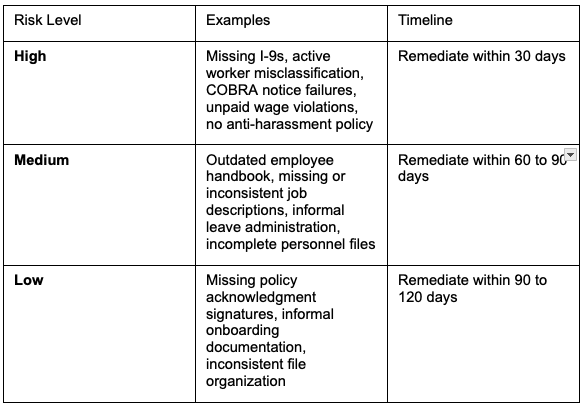
High-risk items are those that carry immediate legal exposure, active regulatory penalties, or the potential for employee complaints. These get addressed first, without exception.
Step 4: Prioritize and Execute Remediation
Build a written remediation plan that assigns an owner, a deadline, and a deliverable to every identified gap. This is not a wish list. It is a project plan with accountability.
For high-risk items, remediation should begin within the first week of the audit and be completed within 30 days. For medium-risk items, target 60 to 90 days. Low-risk items can be folded into the broader integration timeline.
A compensation analysis should be part of this phase, particularly if the acquired company’s pay structure differs significantly from yours. Compensation equity is a compliance dimension, not just a retention one. Pay disparities between legacy employees and acquired employees can create legal exposure under the Equal Pay Act and state pay equity laws.
Step 5: Align Policies Across the Combined Organization
Once the immediate compliance gaps are addressed, turn your attention to policy alignment. Determine which handbook will govern the acquired workforce going forward. If you are extending your existing handbook, ensure it covers every state where acquired employees are located. If you are creating a unified document, build in state-specific addenda from the start.
Communicate changes clearly and compliantly. Some policy changes require advance notice under state law or existing employment agreements. Do not assume you can implement new policies overnight. Walk acquired employees through the key changes, explain the reasoning, and give them a reasonable timeline to review and acknowledge the updated policies.
Step 6: Establish Ongoing Compliance Monitoring
A post-acquisition audit is a point-in-time assessment. It tells you where things stand today. But compliance is not a one-time event. It is an ongoing operational responsibility that requires systems, ownership, and cadence.
Set a schedule for future audits: annually at minimum, quarterly for high-growth or multi-state organizations. Assign clear ownership for compliance monitoring in the combined organization. And invest in the right HR technology stack to make compliance sustainable at scale. The right HRIS, payroll platform, and document management system can automate much of the monitoring that would otherwise fall through the cracks.
Internal HR Team vs. External HR Partner: Which Is Right Post-Acquisition?
One of the first decisions you will face after closing an acquisition is whether your existing HR team can handle the compliance workload or whether you need outside help. This is not a question with a universal answer, but it is one worth thinking through honestly.
Your Internal HR Team
If you have an internal HR function, they bring institutional knowledge, existing relationships, and immediate access to your company’s systems and records. They understand your culture, your policies, and your leadership team’s priorities.
But internal HR teams are typically staffed for steady-state operations, not for the temporary surge in complexity that an acquisition creates. Your HR generalist who manages benefits, onboarding, and employee relations is now being asked to simultaneously audit an unfamiliar company’s I-9 records, evaluate multi-state compliance exposure, reconcile two different payroll systems, and integrate a workforce that did not choose to work for you. That is not a capacity problem. It is a structural one.
Internal teams may also have blind spots. If your own HR practices have never been externally audited, you may be extending your existing gaps to the acquired workforce without realizing it.
An External HR Partner (Fractional or Consulting)
An external HR partner brings specialized expertise in post-acquisition integration, an objective perspective on inherited gaps, and the ability to move quickly with a clear mandate. They have no political capital at stake, no pre-existing relationships to navigate, and no competing priorities. Their entire focus is on assessing what you have inherited and building a remediation plan.
The trade-off is onboarding time. An external partner needs access to documentation, introductions to key stakeholders, and context about the deal structure and integration goals. For smaller acquisitions, the cost of external support may also be a consideration, though it should be weighed against the cost of undetected compliance exposure.
The honest assessment: Most internal HR teams are not equipped to handle a post-acquisition compliance audit on top of their existing responsibilities. This is not a criticism of their capability. It is a recognition that acquisitions create a temporary, intense demand for specialized expertise that exceeds what a steady-state HR function is designed to provide.
The most effective approach we have seen is a hybrid model: an external partner leads the compliance audit and remediation plan while the internal team focuses on employee communication, culture integration, and day-to-day operations. This keeps your people focused on what they do best while ensuring that the compliance work gets the dedicated attention it requires.
For acquirers evaluating their options, it is worth understanding the difference between fractional HR vs. PEOs. A fractional HR partner embeds with your team and operates as an extension of your leadership. A PEO takes on co-employment responsibilities, which can add complexity in an acquisition context where you are already sorting out employment relationships.
Real-World Proof: What Post-Acquisition HR Support Looks Like
Theory is useful. Seeing it in practice is better. Here are two examples of how Ampleo HR has stepped into organizations facing the exact challenges described in this article.
Rapid Deployment in a High-Growth Healthcare Company
When Comprehensive Mobile Care needed dedicated HR support, Ampleo HR embedded as a partner within 48 hours. The company was growing fast, and its HR function had not kept pace. Ampleo HR shifted the organization from reactive, firefighting-mode HR to proactive people operations, building the compliance infrastructure, processes, and documentation that a scaling company needs to operate confidently. This is exactly what the first weeks after an acquisition look like: rapid assessment, immediate stabilization, and a clear path toward sustainable operations.
Building HR Infrastructure From the Ground Up
A Mental Health Company came to Ampleo HR with virtually no formal HR infrastructure in place. Ampleo HR built it from scratch: compliance processes, compensation bands, recruitment systems, and the foundational policies that every employer needs. For acquirers who discover that the company they just purchased had little to no HR function, this is the playbook. You cannot fix what was never built. Sometimes the work is not remediation. It is construction.
Both of these engagements reflect the core Ampleo HR model: right-sized support that matches the moment. Whether you need a full outsourced HR department, targeted expertise to extend your existing team, or a defined project with a clear finish line, Ampleo HR scales to fit.
Beyond HR: Ampleo’s Full Suite of Acquisition Support
HR compliance is often the most urgent post-acquisition priority, but it is rarely the only one. Ampleo HR is part of a larger family of services under Ampleo. Beyond HR, there is also support for finance, marketing, turnaround, valuation, and sales tax. So if a business needs help in multiple areas, we have got people for that too. Most acquisitions surface challenges across multiple business functions, and having a single network that can address them reduces the coordination burden on your leadership team.
Now That You Know: Here’s What To Do Next
The compliance obligations outlined in this guide are not theoretical. They are sitting inside the company you just acquired, waiting to be discovered, documented, and resolved. The question is not whether inherited HR liabilities exist. The question is whether you find them before a regulator, an auditor, or a departing employee does.
Your next move depends on where you are in the process.
If you have not closed yet:
You still have time to build HR due diligence into your pre-close process. Request HR documentation as part of your diligence package. Identify compliance gaps before they become your liability. Bring in an HR expert to review what you are inheriting. The cost of a pre-close HR assessment is a fraction of the cost of remediating problems you did not know you were buying.
If you closed recently (within 90 days):
Start with the high-risk items this week, not next quarter. Audit I-9 records. Review worker classifications. Confirm COBRA obligations have been met. Verify that payroll is running compliantly in every state where acquired employees are located. Build your remediation plan now and assign owners to every open item. The longer you wait, the more exposure compounds. Remember: 47% of acquired employees leave within the first year. Every week of uncertainty pushes that number higher.
If you are past the 90-day window:
It is not too late, but the urgency is real. Conduct a formal HR compliance audit of the combined organization now. If you have been operating with inherited HR practices you have not reviewed, you may be carrying liabilities you do not know about. The risks do not shrink with time. They accumulate.
Regardless of where you stand, here is what we know from working with companies through exactly this process: the acquirers who move fastest on HR compliance are the ones who retain more talent, face fewer surprises, and build stronger organizations on the other side of the deal. The ones who treat HR integration as an afterthought spend the next 12 months cleaning up problems that could have been contained in the first 30 days.
Ampleo HR’s fractional HR team has guided companies from the first 48 hours post-close through full employee lifecycle integration. Whether you need a rapid compliance audit, a dedicated partner to lead the integration, or simply an objective set of eyes on what you have inherited, Ampleo HR delivers right-sized HR support exactly when you need it.
If you are not sure where to start, start with a conversation. Talk with an HR expert today!

Ampleo Is Partnering with Silicon Slopes to Support Start School
Utah’s entrepreneurial community just got a little stronger.
Ampleo is proud to support Start School, a free entrepreneurship program launched by Silicon Slopes in partnership with Mountain America Credit Union. Open to anyone willing to show up and build, Start School carries no tuition, requires no equity, and sets no barriers to entry — because access to real business education and mentorship shouldn’t depend on your funding or your connections.
Start School is built for a new era of entrepreneurship, one where AI enables solo founders to build what once required large teams and significant capital. The program centers on practical execution, real-world support, and community-driven growth, guided by two core principles: show up consistently, and give more than you take.
This partnership is a natural fit for who we are and what we believe. Ampleo brings seasoned fractional executives and embedded operators to the program, giving early-stage founders access to the kind of leadership and mentorship they couldn’t otherwise afford. PR Newswire
As Joe Grover, Chief Growth Officer at Ampleo, put it: “Ampleo’s mission is to build a world where significantly more startups and small businesses survive and thrive. The failure rates for small businesses are unacceptably high, and what Silicon Slopes and Start School are doing is perfectly aligned with our vision for entrepreneurship in Utah.”
Start School is part of Silicon Slopes’ broader vision of Entrepreneurship for the 99% — the belief that the tools, mentorship, and community needed to build a business should be available to everyone.
Read the full press release for more details, and if you’re ready to build, apply to Start School here.

How to Run a Compensation Review at Your Consulting Firm (And Why Most Get It Wrong)
The U.S. management consulting industry is a $132 billion market growing at nearly 5% year over year. Talent is the fuel behind that growth, and yet most consulting firms still run compensation reviews the same way they did when they had five people on the team: informally, reactively, and often too late. The result? Good consultants leave for firms that pay with intention. Compensation inequities quietly build across levels. And firm leaders are left wondering why retention is slipping when the work has never been better.
This guide is written for the firm, not the employee wondering if their raise was fair. Whether you are a founder scaling past 30 consultants or an operations lead tasked with formalizing a process that has never existed on paper, you will walk away with a clear framework for running a compensation review that actually holds up. We will cover what a compensation analysis actually involves, why consulting firms face unique challenges that generic HR advice ignores, the core components of a review that works, how often to run one, and the common mistakes that quietly erode trust and drive top performers out the door.
What Is a Compensation Review (and What It Isn’t)?
Let’s start with a definition that actually helps. A compensation review is a structured, periodic process where a firm evaluates how it pays its people against the market, against internal peers, and against the firm’s own goals. It is not a single conversation. It is not a reaction to a resignation letter. And it is not just pulling up salary data on Glassdoor and calling it a day.
Here is where the confusion tends to live. Most consulting firm leaders conflate three very different things:
-
A compensation review is a firm-wide process. It looks at every role, every level, and every pay decision through a consistent lens. It happens on a schedule, involves real data, and produces documented outcomes.
-
A salary negotiation is individual and reactive. It happens when one person asks for more money, and someone with authority says yes or no. It is not a strategy. It is a moment.
-
A market benchmarking exercise is one input into a compensation review, not the review itself. Knowing what the market pays is important, but it does not tell you whether your internal pay structure is equitable, whether your bands are current, or whether your top performers are being rewarded in proportion to their contribution.
A real compensation review ties all of these threads together. It is a process that involves data collection, internal auditing, performance alignment, equity analysis, and clear communication. When done well, it becomes a cornerstone of your broader compensation strategy. When done poorly, or not at all, it becomes the reason your best people start taking recruiter calls.
So what is actually included? At a minimum, a compensation review should cover:
-
Current salary and total compensation data for every role in the firm
-
Market benchmarks relevant to your geography, firm size, and specialty
-
Compensation band audits to check whether written bands exist and are being followed
-
Performance-to-pay alignment to ensure raises and bonuses reflect documented contributions
-
Internal equity checks to surface pay disparities across similar roles
-
A communication plan so employees understand the “why” behind every decision
If your firm has never run a formal compensation review, that list might feel overwhelming. That is normal. The point is not to do everything at once. The point is to stop treating compensation like an ad hoc decision and start treating it like the strategic function it is.
Why Consulting Firms Have Unique Compensation Challenges
Generic HR advice on compensation tends to assume a stable headcount, predictable revenue, and clearly defined roles. Consulting firms operate in a different reality entirely. If you have tried to apply a standard compensation playbook to your firm and found it lacking, there is a reason.
Revenue is variable, but payroll is not. Consulting firms live and die by client engagements. A strong Q2 can look very different from a slow Q4, and yet your consultants expect to be paid consistently regardless of utilization rates. This tension between variable revenue and fixed compensation costs makes it harder to commit to aggressive pay structures without careful modeling.
The billable hours model creates a perception gap. When a senior consultant knows they are billing at $350 an hour and taking home a fraction of that, the math starts to feel personal. Even when the economics of overhead, bench time, and business development are perfectly reasonable, the gap between what a consultant generates and what they earn is a persistent source of friction. Firms that do not address this transparently lose trust over time.
Career ladders demand clear compensation bands. The typical consulting progression from analyst to associate to manager to principal to partner requires compensation differentiation at every level. Many firms build the titles but never build the pay structure to match. The result is a promotion that comes with a new business card and a vague promise of “we will revisit comp next quarter.”
Retention risk is constant and acute. Consulting talent is portable. Your best people are being recruited by competitors, by clients, and by firms in adjacent industries. Recent consulting salary data shows flat base pay across much of the industry even as performance expectations continue to rise. That combination puts enormous pressure on firms to differentiate through smarter compensation design, not just higher numbers. This is exactly why so many firms are starting to rethink their comp and benefits approach, looking beyond base salary to build total compensation packages that reflect the full picture of what they offer.
Transparency expectations have shifted. A decade ago, compensation was a private matter between an employee and their manager. Today, consultants compare notes. They read forums. They know what peers at competing firms are earning. Firms that operate without documented compensation bands or clear review processes are not just behind the curve. They are actively creating the conditions for distrust.
The Core Components of an Effective Compensation Review
This is where theory becomes practice. A compensation review that actually works is not a single meeting or a spreadsheet exercise. It is a sequence of deliberate steps, each building on the one before it. Skip a step, and the whole process loses credibility.
Define Your Compensation Philosophy First
Before you look at a single salary number, your firm needs to answer a foundational question: Are we trying to lead the market, match it, or lag it, and why?
This is not a rhetorical exercise. Your compensation philosophy shapes every decision that follows. A firm that wants to attract top-tier talent from Big 4 competitors needs to pay accordingly, or it needs to be explicit about what it offers instead (flexibility, equity, culture, faster advancement). A firm that competes primarily on project quality and client relationships might choose to match the market on base pay and differentiate through bonuses tied to engagement outcomes.
The point is to make this decision intentionally and document it. When your philosophy is clear, individual compensation decisions become easier to explain, easier to defend, and easier to apply consistently across the firm.
Gather Market Benchmarking Data
Your compensation bands are only as good as the data behind them. Relying on what you paid someone when they were hired three years ago, or what a partner “heard” a competitor was offering, is not benchmarking. It is guessing.
Use credible, current salary data from sources that reflect your firm’s actual competitive set. At the top of the market, the numbers are significant: EY Strategy & Operations consultants earn $268,000 at EY, with PwC Consulting Services close behind at $245,000. At the entry-to-mid level, Master’s graduates in consulting are earning approximately $112,000 when bonuses are included.
But here is the nuance that matters: if you are a 40-person consulting firm in Denver, benchmarking against McKinsey compensation is not useful. It will either demoralize your leadership team or create unrealistic expectations among your consultants. Benchmark against your actual competitive set, meaning firms of similar size, geography, and specialization. That is the data that informs real decisions.
Audit Your Current Compensation Bands
This is the step where most firms discover their first real problem. Do your compensation bands actually exist in writing? Are they current? Are they being applied consistently, or has every hire and promotion been a one-off negotiation?
If the answer is “we don’t really have formal bands,” you are not alone. Many consulting firms grow from 10 to 50 people without ever documenting a pay structure. By the time they realize the gap, they have consultants at the same level earning wildly different amounts for reasons no one can fully explain.
Ampleo HR has done this work firsthand. In our engagement with a Mental Health Company, we built everything from the ground up: recruitment tools, scorecards, compensation bands, compliance processes, and more. That kind of foundational work is exactly what a compensation band audit often reveals is needed. The audit itself is straightforward. Pull every role, every salary, and every title into a single view. Map them against your intended structure. Identify where gaps, overlaps, or inconsistencies exist. Then decide what to do about them.
Assess Individual Performance Against Role Expectations
A compensation review without a performance lens is just a cost-of-living adjustment. And while cost-of-living adjustments have their place, they are not a substitute for tying pay to contribution.
This means your firm needs documented performance criteria for every level. What does “exceeds expectations” look like for a senior consultant versus a manager? What metrics matter: utilization, client satisfaction, business development, mentorship? If these criteria do not exist in writing, your compensation review will default to manager instinct, and manager instinct is inconsistent, biased, and impossible to defend when someone asks why their peer got a bigger raise.
Performance assessment does not need to be elaborate. It needs to be consistent, documented, and applied to every person in the review cycle.
Check for Internal Equity
Internal equity is the question most firms avoid until it becomes a crisis. Are people in similar roles, with similar experience and similar performance, being paid consistently? If not, why not?
Pay equity is not just a legal concern, though the legal exposure is real. It is a trust issue. When a consultant discovers that a peer hired six months later is earning 15% more for the same work, the damage is not just to that one relationship. It is to the firm’s credibility as a fair employer. Conducting regular HR compliance audits alongside your compensation review helps surface these disparities before they become retention problems or, worse, litigation.
Internal equity checks should look at pay by role, level, tenure, and demographic factors. The goal is not to pay everyone identically. It is to ensure that differences in pay are explainable, defensible, and aligned with your compensation philosophy.
Communicate the Outcome Clearly
This is the step that separates firms with healthy compensation cultures from firms whose employees vent on Reddit. How you communicate a compensation decision matters as much as the decision itself.
Employees who understand why a decision was made, even if they are disappointed, are far more likely to stay than those left guessing. The “slap in the face” reactions you see in online forums almost always trace back to the same root cause: not the number, but the absence of explanation.
Build a communication plan before you finalize decisions. Decide in advance:
-
Who delivers the message? Direct managers, HR, or firm leadership?
-
What context is provided? Market data, performance rationale, firm financial position?
-
What happens next? Is there a path to revisit the decision, or a timeline for the next review?
Transparency does not mean sharing every detail of the firm’s financials. It means giving people enough information to understand the logic behind their compensation and to trust that the process was fair.
How Often Should a Consulting Firm Conduct a Compensation Review?
The honest answer: it depends on your firm’s stage, but a structured annual review is the absolute minimum. If your firm is growing quickly, hiring aggressively, or operating in a market where consultant salaries are shifting, semi-annual check-ins are worth the investment.
Here are the key factors that should influence your cadence:
-
Rapid headcount growth. If you have added 10 or more people in the past year, your original compensation bands may already be outdated. New hires often come in at market rates that exceed what tenured employees are earning, creating compression issues that compound over time.
-
Significant market shifts. When competitor firms adjust their pay structures or when industry-wide salary trends move meaningfully, waiting 12 months to respond puts you at a disadvantage.
-
Post-promotion or role-change triggers. One of the most common frustrations in consulting is the “lateral move” scenario, where a consultant takes on significantly more responsibility without a corresponding pay adjustment. Build compensation check-ins into every promotion and role change, not just the annual cycle.
-
Pre-budget season timing. Align your compensation review with your firm’s budgeting process so that decisions are informed by both market data and financial reality. Running a review after the budget is locked defeats the purpose.
Without dedicated HR leadership, these decisions often fall through the cracks entirely. The review gets pushed to “next quarter,” then next quarter becomes next year. This is one of the clearest arguments for having senior HR support in place, whether internal or fractional. Someone needs to own the cadence, hold the firm accountable, and make sure the review actually happens.
Common Mistakes Consulting Firms Make During Compensation Reviews
Even firms that commit to running a compensation review can undermine the process with avoidable errors. These are the patterns we see most often, and they tend to compound over time.
Waiting until someone threatens to leave before reviewing their comp. If your compensation review process is triggered by a resignation letter or a counteroffer request, you do not have a process. You have a fire drill. By the time a consultant is ready to leave, the trust damage is already done. Retention-driven raises also create a perverse incentive: the only way to get paid fairly is to threaten to quit.
Using outdated benchmarks. Salary data from 2022 is not useful in 2025. Markets move, cost of living shifts, and competitor firms adjust their structures. If your benchmarks are more than 12 months old, they are a liability, not an asset.
Treating all roles the same regardless of market demand. A data analytics consultant and a change management consultant may sit at the same level on your org chart, but the market values them very differently. Compensation reviews that apply a flat percentage increase across all roles ignore the reality of supply and demand within specialties.
Skipping the communication step. We covered this above, but it bears repeating. Announcing a compensation decision without context is not communication. It is a memo. And memos do not build trust.
Conflating a promotion with a pay increase. Or worse, giving someone more responsibility without either. If a consultant moves from associate to manager and their compensation does not change, the title is meaningless. Promotions without pay adjustments signal that the firm values titles over people.
These are not edge cases. They are HR blind spots that quietly erode culture, drive attrition, and stall growth. The good news is that every one of them is fixable with the right process and the right accountability.
When to Bring in Outside Help
Not every consulting firm has the internal HR infrastructure to run a rigorous compensation review. And that is not a failure. It is a reality of how professional services firms grow. Most consulting firms are built around client delivery, not internal operations. HR is often the last function to get dedicated headcount, which means compensation decisions fall to partners or operations leads who are already stretched thin.
If your firm is experiencing any of the following, it may be time to bring in outside HR expertise:
- Scaling quickly and comp bands have not kept pace. You have doubled headcount in the past two years, but your pay structure still reflects the firm you were, not the firm you are becoming.
- Facing retention issues you suspect are compensation-related. Exit interviews keep surfacing “better opportunity” as the reason for departure, but no one has done the analysis to understand whether your pay is actually competitive.
- Preparing for a leadership transition or ownership change. Compensation structures come under intense scrutiny during mergers, acquisitions, and partner transitions. Getting your house in order before that moment is far less expensive than scrambling during it.
- Running compensation reviews informally with no documentation. If the process lives in a partner’s head and nowhere else, it is not a process. It is a vulnerability.
Ampleo HR has stepped into exactly these situations. In our work with Comprehensive Mobile Care, we embedded as a dedicated HR partner within 48 hours and helped shift a fast-growing organization from reactive to proactive people operations. That kind of rapid, expert-led engagement is what allows firms to go from “we know we need to fix this” to actually fixing it, without pulling consultants off client work or asking partners to become HR specialists overnight.
The right outside partner does not replace your leadership team’s judgment. They give your leadership team the data, structure, and frameworks to make compensation decisions with confidence.
Beyond HR: How Ampleo HR Supports the Whole Business
Compensation reviews do not happen in a vacuum. They connect to budgeting, financial planning, growth strategy, and operational capacity. Ampleo HR is part of a larger family of services under Ampleo. Beyond HR, there is also support for finance, marketing, turnaround, valuation, and sales tax. So if a business needs help in multiple areas, we have got people for that too.
For consulting firms navigating growth, that kind of integrated support means you are not coordinating between five different vendors. You have one team that understands your business from multiple angles and can connect the dots between your people strategy and your financial reality.
What to Do Next
You now have a clear picture of what a real compensation review looks like at a consulting firm and, more importantly, where the gaps tend to be. The framework above is not theoretical. It is the same sequence that experienced HR practitioners use when they sit down with firm leaders who know something is off but have not had the time or structure to fix it.
Here is how to put this to work:
-
Audit what you have. Pull your current compensation bands, or acknowledge that they do not exist in writing. That is your starting point. If you cannot hand a new hire a document that shows where their role sits in your pay structure, you have your first priority.
-
Pick a cadence. Commit to a structured annual review at minimum. Put it on the calendar before budget season, not after. If your firm has grown by more than 20% in the past year, consider a semi-annual check-in to catch compression issues early.
-
Get your benchmarks current. Use real market data for your firm’s size, geography, and specialty. Not what you remember paying someone in 2021. Not what a partner heard at a conference. Actual, sourced, current data.
-
Build the communication process. Decide in advance how compensation decisions will be explained to employees, not just announced. Define who delivers the message, what context is provided, and what the timeline looks like for the next review. This single step prevents more attrition than most firms realize.
-
If you need help, ask for it. Compensation reviews done poorly are worse than no review at all. They create a false sense of rigor while leaving the same inequities and blind spots in place. Ampleo HR has built compensation structures for professional services firms from the ground up, from bands and benchmarks to performance frameworks and communication plans, and can do the same for yours.
Compensation is just one piece of a larger people strategy, but it is often the piece that reveals everything else. How a firm pays its people reflects what it values, how it plans, and whether it is building for the long term or just reacting to the next crisis. The firms that get this right do not just retain better talent. They build the kind of internal credibility that makes every other HR initiative easier to execute. That is the hidden role of HR that too many consulting firms discover only after the damage is done.
If your firm is ready to move from ad hoc compensation decisions to a structured, defensible process, the next step is a conversation. Talk with an HR expert today!

Caregiver Retention: Why Caregivers Keep Leaving—And What Actually Keeps Them
Roughly 70% of newly hired caregivers quit within their first 100 days on the job. Not their first year. Not their first six months. Their first hundred days. That means the caregiver retention crisis isn’t a slow bleed. It’s a front-loaded collapse, and most employers are applying solutions far too late in the employee lifecycle to make a difference. The industry knows turnover is a problem. What it hasn’t fully reckoned with is when the problem actually starts.
This guide breaks down the full picture: the real numbers behind caregiver turnover, the root causes that go deeper than “low pay,” and the specific window where retention is won or lost. You’ll walk away with a practical set of strategies you can start implementing now, whether you have a dedicated HR team or you’re the one juggling people operations on top of everything else. Because the truth is, most caregiver retention advice focuses on what to offer. This guide focuses on what to fix.
How Bad Is Caregiver Turnover, Really?
Everyone in the home care industry knows turnover is high. But “high” doesn’t capture the full weight of what’s happening. When you look at the actual numbers, the picture shifts from a known challenge to a full-scale workforce crisis that’s getting worse, not better.
The Industry-Wide Numbers
According to HCAOA, the median turnover rate for professional caregivers jumped from 77.1% in 2022 to 79.2% in 2023. That’s not a plateau. That’s an acceleration. And it means that for every 10 caregivers you hire this year, roughly 8 of them will be gone before the next one ends.
Let that sink in for a moment.
Seventy-five percent of caregivers leave within their first year. Turnover has climbed more than 12% over the past two years alone. These aren’t numbers that can be solved with a pizza party or a slightly better shift schedule. They represent a structural failure in how the industry recruits, onboards, and supports its workforce.
For agency owners, this translates directly into operational instability. You’re not building a team. You’re running a revolving door, and every rotation costs you time, money, and the trust of the clients who depend on continuity of care.
The Role-By-Role Breakdown
It’s also worth noting that turnover doesn’t hit every role the same way. CNAs, who often bear the heaviest physical and emotional load in home-based settings, tend to experience the steepest attrition. LPNs face a different set of pressures, often caught between clinical expectations and limited autonomy. Hospice RNs, meanwhile, carry the unique emotional weight of end-of-life care, which compounds burnout in ways that standard retention programs rarely address.
The 79% turnover figure reported by CMSA in Q4 2024 confirms that this crisis extends well beyond home care agencies. It’s a systemic workforce problem that touches case management, facility-based care, and every corner of the healthcare ecosystem. If you’re benchmarking your retention rates only against your direct competitors, you’re missing the bigger picture. The entire pipeline is leaking.
Why Do Caregivers Actually Quit?
Ask most agency owners why their caregivers leave, and you’ll hear “pay” within the first five seconds. And pay matters. But if compensation were the only driver, agencies that raised wages would have solved the problem by now. They haven’t. The root causes of caregiver turnover run deeper, and they tend to cluster around three areas that most employers either underestimate or ignore entirely.
The Expectation Gap
Here’s a pattern that plays out constantly: a caregiver accepts a position based on a job description that emphasizes “making a difference” and “flexible scheduling.” They show up on day one and discover that “flexible” means being on call at unpredictable hours, and “making a difference” involves tasks no one mentioned during the interview. They feel misled. They disengage. They leave.
This is the expectation gap, and it’s one of the most preventable causes of early turnover.
The problem isn’t that caregiving is hard. Most people who enter this field know it’s hard. The problem is that employers often oversell the role during hiring, either by omitting the difficult realities or by painting an unrealistically rosy picture of day-to-day work. When the actual experience doesn’t match the pitch, trust breaks down fast.
This dynamic is especially pronounced with younger caregivers entering the workforce. They’re more likely to research employer reviews, compare notes with peers, and walk away quickly when they feel the job was misrepresented. Radical transparency during the hiring process isn’t just a nice idea. It’s a retention lever that costs nothing to pull.
The Isolation and Autonomy Paradox
Home-based caregiving is fundamentally different from facility-based work, and not just in the clinical sense. In a facility, you have colleagues down the hall, a charge nurse to consult, and a break room where you can decompress for ten minutes. In a client’s home, you’re on your own.
For some caregivers, that autonomy is empowering. For many others, it’s deeply isolating. They spend their days in someone else’s home, often without peer interaction, without visible management support, and without anyone checking in to ask how they’re doing. Over time, that isolation erodes engagement. Caregivers start to feel invisible, and invisible employees don’t stay.
Employers who treat home-based care the same as facility-based care from a management perspective are missing a critical retention lever. The physical structure of the work demands a different approach to connection, communication, and support. If your caregivers only hear from the office when something goes wrong, you’ve already lost the engagement battle.
Compensation, Flexibility, and Financial Stress
Pay does matter. Let’s not pretend otherwise. But the conversation about compensation in caregiving is more nuanced than “just pay them more.”
Many caregivers live paycheck to paycheck. When they need time off for a family emergency or their own health, they often face a brutal choice: go without pay or go to work sick. FMLA protections exist on paper, but unpaid leave isn’t a real option for someone who can’t afford to miss a single check. That financial stress compounds over time and pushes caregivers toward any employer offering even a marginally better deal.
Then there’s flexibility. Caregivers are disproportionately likely to be managing their own family caregiving responsibilities at home. They’re caring for aging parents, raising children, or both. When an employer’s scheduling system is rigid and reactive, it forces caregivers into impossible tradeoffs between their job and their family. That’s not a retention problem you can solve with a raise. It’s a structural problem that requires rethinking how schedules are built from the ground up.
Building a thoughtful compensation strategy means looking beyond the hourly rate. It means examining benefits, paid leave policies, scheduling practices, and the financial stress your workforce carries every day. And if you’re unsure whether your current approach is competitive, it’s worth taking the time to define the right compensation structure for your specific workforce and market.
When Caregivers Leave, and Why the First 100 Days Are Everything
Most retention strategies are designed for employees who’ve been around for a while. Annual reviews. Tenure-based raises. Loyalty bonuses at the one-year mark. But if 70% of your caregivers are gone before they hit day 100, those programs never get the chance to work. You’re investing in a retention infrastructure that only serves the 30% who were probably going to stay anyway.
The first 100 days are where the real attrition battle is won or lost. And for most home care agencies, that window is full of gaps.
Here’s what typically goes wrong. A new caregiver accepts the offer and then hears nothing for days. Their first shift is disorganized. They’re handed a client assignment with minimal context. No one checks in after the first week. By day 30, they’ve already started looking at other options. By day 60, they’ve accepted another position. By day 100, they’re gone, and you’re back to square one.
The fix isn’t complicated, but it does require intentionality. Structured onboarding with clear milestones at 30, 60, and 90 days. Early and frequent check-ins that go beyond “how’s it going?” A deliberate effort to create a sense of belonging from the very first interaction, because onboarding isn’t just paperwork and orientation videos. It’s the first real experience a caregiver has of your organization’s culture, and it sets the tone for everything that follows.
If you don’t have a structured onboarding framework in place, Ampleo HR’s free Onboarding Checklist is a practical starting point. It walks you through a 30-60-90 day structure designed to reduce early attrition and give new hires the support they need to actually make it past that critical 100-day mark.
Caregiver Retention Strategies That Actually Work
There’s no shortage of retention advice floating around the internet. Most of it reads like a wish list: offer better pay, improve culture, show appreciation. All true. None of it specific enough to act on.
What follows are four high-impact strategies grounded in what actually moves the needle for home care organizations. Each one addresses a specific failure point in the caregiver experience, and each one can be implemented whether you have a full HR department or you’re running people operations from a spreadsheet.
Be Radically Transparent During Hiring
The single cheapest retention strategy available to any employer is honesty. Realistic job previews, where you show candidates what the work actually looks like on a hard day, not just a good one, dramatically reduce early attrition. When a caregiver walks into the role with accurate expectations, they’re far less likely to feel blindsided and far more likely to stay through the adjustment period.
This means rethinking your job descriptions. Strip out the generic language about “rewarding work” and replace it with specifics: the types of clients they’ll serve, the physical demands of the role, the scheduling realities, and the support (or lack thereof) they can expect on a daily basis. During interviews, talk openly about the challenges. Ask candidates how they’ve handled similar situations in the past. The goal isn’t to scare people away. It’s to attract the right talent who will thrive in the actual environment you’re offering.
Invest in Education and Upskilling
Training is one of the most underused retention tools in home care. Many agencies treat it as a compliance checkbox: complete the required modules, sign the form, move on. But for caregivers, access to meaningful education signals something powerful. It tells them you see them as professionals with a future, not just bodies filling shifts.
The most effective approach isn’t a massive training overhaul. It’s what you might call “baby steps” learning: small, accessible skill-building opportunities that build confidence and competency over time without overwhelming new hires. A 15-minute module on de-escalation techniques. A monthly webinar on a specific clinical skill. A mentorship pairing with a more experienced caregiver.
Education benefits are still relatively rare in the home care sector, which means they function as a genuine competitive differentiator. When a caregiver has the choice between two agencies offering similar pay, the one that invests in their growth wins.
Build in Regular Human Connection
Caregivers who feel seen stay longer. It’s that simple, and that hard to execute consistently.
In home-based settings, connection doesn’t happen organically. There’s no break room. There’s no team huddle at the start of a shift. If you want your caregivers to feel like they’re part of something, you have to engineer those touchpoints deliberately.
Weekly check-ins from a supervisor who actually listens. Peer buddy programs that pair new hires with experienced caregivers. Group text threads or virtual meetups where caregivers can share wins and vent frustrations. Even something as basic as a manager picking up the phone to say “I noticed you handled a tough situation last week, and I wanted you to know it didn’t go unnoticed” can shift a caregiver’s entire relationship with the organization.
Building a motivated workforce isn’t about grand gestures. It’s about consistent, small signals that tell people they matter. In an industry where burnout and invisibility are the default, that consistency becomes your competitive edge.
Treat Flexibility as a Structural Priority, Not a Perk
“We offer flexible scheduling” appears in nearly every home care job posting. But in practice, flexibility often means “we’ll try to accommodate your requests when we can,” which is another way of saying “don’t count on it.”
Real flexibility requires structural change. It means building scheduling systems that account for caregiver availability as a first-order constraint, not an afterthought. It means creating shift-swap protocols that don’t require three levels of approval. It means acknowledging that many of your caregivers are also managing caregiving responsibilities at home and designing schedules that respect that reality instead of punishing it.
When flexibility is baked into the system rather than granted as an exception, it reduces the daily friction that drives caregivers to look elsewhere. It also sends a clear message: we understand your life doesn’t stop when your shift starts.
The Real Cost of Getting Retention Wrong
If the human cost of caregiver turnover doesn’t move the needle internally, the financial cost should. This isn’t just an HR problem. It’s a P&L problem, and it deserves to be treated like one.
The direct costs are substantial. Every time a caregiver leaves, you’re paying to post the job, screen applicants, run background checks, onboard a replacement, and train them to the point of basic competency. Industry estimates put the fully loaded cost of replacing a single caregiver at roughly $3,500 to $5,000 per departure. At an 80% turnover rate, those numbers compound fast.
But the indirect costs are where the real damage hides. Client relationships suffer when caregivers rotate constantly. Families lose trust. Referral rates drop. Remaining staff pick up extra shifts, which accelerates their own burnout and increases the likelihood that they’ll leave too. And then there’s presenteeism: caregivers who show up physically but have already checked out mentally, delivering subpar care while they wait for a better offer to come through.
There is a bright spot buried in the data. According to HHA Exchange, the median turnover rate for caregivers hired through word-of-mouth hires is 59%, significantly lower than the industry average. That’s still high by any normal standard, but it tells you something important: how someone enters your organization affects how long they stay. Referral-based hires come in with more realistic expectations, a built-in social connection, and a stronger sense of commitment. If you’re not actively investing in your employee referral pipeline, you’re leaving one of your most cost-effective retention tools on the table.
What This Looks Like With the Right HR Support
Strategy is one thing. Execution is another. And for many home care organizations, the gap between knowing what to do and actually doing it is where retention efforts stall.
Comprehensive Mobile Care is a good example of what happens when that gap gets closed. The organization was growing quickly but struggling with the HR infrastructure needed to support that growth. People operations were consuming leadership bandwidth, pulling executives away from strategic priorities and into day-to-day HR firefighting.
Ampleo HR stepped in as an embedded HR partner, building out the systems, processes, and frameworks needed to support the workforce at scale. The result wasn’t just better HR. It was 20 to 40 hours of leadership time reclaimed per week, time that went back into running and growing the business.
That’s the difference between having a retention strategy on paper and having the operational support to make it real. For organizations without a dedicated HR function, or with an HR team that’s already stretched thin, that kind of embedded expertise changes the trajectory.
Beyond HR: How Ampleo HR Supports the Whole Business
Ampleo HR is part of a larger family of services under Ampleo. Beyond HR, there’s also support for finance, marketing, turnaround, valuation, and sales tax. So if a business needs help in multiple areas, we’ve got people for that too. For leaders who want to understand why having senior HR support embedded in the business makes a measurable difference at scale, that’s a conversation worth having, especially when the challenges extend beyond any single department.
Now That You Know: Here’s What to Do Next
You’ve seen the numbers. Nearly 80% turnover industry-wide. Seventy percent of new caregivers gone before day 100. A cost-per-departure that compounds into a line item most agencies never fully calculate. And behind every one of those statistics is a caregiver who walked away from a role that could have worked, if the right systems had been in place.
The good news is that the highest-impact retention levers aren’t the most expensive ones. They’re the most intentional ones. And most of them can be set in motion this week.
Here’s where to start:
-
Audit your first 100 days. Map out exactly what a new caregiver experiences from the moment they accept your offer through day 100. Every touchpoint. Every gap. Every silence. If you can’t describe the journey with specificity, neither can your new hires, and that ambiguity is costing you people.
-
Download the Ampleo HR Onboarding Checklist. It gives you a structured 30-60-90 day framework you can adapt to your organization today. No HR department required. Just a commitment to giving new caregivers a reason to stay past the point where most of them leave.
-
Have an honest conversation about transparency and compensation. Sit down with whoever owns your hiring process and ask two questions: Are we setting realistic expectations before someone accepts the offer? And is our compensation structure competitive enough to survive the first conversation a caregiver has with a recruiter from another agency? If the answer to either question is uncertain, that’s your next project.
The caregiver retention crisis is real, but it’s not inevitable. The organizations that treat retention as a design problem, not a morale problem, are the ones that build stable teams, earn client trust, and stop hemorrhaging the time and money that constant turnover demands.
If you’re navigating this without a dedicated HR function, or if your current team is stretched too thin to build the systems that actually move the needle, that’s exactly the kind of challenge Ampleo HR was built to solve. Whether you need a full outsourced HR department, targeted expertise to fill a specific gap, or a defined project with a clear finish line, Ampleo HR offers right-sized support that scales with your business.
And if you want to think bigger about what it means to build an organization where caregivers genuinely want to stay, take a few minutes to read about bringing people strategy into the heart of how you operate. Because retention isn’t a program. It’s a reflection of how your organization treats people from the very first interaction.
Ready to stop losing caregivers in the first 100 days? Talk with an HR expert today!

Freight Recession 2026: A Practical Survival Framework for Carriers, Brokers & Fleet Operators
Load rejection rates near 10%, spot rates still down 30% from their peak, and national truck tonnage off roughly 7% year over year. If you run a freight or logistics company, the last three years have tested every assumption you had about your business. The freight recession that began in late 2022 has outlasted most forecasts, and while a few indicators suggest the market may be tightening, “stabilizing at a lower baseline” is not the same thing as recovery. For many carriers, brokers, and fleet operators, the real question is no longer “when does this end?” but “what do we do right now?”
This article is built for that question. We will walk through how the freight recession developed, where the market sits in early 2026, and what the mixed signals actually mean for individual companies. But the core of what follows is not market analysis. It is a practical framework for evaluating whether your company is weathering the downturn, sliding toward distress, or already in crisis. Each category calls for a different response, and the cost of misjudging which one you are in is measured in lost cash, lost options, and lost time. Whether you are a business owner watching margins compress, a lender evaluating a struggling borrower, or an attorney advising a distressed client, the goal here is the same: clarity on where things stand and a concrete path forward.
What the Freight Recession Is (And How We Got Here)
A freight recession is a prolonged period of overcapacity, declining freight volumes, and compressed or negative margins across the trucking and logistics industry. It is not a single event. It is the slow, grinding result of supply and demand falling out of alignment and staying that way.
Here is the short version of how we got here.
During the pandemic, freight demand surged. Consumers shifted spending from services to goods, e-commerce volumes exploded, and supply chains scrambled to keep up.
Carriers expanded fleets. New owner-operators entered the market. Spot rates hit historic highs. It felt like the boom would last.
It did not.
By late 2022, consumer spending patterns normalized. Retailers who had over-ordered began destocking inventory. Freight volumes dropped. But the capacity that had been added during the boom did not disappear overnight. The result was too many trucks chasing too few loads, and rates fell accordingly.
Inflation made it worse. Fuel costs, insurance premiums, maintenance expenses, and driver wages all climbed while revenue per load declined. By 2023 and 2024, the market had shed over 20% of its capacity due to inflation and fuel costs while freight rates dropped. That is a substantial amount of capacity rationalization, and it still was not enough to bring the market back into balance.
The freight recession is not something that happened to a few unlucky companies. It reshaped the entire industry.
Where the Market Stands Now (Early 2026)
The signals in early 2026 are mixed, and that is part of what makes this moment so difficult for decision-makers.
On the positive side, tender rejection rates, which measure how often carriers decline load requests, have ticked up, suggesting that carriers are beginning to turn down loads they would have accepted a year ago. Spot rates have shown modest improvement in certain lanes. Some capacity has exited the market permanently, which should eventually support pricing.
On the other side, first-tender acceptance, the rate at which carriers accept the initial load offer, is hovering around 85%, significantly lower than historical averages. That means carriers are still accepting loads at rates below what a healthy market would produce. Freight volumes remain mostly flat. External disruptions like tariffs, fuel price volatility, and geopolitical uncertainty continue to add noise.
The honest read: the market may be stabilizing, but stabilizing at a lower baseline does not mean individual companies are healthy. A company that was profitable at 2021 rate levels may still be losing money at 2026 rate levels, even if those rates are slightly better than 2024.
The macro picture matters for context. But the question that actually determines your next move is a micro one.
The Real Question: Is Your Company in Distress, or Just Waiting Out the Market?
Market analysis is helpful context. But the question that matters is this: is your company in trouble, or are you just experiencing what everyone else is experiencing?
We find it useful to think about freight companies in three categories right now. Each one calls for a different response.
Category 1: Weathering the Storm
These companies have cash reserves adequate for 12 or more months at their current burn rate. Debt service is current. Customer relationships are stable. There are no covenant violations or lender pressure.
If this describes your situation, the right move is usually to stay the course. Preserve cash, avoid unnecessary capital expenditures, and monitor leading indicators closely. Review the 12 steps to avoid a cash crisis and pressure-test your assumptions monthly. The companies that come out of a freight recession strongest are the ones that stayed disciplined during it.
Category 2: Under Pressure (The Danger Zone)
This is where we see the most consequential decisions being made, or not made.
Companies in this category typically share several characteristics:
- Cash runway has shortened to six months or less
- Credit lines are being used to cover operating expenses
- Vendor payments are being delayed or missed
- Lender conversations are becoming more frequent or more tense
- Covenant violations have occurred or waivers are needed
- Key employees are leaving
If this sounds familiar, the most important thing to understand is that delay has the highest cost in this category. You still have options. A turnaround strategy can stabilize the situation. Crisis management strategies can buy time. A forbearance agreement with your lender can create breathing room. But every one of those options narrows the longer you wait.
Category 3: In Crisis
Companies in this category are past the tipping point of self-correction. The indicators are stark:
- Unable to make payroll or debt service
- Lawsuits filed or threatened
- Lender has declared default
- Personal guarantees are at risk
- No clear path to profitability even if the market recovers
At this stage, the focus shifts from recovery to preservation. What can be salvaged? What equity can be protected? What liabilities can be contained? Companies in this category typically need a receiver, CRO, or restructuring advisor. The Turnaround & Restructuring team at Ampleo T&R has handled situations like this across all 50 states, including a $67.5M debt restructuring that reduced a working capital line from $55M to $8.5M and returned loans to performing status.
Severe distress does not mean the situation is hopeless. It means the window for action is short.
What Delay Costs You (And Why Acting Early Matters)
Every month of delay in a distressed situation has a quantifiable cost. Interest and penalties accrue. Vendor relationships deteriorate. Key employees leave for more stable opportunities. Asset values decline as equipment ages and market conditions shift. Lender patience erodes. Personal liability exposure increases.
This is a principle we return to constantly at Ampleo T&R: speed is strategy. The best deal you can get today is almost always better than a theoretically better deal six months from now, after you have burned through more cash and lost more negotiating position.
If you are unfamiliar with what outside intervention looks like in practice, turnaround management is a good starting point. It is not about someone coming in and taking over your business. It is about stabilizing the situation, building a realistic plan, and executing it with the urgency the circumstances demand.
Three Questions to Ask Before You Act
We use three criteria when evaluating distressed situations, and these same questions can help any business owner decide whether to engage outside help.
1. Is There a Path to Exit?
Can this situation be resolved in a reasonable timeframe? If the honest answer is “we just need the market to recover,” that is not a plan. That is hope. What you need is a realistic 90-day cash flow forecast, a clear understanding of your buyer universe if assets need to be sold, and confidence that operations can be stabilized quickly enough to preserve value.
2. Are You Adequately Protected?
If you are operating under personal guarantees or facing potential personal liability (environmental issues, payroll taxes, regulatory exposure), do you have protections in place? Have you consulted an attorney about your liability exposure? Are personal assets at risk? If you are considering a court-supervised process like receivership or bankruptcy, what protections exist under your state’s statutes? Ampleo T&R professionals are not attorneys, but we work alongside counsel to make sure these questions get answered before the situation escalates.
3. Is There a Mechanism to Fund the Work?
If you are bringing in outside help, how will professional fees be covered? Is there cash in the business? Will a lender provide a carve-out or debtor-in-possession financing? If the answer is no, that is a signal that liquidation may be the only viable path. This is not just a concern for the professionals involved. It is a diagnostic indicator of how workable the situation truly is.
When the Answer Is Wind-Down (And Why That Is Not Failure)
Not every distressed company can or should be saved. That is a hard truth, but acknowledging it early protects more value than avoiding it.
A structured wind-down, whether through an assignment for the benefit of creditors, a receivership, or a managed liquidation, preserves more value than a chaotic collapse. Owners who act early can often protect equity, maintain relationships, and ensure employees are treated fairly. Those who wait until there is nothing left to work with lose all of those options.
Closing a business you built is hard. The emotional toll is real, and we do not minimize it. But doing it with a plan is better than doing it in crisis.
How Ampleo T&R Helped a Distressed Operation Manage Multiple Stakeholders
To illustrate what professional intervention actually looks like, consider a case where Ampleo T&R stepped into an interim CEO role for a mushroom grower in Eastern Washington.
The company faced operational challenges after a major facility transition. Revenue was under pressure. The lender was losing confidence. Management needed support.
Ampleo T&R did not hand over a report and leave. The team went on-site, implemented operating improvements at the facility, and drafted a long-term recovery plan that secured the lender’s continued support. The situation stabilized because someone stepped in with operational authority and a clear mandate.
The parallels to the freight industry are direct. Many carriers expanded during the boom, invested in equipment and facilities, and are now struggling with overcapacity and margin compression. The dynamics are different, but the playbook is similar: stabilize operations, manage stakeholder relationships, and build a credible path forward.
Beyond Turnaround: Ampleo T&R’s Full Suite of Services
Ampleo T&R is part of a larger family of services under Ampleo. Beyond Turnaround and Restructuring, there is also support for finance, marketing, HR, valuation, and sales tax. If a business requires support across multiple functional areas, our firm provides the necessary professional expertise. You can explore the full range of services to see what fits your situation.
What to Do Next
The freight recession has reshaped the freight market, but your company’s health is not determined by industry forecasts. It is determined by the decisions you make right now.
If you are weathering the storm, stay disciplined. Preserve cash, monitor your runway monthly, and review the 12 steps to avoid a cash crisis.
If you are under pressure, do not wait. Talk to your lender proactively, explore a forbearance agreement, and consider bringing in a turnaround advisor before your options narrow further.
If you are in crisis, speed matters. Engage a restructuring professional immediately. Review case studies like the $67.5M debt restructuring to understand what is possible even in severe distress.
Across every category, the same principle holds: the cost of delay is real, measurable, and compounding. Acting based on your situation today beats waiting for a market recovery that may not arrive in time.

HR Outsourcing Cost: What Businesses Actually Pay (And What Drives the Price)
Most business leaders know HR is expensive. What they don’t know is whether they’re overspending, underspending, or simply spending in the wrong places. Here’s a number worth sitting with: companies save an average of 22% by getting external help with HR operations. That’s not a rounding error. It’s a strategic lever that most growing companies haven’t pulled yet, often because the pricing feels opaque and the options feel overwhelming.
But here’s what the traditional “outsourced HR” conversation gets wrong: it treats HR as a commodity to be shipped off-site rather than a strategic function that deserves senior-level attention. There’s a better way.
This guide is designed to help you understand the full landscape of HR support options, from traditional outsourcing to more strategic alternatives. You’ll walk away with a clear understanding of how HR support is actually priced, what it costs at different business sizes, what drives those numbers up or down, and how to calculate whether external HR support makes financial sense for your specific situation. We’ll also break down the real differences between PEOs, full-service providers, and fractional HR—a model that most cost guides skip entirely but that companies like yours are increasingly turning to for senior-level expertise without the full-time price tag.
Not sure if you even need HR support right now? Take our quick assessment: Do I Need HR Now?
What Does HR Support Actually Include?
Before you can evaluate cost, you need to understand what’s actually being priced. One of the biggest sources of confusion in external HR support is that the term covers a wide spectrum of services. A company paying $30 per employee per month for payroll software and a company paying $3,000 per month for a fractional HR leader are both getting “external HR help,” but they’re buying very different things.
The most commonly externalized functions tell a clear story about where businesses need the most help: benefits administration (54%) and payroll processing (53%) lead the pack, according to SHRM research. But the full scope of what can be supported extends well beyond those two categories.
Here’s what typically falls under the HR support umbrella:
Payroll processing: Calculating wages, managing deductions, filing payroll taxes, and ensuring employees are paid accurately and on time.
Benefits administration: Selecting, enrolling, and managing health insurance, retirement plans, and other employee benefits.
Compliance and regulatory support: Staying current with federal, state, and local employment laws, handling required filings, and reducing legal exposure. For a deeper dive into this critical area, read our guide on The HR Compliance Audit: A Strategic Framework for Risk Mitigation.
Recruiting and onboarding: Sourcing candidates, managing the interview process, extending offers, and building a structured onboarding experience.
Employee relations: Handling workplace issues, performance management, investigations, and terminations with proper documentation and legal awareness.
HR technology management: Selecting, implementing, and maintaining HRIS platforms, applicant tracking systems, and other people-operations tools.
The important thing to understand is that HR is not a single line item. It’s an end-to-end process, from recruitment to payroll and everything in between. When you see a price quote from any provider, the first question to ask is: which of these functions are included, and which ones aren’t?
That distinction is what separates a $500/month engagement from a $5,000/month one—and more importantly, it’s what separates transactional task completion from genuine strategic partnership.
How HR Support Is Priced: The 3 Main Models
HR support doesn’t come with a single sticker price. According to HR University, HR services are priced in two primary ways: a flat rate per employee per month or a percentage of each employee’s pre-tax payroll per pay period. But in practice, there’s a third model that’s become increasingly common, especially among growing businesses that need strategic guidance rather than transactional processing.
Let’s break down all three.
Per Employee Per Month (PEPM)
This is the most widely used pricing structure in traditional HR outsourcing. You pay a flat monthly fee for each employee on your roster.
- Typical range: $50 to $200 per employee per month for bundled HR and payroll services
- HRIS software alone typically runs $8 to $30 per employee per month
- Pricing varies significantly based on which services are included, how many employees you have, and the type of provider
PEPM works for businesses that want predictable monthly costs and are primarily looking for administrative and operational HR support. The more employees you add, the more you pay, but the per-employee cost often decreases at scale.
The limitation: This model treats HR as a volume-based administrative function. You’re essentially paying for task completion, not strategic thinking.
Percentage of Payroll
This model is common with PEOs (Professional Employer Organizations) and traditional full-service providers. Instead of a flat fee per head, you pay a percentage of your total gross payroll each pay period.
- Typical range: 2% to 12% of gross payroll
- Works for businesses with fluctuating headcount or seasonal staffing
- Can become expensive quickly as salaries grow, since the fee scales with compensation rather than headcount
If your average employee salary is $60,000 and you’re paying 6% of payroll, that’s $3,600 per employee per year in fees alone. For a 50-person company, that’s $180,000 annually. It’s not inherently a bad model, but it requires careful evaluation as your payroll grows.
The limitation: Your costs increase as your employees earn more, even if the work required to support them stays the same. And like PEPM, this model is fundamentally transactional.
Flat Monthly Retainer
This model is most common with fractional HR providers and strategic HR consultancies like Ampleo HR. You pay a fixed monthly fee regardless of how many employees you have.
- Typical range: $500 to $5,000+ per month depending on scope and seniority of the consultant
- Offers cost predictability and includes strategic, senior-level support
- Well-suited for businesses that need ongoing guidance, not just transactional processing
Retainer-based engagements look less like “outsourcing” and more like having a senior HR leader embedded in your business on a part-time basis. That’s a fundamentally different value proposition than payroll processing, and the pricing reflects it.
The advantage: You’re not paying for tasks. You’re paying for expertise, judgment, and strategic leadership that scales with your business complexity—not just your headcount. Learn more about why this model works so well in our article: Why Fractional HR Services Are the Smartest Investment for Growing Companies.
What Does HR Support Cost By Business Size?
The pricing models above give you the framework. But what you’ll actually pay depends heavily on where your company sits on the growth curve. Here’s how costs typically break down by business size—and where traditional outsourcing falls short.
Small Businesses (Under 50 Employees)
For companies at this stage, HR often means “the CEO handles it” or “the office manager figured it out.” Neither is sustainable.
- Fully outsourced HR services for basic or occasional support typically run $50 to $1,500 per month
- This is the most cost-sensitive segment
- Key needs at this stage: compliance foundation, basic payroll, and hiring support
Small businesses rarely need a full-time HR director. But they also don’t need a faceless call center handling their compliance questions. What they need is someone with the expertise of a senior HR leader, available at a fraction of the time and cost—someone who understands their business, not just their employee count.
Where traditional outsourcing falls short: Cookie-cutter solutions designed for scale can’t address the nuanced challenges of a growing business finding its footing. If you’re a startup trying to figure out the right approach, our guide on Fractional HR for Startups breaks down exactly what early-stage companies need.
Mid-Size Businesses (50 to 250 Employees)
At this stage, HR complexity increases significantly. You’re dealing with benefits administration, multi-state compliance, employee relations issues, and the need for real HR technology.
- PEPM pricing becomes more predictable and cost-effective at this scale
- A fractional HR retainer can deliver senior HR support without the $150,000+ cost of a full-time CHRO
- Many mid-size companies find the most value in a hybrid approach: strategic HR leadership paired with a lean internal HR coordinator
Where traditional outsourcing falls short: At this stage, you don’t just need someone to process paperwork. You need someone who can build systems, develop your managers, design compensation structures, and advise on workforce strategy. Most traditional outsourcing providers aren’t built for that.
Growing Companies (250 to 500+ Employees)
At this level, the math starts to shift. A fully outsourced HR model at scale can rival or exceed the cost of building an internal team.
- Companies in this range may benefit from external support for specialized functions (compliance, compensation benchmarking, HR tech) while keeping generalist HR in-house
- The evaluation of ROI becomes critical here, because the question isn’t just “what does external support cost?” but “where does external support deliver more value than an internal hire?”
Where traditional outsourcing falls short: Generic outsourcing becomes a poor fit when you need customization, cultural alignment, and strategic partnership. But specialized fractional support can still add tremendous value for specific initiatives or as a complement to your internal team.
No matter your size, the key is matching the engagement model to your actual needs—not buying more than you need or, just as dangerously, settling for less strategic value than your business deserves.
The Hidden Costs of Not Getting Strategic HR Support
Most articles about HR costs focus exclusively on what you’ll pay a provider. Almost none of them ask the more important question: what are you paying right now by trying to handle everything internally—or by using a provider that treats HR as purely transactional?
The answer, for most growing businesses, is a lot more than they think.
Leadership Time Diverted to HR Tasks
If a CEO earning $200,000 per year spends 10 hours a week on HR administration, that’s roughly $96,000 in annual leadership time consumed by work that isn’t growing the business. That number doesn’t show up on any invoice, but it’s real.
This isn’t hypothetical. When Comprehensive Mobile Care engaged fractional HR support, the leadership team reclaimed 20 to 40 hours per week. That’s not just time saved. That’s time redirected toward revenue, strategy, and growth.
Compliance Risk and Penalties
One misclassified employee. One missed state filing. One outdated handbook policy. Any of these can trigger fines, lawsuits, or regulatory action that costs far more than a year of strategic HR support. The Department of Labor and state agencies are increasingly active in enforcement—the businesses that avoid costly HR mistakes aren’t the ones that got lucky. They’re the ones that had someone watching—someone with the expertise to anticipate problems, not just react to them.
If you’re not sure where your compliance gaps are, start with a structured review. Our article on The HR Compliance Audit: A Strategic Framework for Risk Mitigation walks you through exactly how to identify and address vulnerabilities before they become expensive problems.
Turnover Costs
Poor HR infrastructure drives attrition. And replacing a single employee can cost 50% to 200% of their annual salary when you factor in recruiting, onboarding, lost productivity, and institutional knowledge walking out the door, according to Gallup research. If your annual turnover rate is even slightly above industry average, the financial impact dwarfs most HR support fees.
What traditional outsourcing misses: Transactional providers process terminations. Strategic HR partners help you understand why people are leaving and build systems to retain your best talent.
Opportunity Cost
Every hour your leadership team spends on HR administration is an hour not spent on sales, product development, customer relationships, or strategic planning. This is the cost that never appears on a balance sheet but shapes every growth trajectory.
The real question isn’t “can we afford to get HR help?” It’s “can we afford to keep treating HR as an afterthought?”
Is External HR Support Worth It? How To Calculate ROI
The answer depends on your numbers, not someone else’s. Here’s a practical framework for calculating whether external HR support makes financial sense for your specific business.
Step 1: Calculate Your Current Internal HR Cost
Add up everything you’re spending on HR today. That includes:
- Salaries and benefits for any HR staff
- HR software and tools (HRIS, payroll platforms, applicant tracking systems)
- Time spent by non-HR employees on HR tasks (multiply hours per week by their effective hourly rate)
- Legal or consulting fees for compliance questions
- Recruiting costs (job board fees, agency fees, time-to-fill)
Most business leaders are surprised by this number. It’s almost always higher than they expected.
Step 2: Get Clear Quotes—And Understand What You’re Actually Comparing
Whether it’s PEPM, percentage of payroll, or a flat retainer, get specific numbers from at least two providers. But don’t just compare price tags. Compare what you’re getting:
- Is this transactional support or strategic partnership?
- Will you have access to senior-level expertise, or will you be handed off to junior staff?
- Is the provider invested in understanding your business, or are you just another account?
Step 3: Factor in Risk Reduction
Assign a dollar value to the compliance penalties, lawsuits, and turnover costs you’re currently exposed to. Even a conservative estimate makes the case stronger.
Step 4: Quantify Time Reclaimed
This is where the ROI case often tips decisively. If your CEO spends 8 hours per week on HR at an effective rate of $150 per hour, that’s $62,400 per year in leadership time. If a COO spends 5 hours per week, add another $39,000. These are real dollars being spent on work that a strategic HR partner could handle more efficiently and more effectively.
According to ADP survey findings, the cost of managing compensation and benefits externally is up to $165 per employee, which is 17% less than managing those same functions in-house. That’s not a convenience premium. That’s a discount—and it doesn’t account for the strategic value that the right partner brings.
When you stack the investment against the combined cost of internal HR spend, risk exposure, leadership time, and the opportunity cost of not having strategic HR guidance, the math usually speaks for itself.
Fractional HR vs. PEO vs. Full-Service Outsourcing: What’s The Real Difference?
Not all HR support is created equal. The model you choose affects not just what you pay, but what you get—and that’s where the conversation needs to shift from “outsourced HR cost” to “strategic HR value.”
PEOs
PEOs bundle HR services with co-employment, meaning they become the employer of record for tax and benefits purposes. This can simplify benefits access for small companies, but it also means giving up a degree of control. And as your payroll grows, so does the fee.
Best for: Companies whose primary need is access to better benefits rates and basic compliance support.
Not ideal for: Businesses that need customized HR strategy, culture development, or hands-on leadership support.
Traditional Full-Service Outsourcing
Full-service outsourcing providers handle the day-to-day execution of HR functions. Quality varies significantly. Some are essentially payroll processors with an HR label. Others provide genuine operational support.
Best for: Companies with straightforward, stable HR needs who primarily need reliable transaction processing.
Not ideal for: Growing businesses facing complex challenges like scaling culture, developing leadership, navigating difficult employee situations, or preparing for significant transitions.
Fractional HR: A Better Alternative
Fractional HR is fundamentally different from traditional outsourcing. Instead of shipping tasks off-site to be processed by whoever’s available, you’re bringing in a senior HR leader—someone with the experience of a VP of People or CHRO—on a part-time or retainer basis. They don’t just process paperwork. They build systems, advise on strategy, and help you scale your people operations alongside your business.
This is Ampleo HR’s approach. Rather than positioning ourselves as “outsourced HR,” we operate as an extension of your leadership team. Our practitioners bring decades of experience to every engagement—the kind of expertise that traditionally required a six-figure full-time hire. But instead of paying for a full-time executive, you get right-sized support that matches your actual needs.
Best for: Growing businesses that need more than task completion. Companies preparing for scale, navigating complex people challenges, or building HR infrastructure for the first time.
For a detailed breakdown of how these models compare as your company grows, read Fractional HR vs. Traditional HR: Which Model Actually Scales with Your Business?
What Factors Drive HR Support Costs Up (Or Down)?
Understanding the price range is one thing. Understanding the levers that move the needle within that range is what helps you plan smarter and get better value.
Factors That Increase Cost
Higher headcount. More employees means more payroll runs, more benefits to administer, more compliance to track, and more employee relations issues to manage.
Multi-state compliance requirements. Operating in multiple states introduces different employment laws, tax obligations, and filing requirements. Each additional state adds complexity.
Complex benefits packages. The more options you offer (multiple plan tiers, HSAs, FSAs, retirement matching), the more administration is required.
International workforce. Global employment introduces an entirely different layer of legal, tax, and HR complexity.
Specialized industry regulations. Healthcare, financial services, government contracting, and other regulated industries require HR partners with specific expertise—and that expertise commands appropriate fees.
Factors That Reduce Cost
Narrower scope of services. If you only need help with specific functions, you’ll pay less than a company seeking comprehensive HR support.
Existing HR technology in place. If you’ve already invested in solid HR technology, your HR partner can work within those systems rather than building from scratch.
Lower employee turnover. Less turnover means less recruiting, less onboarding, and less time spent replacing institutional knowledge. Companies with stable teams need less support in these areas.
Standardized, single-state operations. A 75-person company operating entirely in one state has a simpler compliance profile than a 75-person company spread across eight states.
The takeaway: The cost of HR support isn’t fixed. It’s a function of your complexity, your needs, and the level of strategic value you require. The cheapest option isn’t always the best investment—and the most expensive option isn’t always the most valuable.
Beyond HR: The Ampleo Family of Services
HR challenges rarely exist in isolation. The company struggling with retention might also be navigating a cash flow crunch. The business preparing for an acquisition needs people strategy and financial diligence working in lockstep. The founder scaling from 30 to 150 employees needs help with hiring, yes, but also with forecasting, brand positioning, and operational efficiency.
Ampleo HR is part of a larger family of services under Ampleo. Beyond HR, there’s also support for finance, marketing, turnaround, valuation, and sales tax. So if a business needs help in multiple areas, there are experienced practitioners across all of them under one roof.
This matters because the most expensive thing a growing company can do is solve problems in silos. When your HR strategy connects to your broader business strategy—whether that’s preparing for a transaction, restructuring operations, or entering a new market—the return on every dollar spent goes up.
Now That You Know the Numbers, Here’s What to Do Next
You have the pricing models. You have the cost ranges. You have a framework for calculating ROI. The question now isn’t whether external HR support makes financial sense. For most growing businesses, the math is clear. The question is whether you want transactional task completion or genuine strategic partnership.
Here are three steps worth taking this week.
1. Audit your current HR spend.
Pull the real number together. Not just the line items you’d expect, like payroll software or an HR coordinator’s salary, but the hidden ones: your CEO’s time spent reviewing offer letters, the COO fielding employee complaints, the office manager Googling state compliance requirements at 9 p.m. Add it all up. Most leaders who do this exercise for the first time find they’re spending 30% to 50% more on HR than they realized—and getting less strategic value than they should.
2. Define what you actually need before you shop.
Not every business needs the same level of support. Some need a compliance foundation. Others need a senior strategist who can build the systems that let them scale from 50 to 200 employees without breaking. Still others need targeted project work: an HRIS implementation, a compensation benchmarking exercise, a handbook overhaul. Knowing which category you fall into before you start talking to providers saves you time, money, and the frustration of comparing proposals that aren’t actually solving the same problem.
Not sure where you fall? Our quick assessment can help: Do I Need HR Now? (https://ampleo.com/2026/02/13/assessment-do-i-need-hr-now/)
3. Have a real conversation with someone who’s done this before.
HR support is not a commodity purchase. A pricing page can’t tell you whether a provider understands your industry, your growth stage, or the specific pain points keeping your leadership team up at night. A 30-minute conversation with a senior HR strategist will give you more clarity than three hours of reading pricing tables. It will also help you pressure-test the numbers you pulled together in step one.
That’s exactly what Ampleo HR is built for. We’re not traditional outsourced HR—we’re a better alternative. Whether you need comprehensive HR leadership, extra capacity for your existing team, or expert execution on a defined project, Ampleo HR delivers right-sized, senior-level support that integrates with your business. No long-term contracts you’ll regret. No junior consultants learning on your dime. No faceless call centers. Just experienced HR leadership, available when and how you need it.
If you’re ready to stop settling for transactional HR support and start building a people function that actually drives your business forward, talk with an HR expert today.

Restaurant Bankruptcies: A Guide for Owners, Lenders, and Attorneys
The US restaurant industry carries a 30% failure rate, and that number only tells part of the story. Behind every closure is a business that burned through its cash reserves, missed one too many loan payments, or simply ran out of time to fix what was breaking. Restaurant bankruptcies have surged in recent years, hitting independent operators and national chains alike. The reasons are predictable if you know where to look: razor-thin margins, rising costs, overleveraged balance sheets, and the compounding effect of small operational problems left unaddressed for too long.
This guide breaks down why restaurants fail from an operational and financial perspective. It also explains what actually happens when a restaurant files for bankruptcy and what options exist before it gets to that point. We cover the full continuum, from early warning signs and turnaround management to receivership, restructuring, and orderly wind-down. Whether you’re a restaurant owner managing past-due invoices, a lender watching a borrower deteriorate, or an attorney advising a distressed client, the goal is the same. You must understand your options and act before delay narrows them further.
The Current State of Restaurant Bankruptcies
Restaurants contribute $1.1 trillion annually to the US economy. More than half of all family food spending now happens at restaurants. By every measure, this is a massive and growing industry.
And yet, the failure rate tells a different story. Industry estimates vary, suggesting roughly 50% by year five, though some studies show as many as 60% fail within their first three years. The last few years have accelerated that trend. National chains like Red Lobster and TGI Friday’s filed for bankruptcy protection. Hundreds of independent operators quietly closed without making headlines.
Here’s the paradox: consumer spending on dining is up, but restaurants are still failing at elevated rates. The issue isn’t demand. It’s what happens inside the business once that revenue comes through the door.
Understanding why restaurants fail requires looking beyond headlines to the operational and financial realities these businesses face every day.
Why Restaurants Fail: The Operational Reality
Restaurant failures rarely come from a single catastrophic event. They come from a series of small problems that compound over time until the business lacks the financial cushion to manage further disruptions.
Thin Margins Meet Rising Costs
Restaurants operate on 3-5% net margins in good times. That means a restaurant generating $1 million in annual revenue might keep $30,000 to $50,000 after all expenses. When food costs rise even a few percentage points, or when a minimum wage increase hits the labor line, that margin disappears. Unlike software companies or professional services firms, restaurants can’t easily cut costs without degrading the product. You can’t serve smaller portions or use cheaper ingredients indefinitely without losing customers.
Cash Flow Timing Issues
Revenue is daily, but obligations are constant. Rent is due on the first. Payroll runs every two weeks. Vendor invoices come in waves. Seasonal fluctuations, a slow January after a strong December, can create cash crunches that force owners to make impossible choices. Many operators don’t maintain adequate working capital reserves, which means one bad month can trigger a cash crisis that cascades into the next quarter.
Operational Inefficiencies That Compound Over Time
Inventory waste, poor labor scheduling, inconsistent vendor management: these problems don’t show up as a single line item on a P&L. They show up as a slow bleed. A restaurant losing 2% to food waste and another 3% to overstaffing during slow shifts is already operating at a loss before debt service enters the picture. Over months and years, these inefficiencies erode whatever financial cushion existed.
Debt Service Becomes Unsustainable
Many restaurants are overleveraged from day one. Buildout costs for a full-service restaurant can run $500,000 to $2 million or more. Expansion into a second or third location doubles the debt load. When revenue declines even slightly, debt coverage ratios fail, meaning the business no longer generates enough operating income to cover its debt payments. Lenders lose confidence. Credit lines get pulled. And suddenly the business that looked viable on paper is insolvent in practice.
What Happens When a Restaurant Files for Bankruptcy
Chapter 7 vs. Chapter 11: Understanding the Difference
Chapter 7 is liquidation. The restaurant stops operating. A trustee sells the assets, including equipment, furniture, inventory, and sometimes the lease itself, and distributes proceeds to creditors in priority order. For most restaurants that reach this point, Chapter 7 is the end of the road.
Chapter 11 is reorganization. The restaurant continues operating while restructuring its debts and operations under court supervision. The goal is survival: renegotiate leases, reduce debt, and emerge as a viable business. Small restaurants may qualify for Subchapter V, a streamlined process designed specifically for small businesses with lower costs and faster timelines.
The reality is that most restaurants filing Chapter 11 eventually convert to Chapter 7. Reorganization requires cash flow to fund ongoing operations during the process, and most distressed restaurants don’t have it.
What Happens to Employees, Vendors, and Lenders
Employees become unsecured creditors for any unpaid wages. Bankruptcy law gives them limited priority for back pay, but the amounts are capped. If mass layoffs occur, the WARN Act, which governs mass layoff notifications, may require advance notice.
Vendors face a freeze on pre-bankruptcy debts. Post-filing, they must be paid current or they can refuse to deliver. Many suppliers switch to cash-on-delivery, which puts additional pressure on already strained cash flow.
Secured lenders have first claim on collateral. The automatic stay prevents foreclosure without court permission, but it doesn’t eliminate the debt. Lenders often push for receivership or liquidation when reorganization looks unlikely.
Alternatives to Bankruptcy: The Full Insolvency Continuum
Bankruptcy is one option on a spectrum, and often not the best one. The earlier a distressed restaurant engages experienced professionals, the more paths remain available.
Early-Stage Turnaround Management
When a restaurant is struggling but still solvent, turnaround management focuses on stabilizing cash flow, renegotiating vendor terms, and restructuring operations. The goal is to avoid insolvency entirely. This is where intervention has the highest return, because every option is still on the table.
Out-of-Court Restructuring
Negotiating directly with lenders and major creditors can achieve results faster and at lower cost than bankruptcy court. Debt forbearance agreements, modified payment plans, or debt-for-equity swaps can buy the time a business needs to recover.
Receivership
When lenders have lost confidence in ownership, a court can appoint a neutral third party, a receiver, to take control of the business. The receiver’s job is to stabilize operations and pursue the outcome that maximizes value for all stakeholders, whether that’s a sale, a restructuring, or an orderly wind-down. Receivership is faster and often more practical than bankruptcy for single-location or small-chain restaurants.
Assignment for the Benefit of Creditors
An Assignment for the Benefit of Creditors (ABC) is an alternative to bankruptcy where a third party liquidates assets and distributes proceeds to creditors. It’s faster, more private, and often yields better recoveries than a formal bankruptcy proceeding.
The key message across all of these options: speed matters. Every day of delay in a distressed situation accrues additional costs, erodes asset value, and narrows the available paths forward.
When to Bring in Turnaround Professionals
For Restaurant Owners
Consider reaching out when you’ve missed two consecutive loan payments, vendors are demanding cash-on-delivery, you’re using credit cards to make payroll, or you’re facing a lawsuit or lien that could trigger foreclosure. These are not problems that resolve themselves. They are crisis management situations that require experienced hands.
For Lenders
If a borrower is out of compliance with loan covenants, if you’ve lost confidence in management’s ability to execute a turnaround, or if you need independent oversight to protect collateral value, it’s time to evaluate whether a receiver or CRO could stabilize the situation. Passive monitoring won’t protect your position.
For Attorneys
If your client needs operational expertise alongside legal strategy, or if you need someone to stabilize the business while you negotiate, engaging a turnaround professional early changes the calculus. Understanding operational turnarounds helps attorneys advise distressed clients more effectively.
How Ampleo T&R Approaches Restaurant Distress
-
We go on-site. In distressed situations, we’re physically present, managing operations, talking to staff, and making real-time decisions. We don’t hand over a report and leave.
-
We move fast. Delay has a quantifiable cost. Every day a restaurant sits closed or bleeding cash, value erodes. We emphasize rapid assessment, fast decision-making, and swift execution.
-
We handle both sides of the table. We represent debtors and creditors, which gives us credibility with courts and lenders. We serve as court-appointed fiduciaries, receivers, trustees, and CROs, focused on maximizing value for all stakeholders.
-
We cover the full continuum. Whether a business needs early-stage turnaround advice, a court-appointed receiver, or help winding down gracefully, we handle the entire arc. In one complex liquidation, we managed the orderly sale of a 180,000-head facility’s livestock, equipment, and real property while serving as the company’s sole officer during restructuring. The principles are the same whether the business serves barbecue or raises hogs: stabilize, assess, execute.
Ampleo T&R is part of a larger family of services under the Ampleo brand. Beyond Turnaround & Restructuring, there’s also support for finance, marketing, HR, valuation, and sales tax. So if a business needs help in multiple areas, likea fractional CFO to rebuild financial controls and HR support to manage staff transitions, we have people for that too.
The Emotional Reality of Restaurant Bankruptcy
Restaurants are personal. They carry someone’s name, someone’s recipes, someone’s life savings. Bankruptcy isn’t just a financial event for these owners. It’s the loss of an identity, a community gathering place, and often years of work.
We see this in every engagement. Owners feel shame. Staff feel abandoned. Regulars lose their spot. The emotional toll of business failure is real, and pretending otherwise doesn’t help anyone work through the process.
Our job is to help people move through this with dignity and to preserve as much value as possible, both financial and personal. That means being honest about what’s salvageable, moving quickly to protect what can be protected, and treating everyone involved with respect throughout the process.
Key Takeaways
- Restaurant bankruptcies are rising, but bankruptcy isn’t the only option. Early intervention through turnaround management, out-of-court restructuring, or receivership can preserve more value.
- Speed matters. Every day of delay accrues additional costs, erodes asset value, and narrows your options.
- Know the warning signs. Missing loan payments, vendor credit cuts, and using credit cards for payroll are red flags that require immediate attention.
- Engage professionals early. The earlier you bring in experienced turnaround advisors, the more paths remain available.
- Protect yourself. Whether you’re an owner, lender, or attorney, understanding your rights and protections is critical before a crisis escalates.
What You Can Do Right Now
If you’re a restaurant owner facing financial distress, the worst thing you can do is wait. Delay doesn’t make the problem smaller. It makes your options fewer. If you’re a lender watching a borrower deteriorate, passive monitoring won’t protect your collateral. And if you’re an attorney advising a distressed client, operational expertise can make the difference between a successful restructuring and a failed one.
For Owners: Pull your last 90 days of cash flow statements. List every creditor and what you owe. Identify which debts are secured vs. unsecured. Then call someone who has done this before.
For Lenders: Request updated financials from any borrower showing signs of distress. Evaluate whether current management can execute a turnaround. Consider whether a receiver or CRO could stabilize the situation.
For Attorneys: Assess whether your client needs operational support alongside legal strategy. Identify whether there’s a path to reorganization or if liquidation is inevitable. Engage a turnaround professional early to maximize options.
Ampleo Turnaround & Restructuring has guided restaurant operators, lenders, and attorneys through these situations. We know what the path looks like because we’ve walked it dozens of times. If you’re facing a distressed restaurant situation, let’s talk about what’s possible.

Your Employees Are Already Using AI. Does Your Company Have a Policy?
The companies that think they’ve opted out of AI haven’t. Their employees made that decision for them.
This is not hypothetical. Across the organizations I’ve worked with, the pattern is consistent: no formal AI policy, no guidance given, and a team quietly using AI tools to draft job postings, summarize performance reviews, screen candidates, or write internal communications. Not because anyone is trying to cause problems. Because no one told them what responsible use actually looks like.
That gap is not a technology problem. It is a people operations problem. And it starts with leadership.
When Silence Becomes a Default Policy
Most companies have not banned AI. They just have not said anything about it. And in that silence, employees fill the void with their own judgment—using whatever tools feel useful, inputting whatever data feels relevant, with no shared understanding of where the line is.
The result is inconsistency at best and real exposure at worst. Who decides whether candidate data goes into an AI tool? Who reviews the output before it influences a hiring decision? What happens when two managers are using completely different AI tools to evaluate performance, with no common standard?
These are not edge cases. They are happening right now in companies that believe they have not yet adopted AI.
The Ethical Case Comes First
Before compliance enters the conversation, there is a simpler argument: your employees deserve clarity.
When AI touches people decisions—hiring, performance, compensation, termination—without any governance in place, you are making choices about your workforce by default rather than by design. That is not fair to your employees. It is not consistent with the kind of culture most leaders say they want to build.
An AI policy is not about restricting what your team can do. It is about being intentional. It communicates what your company values, where human judgment is required, and how you expect people to use these tools responsibly. Done right, it builds trust rather than skepticism.
Then There Is the Compliance Piece
Regulation is catching up, and the direction is clear.
The EU AI Act, the world’s first comprehensive legal framework governing artificial intelligence, classifies AI used in recruitment, performance management, and employment decisions as high-risk. Requirements are phasing in through 2026 and beyond. US states are following with their own rules. If you want to go deeper on what the regulation actually covers, the EU’s official overview is a good place to start.
Most small and mid-size companies are not thinking about EU compliance today. But the ethical argument for building governance early does not require an international footprint. And the companies that get intentional now will not be scrambling when US regulation catches up—which it will.
What an AI Policy Actually Needs to Cover
A good AI policy does not need to be a 20-page document. It needs to answer four questions clearly.
What tools are approved? Define which AI tools employees can use for work purposes and in what contexts. This does not mean you have to pick one platform and lock everything else out. It means your team should not have to guess.
What data is off-limits? Employee records, candidate information, client data, confidential business information—these should never go into an AI tool that has not been reviewed and approved. This is the most common and most costly gap.
Where is human oversight required? Any AI output that influences a people decision—screening a candidate, flagging a performance issue, drafting a disciplinary document—needs a human in the loop before it becomes action. Define where that review happens and who is responsible for it.
How do you handle vendors? If your ATS, HRIS, or any other platform has AI features embedded, those count. You are still the deployer. Vet your vendors and understand what their tools are actually doing.
How to Roll It Out Without Making It a Big Deal
The biggest mistake companies make with AI policy is treating it like a compliance project instead of a communication effort. A policy that lives in a handbook and never gets explained is not a policy. It is a document.
Start with a conversation, not a mandate. Bring your managers together, explain why you are formalizing this now, and ask them what they are actually seeing on their teams. You will learn more in that meeting than any audit will tell you.
Draft something simple and usable. A one-page policy with clear language outperforms a comprehensive framework that no one reads. Cover the four areas above. Build in a review cycle so it does not become stale as the tools evolve.
Train your team. Not a 45-minute compliance module—a real conversation about what responsible AI use looks like in your specific context. What tools are available, how to use them well, and when to stop and ask a question.
Revisit it regularly. AI capabilities are moving fast. A policy written today will need to be updated. Build that expectation in from the start.
Getting Ahead of This Is Not Complicated. Waiting Is.
The companies that build AI governance now are not the most tech-forward ones. They are the most intentional ones. They have decided that clarity and fairness to their workforce matter more than waiting to see what the law requires.
Your employees are already making decisions about AI. The question is whether those decisions are happening inside a framework you built—or in a vacuum you left behind.
[Link to AI policy consult CTA]
This blog is for informational purposes only and does not constitute legal advice. Organizations should consult with qualified legal and HR professionals regarding their specific compliance obligations.

What Is Skills-Based Hiring — And Why More Companies Are Making the Switch
Most companies still hire the same way they did twenty years ago: scan for the right degree, count years of experience, and hope the resume tells the truth. The problem? None of those things reliably predict whether someone will actually succeed in the role. Skills-based hiring flips that script by evaluating candidates on what they can demonstrably do, not where they went to school or what their last job title was. And the shift is well underway. Today, 81% of employers have adopted some form of skills-based hiring, expanding their talent pools by as much as 15.9x. This isn’t a fringe experiment. It’s becoming the new baseline for companies that want to compete for top talent.
Still, knowing the term and knowing how to execute it are two very different things. In this guide, we’ll break down exactly what skills-based hiring is, walk through the data that makes the business case impossible to ignore, and lay out a practical, four-step implementation framework you can start using today. We’ll also tackle the most common misconceptions (no, it doesn’t mean throwing out degrees entirely) and share real results from companies that made the shift with the right support. Whether you’re a founder wearing the HR hat by default or an HR leader looking to attract the right talent, this is the practitioner’s playbook you’ve been looking for.
What Is Skills-Based Hiring?
Skills-based hiring is a recruitment approach that evaluates candidates based on their demonstrated abilities, competencies, and potential rather than using proxies like college degrees or previous job titles as the primary filter.
That distinction matters more than it sounds. For decades, hiring managers have leaned on credentials as shorthand for capability. A four-year degree became the default gatekeeper for roles that never actually required one. As Harvard Business School researchers have pointed out, “jobs do not require four-year degrees; employers do.” That single insight reframes the entire conversation for business owners who have been struggling to fill roles in a tight labor market.
Here’s what skills-based hiring actually looks like in practice:
- It evaluates what someone can do. Instead of asking “where did you go to school?” it asks “can you build this report, manage this workflow, or solve this problem?”
- It opens the door to non-traditional talent. Military veterans, bootcamp graduates, self-taught professionals, and career changers all get a fair shot when the filter is competency, not pedigree.
- It doesn’t mean ignoring education entirely. A degree can still be relevant. The difference is that it’s no longer the only thing that gets a candidate through the door.
- It’s not a shortcut. Done well, skills-based hiring requires more intentional process design than traditional resume screening. It demands better job descriptions, structured assessments, and trained interviewers.
Think of it this way: traditional hiring asks “does this person look right on paper?” Skills-based hiring asks “can this person actually do the job?” The second question is harder to answer, but it’s the one that predicts performance.
Why The Business Case Has Never Been Stronger
If skills-based hiring sounds like a nice idea in theory, the data makes it a compelling one in practice.
Adoption is accelerating fast. According to NACE’s 2026 data, 70% of employers now use skills-based hiring for entry-level roles, up from 65% just one year prior. And the companies making the shift aren’t doing it for optics. They’re doing it because the results speak for themselves.
Hiring outcomes improve measurably. An ADP report found that 90% of companies report fewer hiring mistakes with skills-based approaches, and 94% find that skills-based hires outperform their traditionally hired counterparts. For growing companies where every hire carries outsized impact, those numbers are hard to ignore.
The real culprit behind bad hires isn’t a missing credential. LinkedIn data shows that 92% of professionals say soft skills matter most, and 89% report that hiring failures are typically caused by soft skills gaps, not technical deficiencies. Traditional resume screening almost never surfaces those gaps. Skills-based hiring forces companies to evaluate the qualities that actually predict success on the job: judgment, communication, adaptability, and problem-solving.
AI is reshaping the landscape. As automation handles more routine technical tasks, the differentiator between a good hire and a great one increasingly comes down to durable human skills. Critical thinking, collaboration, and the ability to navigate ambiguity aren’t things you can verify with a diploma. You verify them through structured evaluation.
The bottom line: companies that continue to filter candidates primarily by degree and tenure are narrowing their own talent pools at exactly the moment they need to be expanding them. The organizations that attract the right talent in today’s market are the ones willing to rethink what “qualified” actually means.
The 4 Core Elements Of A Skills-Based Hiring Process
Shifting to skills-based hiring isn’t a single decision. It’s a process redesign that touches every stage of how you find, evaluate, and select talent. Here’s what it looks like when it’s done right.
1. Rewrite Job Descriptions Around Outcomes, Not Credentials
This is where most companies stall before they even start. The job description is the first filter, and if it leads with “Bachelor’s degree required” for a role where no specific degree is actually necessary, you’ve already eliminated a significant portion of your potential talent pool.
Instead, lead with outcomes. Define what success looks like in the role at 30, 60, and 90 days. Replace vague credential requirements with specific skill requirements: “proficiency in financial modeling” rather than “finance degree preferred.” Use inclusive language that doesn’t inadvertently screen out qualified candidates from non-traditional backgrounds.
This single change can dramatically expand who applies. And a broader, more diverse applicant pool gives you better options, not worse ones.
2. Design Skills-Based Assessments
Resumes tell you what someone says they’ve done. Assessments show you what they can actually do. The gap between those two things is where most hiring mistakes live.
Effective skills-based assessments include:
- Work samples and case exercises that mirror real tasks the candidate would perform on the job
- Scenario-based interview questions that surface judgment, reasoning, and problem-solving under realistic conditions
- Standardized scoring rubrics that reduce bias and make it possible to compare candidates on a level playing field
The key is standardization. When every candidate completes the same assessment and is evaluated against the same criteria, you remove the subjectivity that leads to inconsistent (and often biased) hiring decisions.
3. Train Hiring Managers On Competency Evaluation
Here’s an uncomfortable truth: most hiring managers still default to “gut feel.” They gravitate toward candidates who remind them of themselves, who went to a familiar school, or who simply interview well. None of those things reliably predict job performance.
Structured training changes outcomes. This means:
- Introducing scorecards and evaluation frameworks that align with the specific competencies each role requires
- Establishing consistent criteria across all interviewers so that every person on the hiring panel is evaluating the same things
- Coaching managers to distinguish between “culture fit” and “culture add” so that teams grow in capability and perspective, not just familiarity
This step is often the most overlooked, and it’s the one that makes or breaks the entire approach. Without trained evaluators, even the best-designed assessments won’t produce better hiring decisions.
4. Build A Broader Candidate Sourcing Strategy
If you’re only posting on the same job boards and waiting for applications to roll in, you’re fishing in the same pond as everyone else. Skills-based hiring works best when it’s paired with a sourcing strategy that reaches talent where they actually are.
That means expanding beyond traditional channels to engage candidates from:
- Community colleges and technical programs that produce highly skilled graduates without four-year degrees
- Apprenticeship and workforce development programs that build job-ready competencies through hands-on training
- Military transition programs where veterans bring leadership, discipline, and operational skills that translate directly to civilian roles
- Coding bootcamps and professional certification programs that produce specialists in high-demand fields
It also means leveraging skills-based platforms and pre-hire assessments at the top of the funnel, so you’re filtering for capability from the very first touchpoint.
For companies that want to implement this kind of full recruitment lifecycle redesign but don’t have the internal bandwidth, a Recruitment as a Service model can provide the embedded expertise to build and execute the strategy without overwhelming your existing team.
Does Skills-Based Hiring Mean Eliminating Degrees Entirely?
This is the question that comes up in nearly every conversation about skills-based hiring, and the answer is straightforward: no.
Degrees still matter for roles where they’re legally or professionally required. Licensed positions in healthcare, engineering, law, and regulated industries have credentialing requirements for good reason. No one is arguing that hospitals should hire surgeons without medical degrees.
The shift is about removing unnecessary degree requirements that act as proxies rather than predictors. When a job posting for an entry-level marketing coordinator requires a bachelor’s degree, the question worth asking is: does that degree actually predict success in this role, or is it just a convenient screening mechanism?
This distinction is already being formalized at scale. Federal and state governments have begun removing degree requirements from public-sector job postings, and legislation like Washington State’s HB 2309 reflects a growing recognition that credential inflation has been quietly shrinking talent pools for years.
According to NACE’s 2026 data, adoption of skills-based hiring continues to climb, but there’s still a significant knowledge gap around what it actually means in practice. Many candidates and even some employers conflate “skills-based” with “no education required,” which misses the point entirely.
The goal is intentionality. Require what’s actually required. Evaluate what actually predicts success. And make sure your HR technology stack supports structured, skills-forward screening rather than defaulting to keyword-based resume filters that perpetuate the old model.
What Skills-Based Hiring Looks Like In Practice
Theory is useful. Results are better. Here’s what happens when companies actually commit to skills-based hiring with the right infrastructure and support behind it.
When Ampleo HR partnered with a growing Mental Health Company, the organization was struggling to attract qualified candidates for critical clinical and operational roles. By rebuilding the recruitment infrastructure with skills-aligned job descriptions, structured assessments, and a broader sourcing strategy, applications for key positions increased from 17 to 54 in a single hiring cycle. Time-to-fill dropped to just 25 days. The talent was out there. The previous process just wasn’t designed to find it.
A similar pattern played out with Cohn & Schwartz, a firm that had been trying to fill a paralegal position for months without success. Traditional posting-and-screening methods kept producing candidates who looked right on paper but didn’t stick. Ampleo HR embedded directly into the hiring process, redesigned the screening criteria around demonstrable competencies, and filled the role within three months through strategic, skills-focused recruiting.
These aren’t outlier results. They’re what happens when you stop relying on credential proxies and start building a hiring process that evaluates what actually matters. The companies that see the biggest improvements aren’t necessarily the ones with the biggest budgets. They’re the ones willing to redesign the process itself.
How Ampleo HR Helps Companies Make The Shift
Implementing skills-based hiring well requires more than a checklist. It means redesigning job descriptions, building assessment frameworks, expanding sourcing strategies, and training every interviewer on competency-based evaluation. For most growing companies, that’s a significant lift, especially when the HR team is already stretched thin (or doesn’t exist yet).
That’s exactly the kind of challenge Ampleo HR was built to solve.
Ampleo HR embeds directly into organizations to build this infrastructure from the ground up. Not as a vendor handing off a playbook, but as a strategic HR partner who stays in the work alongside your team. Whether a company needs a full outsourced HR department, extra capacity during a high-growth sprint, or expert execution on a defined project like a hiring process overhaul, Ampleo HR offers the right-sized engagement:
- Total HR for companies without in-house HR or in rapid growth mode, providing full-service support from hiring and compliance to culture and strategy
- Extend HR for organizations that already have an HR team but need additional capacity or specialized expertise in areas like compensation, compliance, or HR technology
- Project HR for targeted, time-bound initiatives like HRIS launches, recruiting sprints, or building a structured interview framework from scratch
For CEOs and founders who know they need senior HR support but aren’t ready for a full-time hire, the fractional model provides experienced, strategic leadership without the overhead. And because skills-based hiring doesn’t exist in isolation, Ampleo HR helps companies connect it to their broader workforce planning strategy so that every hire fits into a long-term talent roadmap, not just a short-term gap.
Beyond HR: The Broader Ampleo Family
Ampleo HR is part of a larger family of services under Ampleo. Beyond HR, there’s also support for finance, marketing, turnaround, valuation, and sales tax. So if a business needs help in multiple areas, we’ve got people for that too. If HR is the entry point, it doesn’t have to be the only conversation.
Now That You Know: Here’s What to Do Next
The data is clear. Companies using skills-based hiring report fewer hiring mistakes, stronger on-the-job performance, and talent pools that expand by orders of magnitude. The organizations still defaulting to degree filters and resume keywords aren’t just missing candidates. They’re actively shrinking their competitive advantage in a labor market that rewards precision and intentionality.
But here’s the good news: you don’t have to overhaul everything at once.
Start with one role. Rewrite one job description around outcomes instead of credentials. Add one structured assessment that evaluates what a candidate can actually do. Train one hiring panel on competency-based evaluation instead of gut feel. See what changes. The companies that have seen the biggest results, like the Mental Health Company that tripled its applicant flow and cut time-to-fill to 25 days, didn’t transform overnight. They started with a single process change and built from there.
The shift to skills-based hiring is not a trend to monitor from the sidelines. It’s an operational upgrade that directly impacts the quality of every person you bring into your organization. And the gap between companies that act on it and companies that don’t will only widen as the talent market continues to evolve.
If the infrastructure isn’t there yet, if your team is stretched thin, or if you’re not sure where the highest-impact starting point is, that’s exactly what Ampleo HR is built for. Our consultants embed directly into your organization to redesign hiring processes, build assessment frameworks, train your managers, and expand your sourcing strategy. Not as an outside vendor delivering a report, but as a strategic partner doing the work alongside you.
Whether you need a full outsourced HR function, specialized expertise to complement your existing team, or targeted support for a hiring process overhaul, Ampleo HR offers the right-sized engagement to meet you where you are and build something that lasts.
You've Got the Vision.
We've Got the Fractional
Team to Build It.
A fractional CFO who knows your numbers. A fractional CMO driving your pipeline. An HR leader building your people systems. Sales tax specialists keeping you compliant. Valuation experts ready when you need them. All embedded. All executing. All backed by Ampleo Intelligence, our AI platform.

You've Got the Vision.
We've Got the Fractional
Team to Build It.
A fractional CFO who knows your numbers. A fractional CMO driving your pipeline. An HR leader building your people systems. Sales tax specialists keeping you compliant. Valuation experts ready when you need them. All embedded. All executing. All backed by Ampleo Intelligence, our AI platform.
You've Got the Vision.
We've Got the Fractional
Team to Build It.
A fractional CFO who knows your numbers. A fractional CMO driving your pipeline. An HR leader building your people systems. Sales tax specialists keeping you compliant. Valuation experts ready when you need them. All embedded. All executing. All backed by Ampleo Intelligence, our AI platform.
You've Got the Vision.
We've Got the Fractional
Team to Build It.
A fractional CFO who knows your numbers. A fractional CMO driving your pipeline. An HR leader building your people systems. Sales tax specialists keeping you compliant. Valuation experts ready when you need them. All embedded. All executing. All backed by Ampleo Intelligence, our AI platform.