



Real advice from people who've done the work.
Advice grounded in experience from the experts inside 13,000+ businesses.
Everything we publish comes from people who are actually doing this work. You won't find generic business advice here. You'll find specific, useful content from finance leaders, HR directors, marketing experts, and turnaround specialists who bring real experience to businesses like yours.




All Insights
Explore by Category

Why Fractional CFO Is the Key To Growth – Ampleo | Business Ninjas Podcast
In this podcast, Andy speaks with Patrick McMillan, the CFO consultant and lead for the transaction advisory team at Ampleo, who provides business professionals, such as CFOs, CMOs, and CHROs, on a fractional basis in order to help organizations achieve their full potential. Ampleo’s services are tailored to companies in the growth stage that are seeking capital management, bank financing, or more visibility into their financials.
Patrick discusses the different phases of engagement that a client goes through when working with Ampleo. The first step is the scoping phase where they learn more about the client’s business, their strengths, weaknesses, and goals. From there, they put together an engagement letter that addresses the client’s needs and pain points.
The conversation delves into the importance of having accurate and timely financials for any business. Patrick talks about how Ampleo’s team of consultants works to clean up businesses’ financials, create dashboards and provide visibility to help business owners make informed decisions. They work with investment banking firms in preparing for transactions by ensuring that financials are in order, including being GAAP compliant, inventory is not overstated, and finances represent what happens economically with the company. Patrick notes that the earlier they get involved in the transaction, the better they can clean up the financials, ensure financial stability, and guarantee smooth bank reporting, among other things.
Patrick provides a general example of the transaction advisory process, which involves financial due diligence, quality of earnings, and cleaning up books to prepare for a sale. Post-transaction, Ampleo also offers purchase price allocation services.
Patrick goes on to share his story about how he joined Ampleo, describing how the company’s founder, Kent Thomas, started the firm in 1996. He talks about how he came to join the company, and the role he played in its growth, emphasizing the importance of hiring the right people.
Overall, this podcast offers valuable insights into the importance of hiring top-tier financial experts for businesses, especially when preparing for transactions. It highlights the role of Ampleo in ensuring that businesses have accurate and timely financials, which is crucial for making informed decisions. Ampleo’s services are tailored to the needs and pain points of companies in the growth stage, making them an ideal partner for companies seeking financial and accounting support during different stages of their growth. Ampleo has worked with companies ranging from pre-revenue to a billion dollars, with a sweet spot in the 2 million to 100 million range.
Listen on:



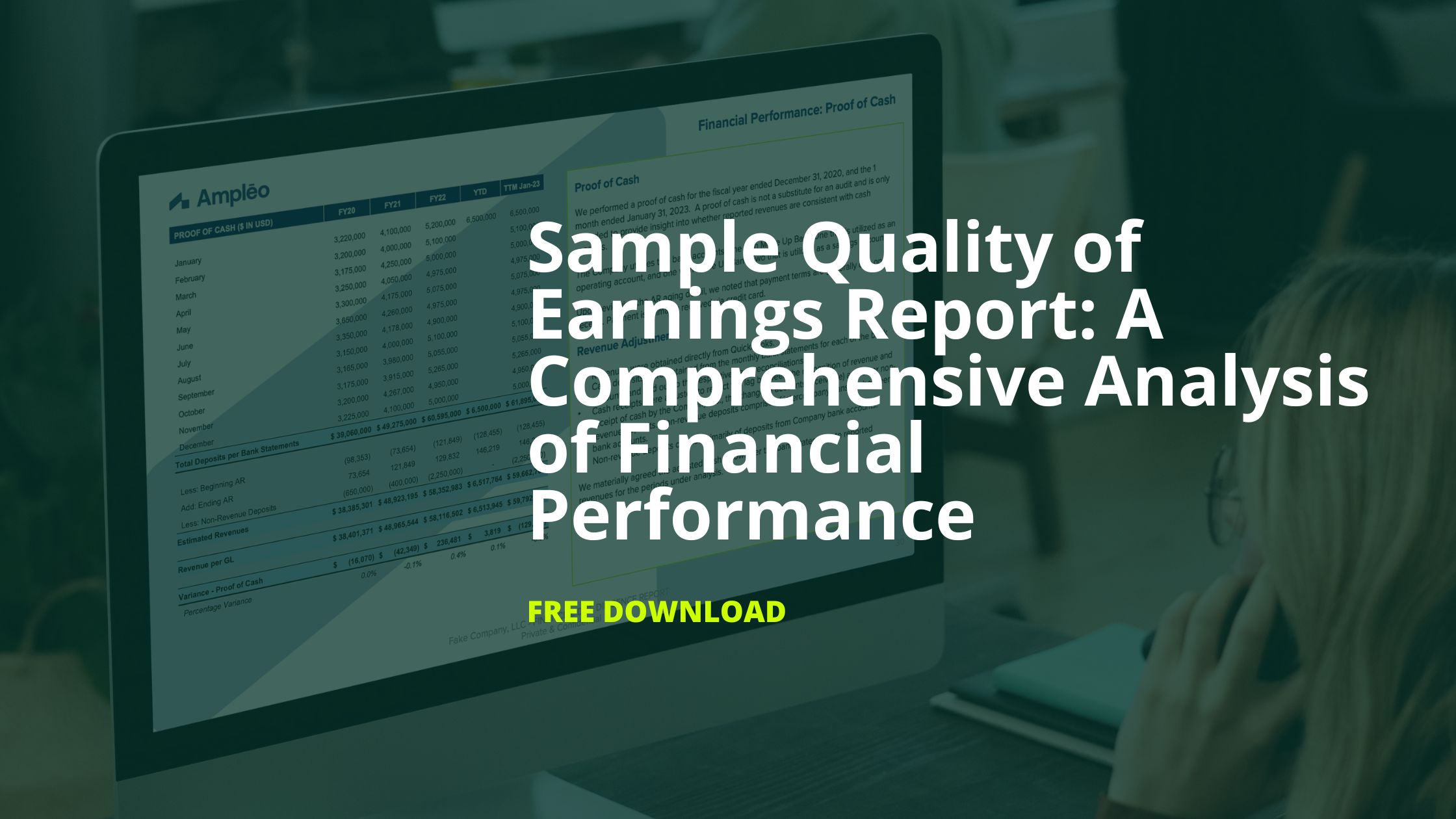
Sample Quality of Earnings Report: A Comprehensive Analysis of Financial Performance
This downloadable is an example of Ampleo’s final deliverable for a quality of earnings report. You will find that the report is broken up into 7 different sections:
- Background, Overview, and Key Findings
- Quality of Earnings
- Financial Statements
- Financial Performance
- Working Capital
- Appendix A: Scope of Procedures
- Appendix B: Supporting Schedules
The report is designed to help investors, analysts, and other financial professionals gain a deeper understanding of the company’s financial health and performance. The example below showcases the level of detail and analysis that can be expected from a quality of earnings report, and how it can be used to make informed investment or strategic decisions.
Although the financial information throughout this report is a completely FAKE (made up) company and the data is not real, nor was it derived from a real company, the example report provides a valuable resource for anyone seeking to understand how a quality of earnings report is structured and what kind of information it can provide.
Download the example report today to learn more about this important financial document and how it can help you make better-informed decisions.

What Is a Balance Sheet?
A balance sheet is an essential financial statement used to determine a company’s assets, liabilities, and equity over a specific period. Also referred to as the statement of financial position , a balance sheet is what a company uses to disclose what it owns and what it owes—represented by a single, fundamental equation:
Assets = Liabilities + Equity
Table of Contents
- The 3 Main Elements of a Balance Sheet
- What Is a Clean Balance Sheet?
- What Is the Purpose of a Balance Sheet?
- Balance Sheet Key Takeaways
The 3 Main Elements of a Balance Sheet
As the name suggests, a balance sheet must always balance to reflect a company’s financial position accurately. A balance sheet’s three core elements are broadly defined as the following:
Assets
Assets are all items of value held by a company. A balance sheet organizes assets in order of their liquidity—how quickly and easily a company can convert the assets into cash.
Assets include short-term and long-term values (also called current and non-current), indicating whether a company means to liquidate them within a specified period or hold them longer.
Assets commonly include a combination of the following:
- Cash equivalents, such as treasury bills and certificates of deposit
- Accounts receivable (AR)—money owed by a company’s customers
- Inventory
- Fixed assets like land, physical structures, and equipment
- Intangible assets like intellectual property (IP) and patents
Liabilities
Liabilities are debts owed by a company in the recorded period. As with assets, a balance sheet classifies liabilities as short-term and long-term. In this case, the term of a liability specifies whether a company means to pay a debt within the given year. Common liabilities owed by companies include:
- Accounts payable
- Wages payable
- Federal and state taxes payable
- Loans
Equity
Equity is often referred to as owner’s equity or shareholder’s equity and is the total value of a company’s assets after deducting the company’s total liabilities.
What Is a Clean Balance Sheet?
A clean balance sheet is error-free, providing a financial record for a set period that is:
- Accurate
- Consistent
- Up-to-date
- Formatted correctly
- Uncluttered
What Is the Purpose of a Balance Sheet?
A balance sheet assesses a business’s health, meaning whether a company is sufficiently liquid or substantially in debt. In this critical role, a balance sheet evaluates how a company operates, whether it’s on a positive trajectory with profits and spending or must make changes for its well-being.
The benefits of transparency and insight help further illustrate what a balance sheet is. For a business to secure capital, a balance sheet can provide a record of its creditworthiness to a bank and other lenders. Investors can view a balance sheet to determine an expected rate of return, while potential investors can use it to assess risk levels when considering an investment.
Financial Ratios
One can use a balance sheet to formulate several commonly-used ratios when evaluating a company’s finances. Three of the most widely used financial ratios are:
Liquidity Ratios
This ratio determines the capability of a business to convert assets into readily available cash.
Solvency Ratios
A solvency ratio helps assess a company’s ability to pay off its debts.
Profitability Ratios
This ratio helps to evaluate a business’s ability to generate income.
Balance Sheet Key Takeaways
A balance sheet must do the following:
- Provide a clear picture of a company’s finances
- Always balance assets, liabilities, and equity perfectly
- Measure financial performance, responsibility, and creditworthiness within a set period

What Is Quality of Earnings (QofE)
Quality of earnings (QofE) is the proportion of a company’s income that can be attributed to increased sales or operational values. Thus, quality of earnings refers to the actual income a company generates.
Meanwhile, a quality of earnings report is a deep dive into a company’s financial statements to determine the accuracy and quality of its historical earnings and assets. It is a form of due diligence and may be requested or even required when a company wishes to buy or sell.
While an audit is the what , a QofE is the why . An audit discusses what is on the financial statements and their accuracy, while a QofE discusses why there are specific numbers on the financial statements and tell the story.
What Is Included in a Quality of Earnings Report?
A quality of earnings report is usually formatted with the following core features:
- Executive Summary: The executive summary includes information regarding the company background, systems, and accounting department, as well as an overview of key findings and other items.
- Quality of Earnings (EBITDA): This is the meat of the report. It’s an overview of your net income compared to earnings before interest, taxes, depreciation, and amortization (EBITDA). This section discusses normalization adjustments, such as management-proposed adjustments, diligence adjustments, and other considerations.
- Financial Statements: This section analyzes the income statement and balance sheet. It includes an income statement analysis, including the percent of total sales and year-over-year fluctuations. The balance sheet analysis discusses current assets, liabilities, and other details like long-term debt. Details like purchase price allocations may be calculated in this phase when the business considers its potential sale.
- Financial Performance: This section covers items such as proof of cash—which compares the cash deposits recorded in the bank statements to the cash collections reported in the financial statements—sales by top products, revenue by customer/channel, and vendor concentration.
- Working Capital: This section discusses trends and unusual fluctuations surrounding working capital. It also identifies key ratios that are necessary to establish a “peg” amount for purchase price adjustment purposes. Some of those key ratios include DSO (days sales outstanding), DPO (days payable outstanding), DIO/DOH (days inventory outstanding, or days of inventory on hand), and inventory turnover ratio.
- Appendices: This section includes the scope of processes, as well as the monthly adjustments made to EBITDA.
Difference Between Sell-Side and Buy-Side QofE Report
Sell-side QofE means the report was requested by the company wishing to be purchased. Meanwhile, buy-side QofE means the purchasing company requested the report.
As a seller, we always want to know how a buyer will see our financials when performing a QofE. We want to prepare now for those discussions and not be surprised in any way.
As a buyer, we want to be able to argue for a fair valuation if we discover something that alters our initial view of the company’s earnings. Again, we don’t want any surprises.
Why Is Quality of Earnings Important?
Shareholders of your company want to see high-quality earnings, as it can attract more investors and produce higher stock prices. Quality of earnings is also indicative for potential buyers of your company. If you wish to sell or merge with another company, your quality of earnings can give interested parties a general idea of your company’s financial well-being.
What Are the Benefits of Quality of Earnings Reports?
There are several advantages you stand to gain from a QofE report:
- Identifies necessary adjustments to EBITDA
- Compares cash deposits to reported revenue to accurately reflect true cash performance
- Addresses and helps resolve possible accounting issues
- Establishes credibility to a company’s financials, creating confidence from a buyer’s perspective
- Fosters more efficient transactions
How Is Quality of Earnings Measured?
Quality of earnings is measured using several factors from your financial statements. These include:
- Income statements
- Net income
- Sales growth
- Credit sales
- Accounts receivable
- Current cash flow
- Any one-time adjustments to net income
Many financiers will dissect every detail in an annual report to determine the quality of earnings, but the above factors provide an adequate baseline.
What Are Low-Quality Earnings?
A company has low-quality earnings if its income is insufficient to cover the company’s cost of capital. If the company has sufficient income derived from non-recurring, one-off payments, that is also considered low-quality earnings.
Low-quality earnings may also be used to describe financial information that does not provide useful context for the company’s financial performance.
When Is a Quality of Earnings Report Required?
A quality of earnings report is usually required before a company begins to solicit buyers for an acquisition. This ensures that any potential problems that may disrupt the sale are uncovered before getting too far into the process.
When Should I Get a Quality of Earnings Report?
The time required to complete a QofE report is not extensive—it generally takes between 4–8 weeks. But it’s best to be proactive when getting your QofE report. The earlier you start the process, the quicker you can identify what needs to be addressed and what the buyer will see about your company.
For sell-side QofE reports, it’s easier to plan ahead because the company has plenty of time to prepare. It’s not uncommon for these companies to complete their report 12 months prior to the final transaction.
For buy-side QofE reports, you want there to be enough time to argue for a fair valuation before you go too far into the deal. As such, you should request a QofE report as soon as you start to consider buying a company.
In short, the insights from a QofE report can never be gained too early as they will guide every decision you need to make during the transaction.
You Might Also Like

How to Get a Quality of Earnings Report [& Why You Need One]
Are you toying with the idea of selling or purchasing a business? Before you go any further in the process, you and any potential investors will want to know one thing: The reality of the company’s financial performance and well-being.
The quickest way to figure that out is with a quality of earnings report. Let’s find out what this report is—and the process to get one.
What Is a Quality of Earnings Report?
A quality of earnings report (also referred to as a QofE, QOE, or financial due diligence report) is an analysis and report of accounting and business records to not only evaluate the accuracy of historical earnings and financial position but also to assist in the identification of any risks or opportunities that may or may not be reflected in the financial statements.
A QofE report is most often used as a form of due diligence to arrive at a basis for a company’s valuation amidst a potential ownership transition, although the report can also be prepared to provide insights to your CFO or financial team.
Once engaged by a prospective seller or buyer, a third party prepares a report that reviews, normalizes, and summarizes a business’ performance for items such as:
- Sources of revenue
- Customer and vendor concentrations
- Non-recurring transactions
- Executive compensation or personal expenses
- Unusual or cyclical trends
- Compliance with U.S GAAP
- Accounting policy changes
- Significant estimates
The QofE report, therefore, attempts to tell the true story of a business’s earnings and financial position and provides insight into prospective performance (i.e. potential for future earnings or risks).
QofE Report versus Audit
It’s easy to confuse the purpose behind a quality of earnings report versus an audit because they are interconnected. The simplest way to explain the difference is this: Audits explain the what of financial statements, while QofE reports explain the why.
A quality of earnings report is a financial analysis that evaluates the quality and reliability of a company’s earnings and profitability. It aims to provide a comprehensive understanding of a company’s financial performance and earnings potential by reviewing key financial metrics such as revenue, operating expenses, and cash flow.
On the other hand, an audit is a comprehensive review and examination of a company’s financial records and operations. The purpose of an audit is to provide an independent assessment of a company’s financial statements to ensure that they are accurate, complete, and in compliance with accounting standards and regulations. An audit is typically performed by an independent auditor who assesses the internal controls, financial reporting processes, and financial statements of a company.
Why Do I Need a Quality of Earnings Report?
The primary reasons to seek a QofE report are to understand your business, prepare for a buy-side transaction, or prepare for a sell-side transaction:
- Understand your business: You should never enter the market blind to the value of either your company or the company you wish to purchase. You may have some projections or estimations of your value, but these shouldn’t be the basis of your price. Getting a QofE report gives you as accurate an estimate as possible so you can enter the market confidently and become aware of any problems in your financials.
- Prepare buy-side: Using your QofE report, a purchasing party can more accurately calculate projections of a business’s future earnings. The report can also reveal how well the two companies will synergize with one another.
- Prepare sell-side: QofE reports ensure your financials are organized enough to initiate a sale. If your report reveals inefficiencies in your business’s revenue cycle, you can correct those issues before entering the market.
Questions Answered in a QofE Report
With a completed QofE report at your disposal, you’re ready to answer the following questions:
- What are the earnings of the business and how are they earned?
- How well-positioned is the company for a sale?
- Are historical earnings sustainable?
- Is your revenue non-recurring or frequent?
- Have your accounting practices changed, and were those changes for the better?
- Are there any off-balance sheet liabilities?
- Do the two businesses have similar customers or vendors (applicable for mergers and acquisitions)?
- What are the cost of goods sold (COGS) (if applicable)?
- What are the potential risks of purchasing the business?
- What are the potential future earnings?
- Are there any deviations from GAAP standards?
How Long Does It Take To Get a Quality of Earnings Report?
The amount of time required to complete a quality of earnings report correlates with the complexity of the sale and the size of the company.
For smaller companies, QofE reports can be delivered within 1–2 weeks depending on the accuracy and availability of current financial figures and supporting documentation.
For larger companies, it can take 1–2 months to complete the entire QofE. This depends on numerous variables, including the complexity of the organization’s inventory, related party transactions, and management’s proposed adjustments.
What Information is in a Quality of Earnings Report?
A quality of earnings report generally covers four major categories: quality of earnings, financial statements, financial performance, and working capital. Within these sections, the following information is revealed:
- Adjusted EBITDA: This stands for Earnings Before Interest, Taxes, Depreciation, and Amortization. The EBITDA is often considered the “real” income of a company after deducting and adjusting for these considerations.
- Recast Income Statement Analysis: This goes over measurements such as percent of total sales and year-over-year fluctuations.
- Recast Balance Sheet Analysis: This discusses current assets, liabilities, long-term debt, and other factors that impact the company’s financial performance.
- Proof of Cash: This compares the cash deposits recorded on bank statements to the cash collections reported on financial statements.
- Net Working Capital: This measures a company’s liquidity and short-term financial health, calculated as the difference between current assets and current liabilities.
Can This Information Come from My Accounting System?
All the above information can be pulled from your accounting system—as long as that system is accurate and up-to-date. Additional information may be needed from the client such as access to bank statements, payroll, invoices, contracts, etc.
If you’re not sure your financials are up to snuff, using a fractional CFO can be paramount in verifying your organization’s readiness for a merger and acquisition. A qualified CFO can get your financials in order and thereby produce an accurate quality of earnings report.
What’s the Process of Getting a Quality of Earnings Report?
While many variables determine the nitty-gritty details, every process generally follows the same four steps when working with Ampleo.
1. Engagement Letter
When a company is interested in getting a QofE from Ampleo, they will be sent an engagement letter that specifies the entities that will be covered, the analysis period, and the diligence procedures and pricing. Once the engagement is signed, our team will send the client a diligence request list.
2. Diligence Request List
To lay the groundwork for the upcoming QofE report, Ampleo will send out a diligence request list to go over some high-level details with the selling company. This looks at how the company was established, its operations, and how it generates revenue. If the company allows, we’ll also access its financial systems to pull financial records to ensure the QofE report meets the highest level of detail.
3. Analysis
With the diligence request list in tow, we can start our analysis. This involves looking at income statements and balance sheets to discover any unusual fluctuations or other concerning variables. Ampleo may reach out to the company’s management if anything concerning arises during the analysis. The management may also communicate any adjustments they wish to propose during this interaction.
4. Report Delivery
While reports come in many forms, Ampleo compiles all of our findings into the following sections.
- Executive Summary: Information regarding the company’s background and systems while summarizing the key findings.
- Other recommendations around accounting policies/procedures
- Quality Of Earnings: Overview of the company’s EBITDA net income and a discussion of adjustments and other considerations.
- Financial Statements: Analysis of income statements and balance sheets.
- Financial Performance: Information regarding the company’s proof of cash and cash collection processes.
- Working Capital: Discussion of trends and unusual fluctuations surrounding working capital
- Appendices: A summary of the scope of the company’s processes and monthly adjustments to EBITDA.
Our reports typically range from 25-50 pages depending on the size of the Company and the scope of diligence work requested.
Get Your QofE Report with Ampleo
You must be proactive when seeking to sell or purchase a company. You want to put your best foot forward when you enter the market, and Ampleo can help you get your footing with our QofE reports.
If you’re ready to get a Quality of Earnings Report, reach out to Ampleo today.

5 Current Fraud Trends That Can Significantly Harm or Kill Your Business
In today’s world where most information is stored on the cloud and employees are working more frequently from home, it should come as no surprise that the top trending business fraud schemes come from the cyber world. The Covid-19 pandemic has resulted in more people working remotely, a change that was for many companies both sudden and unexpected – but absolutely necessary. As a result of this phenomenon, cyberfraud has soared. Cyberfraud is any type of fraudulent crime that is conducted via a computer or computer data. In the early days of the pandemic in 2020, cloud-based attacks rose 630% between January and April as employees were forced to work remotely. Organizations were not ready cybersecurity-wise for this to happen. As a result, ransomware attacks rose approximately 148% in March 2020 alone. Cyber Fraudsters were able to quickly find a weakness and attack in short order!
As companies and their employees have realized that working remotely can be done with little to no effect on productivity, working outside the office is becoming the norm. By 2025, it is estimated that 36.2 million Americans will be working remotely – up 87% from pre-pandemic levels. Additionally, approximately 53% of US employees want to continue working remotely, even after Covid-19. Remote work, as many companies discovered in 2020 and 2021 poses cybersecurity risks for organizations.
Cyber Fraudsters have found a more lucrative “business environment” in which:
- The global cost of cybercrime has reached approximately $6 trillion annually in 2020/2021;
- If cybercrime were measured as a country, it would be the third largest economy after the US and China; and
- In 2020 alone, approximately 55% of attacks were attributed to organized crime gangs.
The Top 5 Cyber Fraud trends in 2021 included ransomware, business email compromise, data breaches, phishing, and insider threats. Below I will go into more depth about each of these trending cyber fraud schemes and what measures you can take for business fraud protection.
1. Ransomware
Malware is a harmful software that seeks to invade, damage, or disable devices, often by taking partial control over the device’s operation. Ransomware is malware that compromises files and computers through:
- Crypto-ransomware, which encrypts your hard drives or files & folders; or
- Locker-ransomware, which only locks users out of their machines, without encryption.
Either of these situations allows the cyber fraudster to hold significant leverage over a company until the company pays significant sums of money, typically paid in cryptocurrency, to the cyber fraudster in order to get their systems back.
Malware Developers are constantly innovating ways to commit their fraudulent deeds. Reports show that approximately 41% of malware families observed were previously unknown. Companies should know that malware quite often targets end-of-life software. One example of this is the targeting of Windows 7 software which was being sunsetted by Microsoft (in favor of Windows 10). Malware targeting of Windows 7 increased by 125% between 2018 and 2019, with support for Windows 7 ending in January 2020. If you are running Windows 7 software you are 3 times more likely to get infected than if you are running Windows 10.
2. Business Email Compromise (BEC)
Business Email Compromise occurs when a compromised or spoofed email from a CEO is sent to a company employee (usually in the finance department) directing them to transfer company funds to an account controlled by the cybercriminal, whereby a significant amount of company funds are extracted by the cybercriminals. BECs currently represent approximately 50% of cybercrime losses in the United States. To commit this type of fraud, the cybercriminal doesn’t need to be tech-savvy, they only need to be able to make the targeted finance employee trust that they are indeed receiving an email from the Company’s CEO (or other company executives).
BECs are evolving to become more sophisticated and more successful – a current growing threat is Vendor Email Compromise (VEC). A VEC starts with an employee’s account being compromised by a cybercriminal. That compromised account is used to notify the company’s customers that a change has been made to where the remittance of invoices should be directed. The company’s customers, following the new remittance directive, send payment to the cybercriminal’s account, whereby the cybercriminal collects funds that the company now never receives.
3. Data Breaches
A Data Breach is an incident that exposes a company’s confidential or protected information intentionally or unintentionally. Data that is compromised will typically include company and customer information. Cybercriminals typically sell that data to other parties. Breaches can happen when a company has not protected itself from a security breach, including: information system vulnerability;
- weak passwords;
- drive-by downloads; and
- targeted malware attacks.
Care needs to be taken by the company to constantly be aware of the need to both updates and strengthen its security over its data.
4. Phishing
Phishing is a cybercrime in which targets are contacted by email, telephone, or text message by someone posing as a legitimate institution to lure employees to provide sensitive data, such as personally identifiable information, banking, and credit card details, and passwords. The information is then used to access important accounts and can result in identity theft and financial loss.
Common features of phishing emails to company employees include:
- too good to be true;
- sense of urgency;
- hyperlinks;
- attachments; and
- unusual senders.
Other examples of trends in phishing include:
- Clone phishing – a virtual replica of a legitimate email previously received by the victim but with malicious links or attachments – the cybercriminal will use an excuse for “resending” the email, such as an issue with the link or the attachment they want the target to click on.
- Domain spoofing – the cybercriminal spoofs the organization or domain name to make emails look like they originate from the official domain or fake websites that adopt the design of the legitimate site using a similar URL – example: sbm@abcconnect.com vs. sbm@abcconect.com.
- SMiShing – a text message that appears to originate from a legitimate source but contains malicious links or coupon codes.
5. Insider Threats
An Insider Threat is a cyber event caused by employees, either by mistake or maliciously. In 2019, approximately 30% of all breaches were caused by insiders. The damage caused by a malicious employee can be great. An employee who has been fired or laid off can often rationalize hurting the company that has hurt them. At times a disgruntled employee can offer assistance to an outside party to breach company safeguards over data and other sensitive matters. Care needs to be taken by the company to monitor employee behavior at all times, particularly when employment is terminated, so that appropriate security measures are taken so the terminated employees can no longer access any company data.
Losses to your company from these trending areas of Cyberfraud can have a significant negative impact on your business in many areas, not all of which are financial, that include:
- productivity losses;
- response costs;
- replacement costs;
- competitive advantage losses;
- fines and judgments; and
- company reputation damage.
5 Steps to Consider to Protect your Businesses from Fraud
- Training – train, train, train! – Training employees about signs of fraudulent activity can help them recognize that an email or link may be a fraud. Teaching your employees about procedures for reporting fraudulent activity can also help a company assess and strengthen its weak spots before a major breach arises.
- Risk Assessment – where is my company weak? – Understanding where your company is lacking or weak against cybercriminals can help you take precautions and protect your business before an attack happens.
- Implementation of automatic security updates.
- Developing an action plan to provide security over mobile devices.
- Developing a business continuity plan should security fail.
It’s important to remember that “Computers don’t create crimes. It’s the people who are using the computers who commit the crimes.” So, train, train, train your people; monitor your people, use data loss prevention (DLP) software; block cloud storage; and manage and limit access to sensitive data.
Ampleo Can Help
If you or your business is the target of fraud, reach out to Ampleo. Its consultants help detect fraud, support litigation to reclaim lost assets, and implement controls to prevent future occurrences.
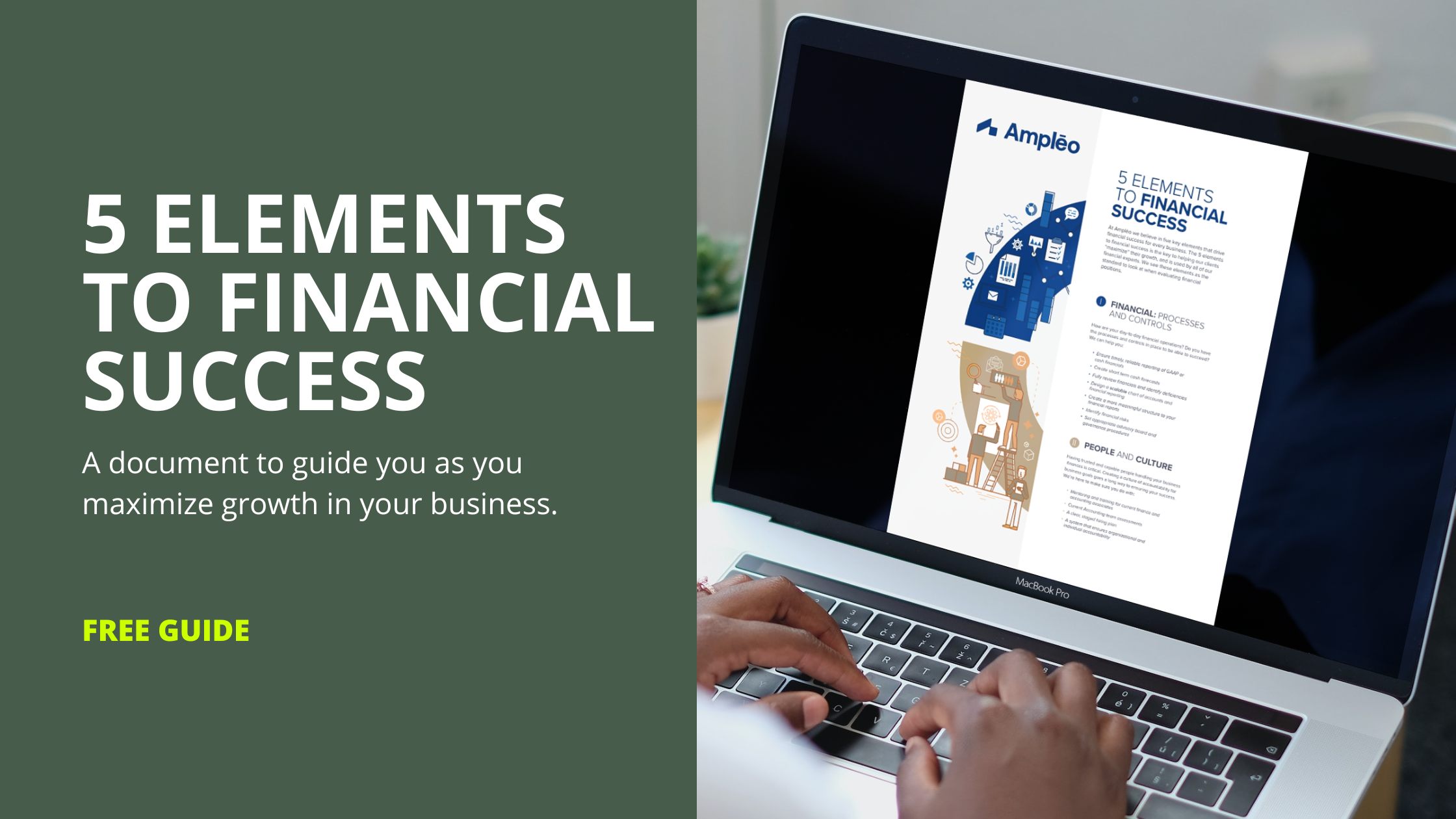
5 Elements to Financial Success
At Ampleo we believe in five key elements that drive financial success for every business. The 5 elements to financial success are the key to helping our clients “maximize” their growth, and all of our financial experts use it. We see these elements as the standard for evaluating financial positions.
What’s Inside
- Financial: Processes and Controls
- People and Culture
- Financial Strategy
- Technology
- Capital

What Is Accrual vs. Cash Accounting for Small Businesses?
Cash and accrual accounting are both legitimate forms of accounting. But is it better to use accrual vs. cash accounting for your small business? Let’s briefly define each method and then break them down with examples to help you consider which might be better for your business.
Cash vs. Accrual – what’s the difference?
Cash accounting records income and expenses only when cash is paid or received. It is the simplest method of accounting and is often used by sole practitioners and small businesses. Accrual accounting records transactions when they are incurred, regardless of when cash is exchanged. This generally means that financial impacts to the business are recorded in a more timely manner and offers a more accurate financial picture of the business.
What Are Two Types of Accruals?
Most accrued transactions fall under two categories:
- Revenue accruals: Revenue is considered earned when an agreed-upon product or service is fulfilled, regardless of when cash is received. For example, if your company has a $30k contract that is fulfilled evenly over 3 months, you can record $10k in revenue each month. This revenue accrual will increase your Accounts Receivable until the cash is received.
- Expense accruals: Goods or services that are received by your business but have yet to be paid for generate accrued expenses. This often happens when a company buys on credit and plans to pay the vendor at a later date. These expense accruals typically result in Accounts Payable until the vendor is paid.
Important Considerations for Accruals
While many accrual transactions are straightforward, some require sophisticated treatment and strict compliance with standards to perform correctly. Having access to the right experience and skills is critical to ensuring your books are correct. Here are a few things to consider when recording accrual transactions:
- Revenue: Revenue is among the most important measures of business health, and recording revenue accruals can get very complicated quickly when dealing with transactions such as customer contracts, subscriptions, partially fulfilled services, warranties, and even the timing and terms of shipping agreements. Standards like ASC 606 and IFRS 15 provide very specific guidelines for ensuring revenue is recorded correctly.
- Expenses:
Expenses can be incurred in many different ways, each requiring unique treatments:
- Current Period Expenses (i.e. utilities): These expenses are both incurred and paid in the same period and are usually booked directly to expense with no accrual required.
- Prepaid Expenses (i.e. prepaid insurance or prepaid software licenses): These expenses haven’t yet been incurred, so the prepayment is recorded on your balance sheet as an asset named Prepaid Expenses, which is gradually reduced as you record the expense each month it covers.
- Accrued Expenses (i.e. property taxes): Accrued expenses are incurred, but not yet paid. By recording the expense as it is incurred with a corresponding payable, you more accurately reflect your financial position and protect your business from financial ‘surprises’ down the road.
What Is an Example of Cash Accounting?
Cash accounting is considered a basic streamlined approach, providing an up-to-date record of the cash you actually have on hand. It is important to note, however, that cash accounting may not provide a complete picture of a business’s financial performance, as it won’t include transactions that have been fulfilled but not yet paid.
Let’s say Jim sells handmade crafts at a local market. Under cash accounting, Jim only records transactions when cash is exchanged. When he purchases supplies for $20 and pays for them in cash, he records the $20 expense. If Jim doesn’t sell anything that month, he’ll show a $20 net loss.
When Jim sells a handmade necklace for $50 cash the following month, he would record the sale as revenue in the business’s financial records. If he didn’t have any additional raw material purchases that month, he would show $50 of revenue, which would also be his profit for that month.
This example helps illustrate the simplicity of cash accounting (no payable or receivables), but also a common drawback: the mismatched timing of revenues and expenses. While Jim’s 2-month cumulative financial picture will be correct ($50 revenue – $20 costs = $30 profit), Jim doesn’t have clarity around his true profitability along the way.
What Is an Example of Accrual Accounting?
Accrual accounting records transactions when they are earned rather than when payment is received.
For example, let’s say a solar company installs solar panels on the roof of a customer’s home for $20,000. The customer pays a deposit of $5,000 at the installation time, with the remaining $15,000 to be paid over the next year.
Using accrual accounting, the solar company would record the full $20,000 as revenue when installation is completed, even though only $5,000 has been received at that point. This is because the company has earned the revenue by completing the installation, regardless of when payment is received.
The solar company would also record the expenses associated with the installation, such as the cost of the solar panels and labor, when they are incurred. For example, if the solar panels cost $10,000 and the labor costs $5,000, the solar company would record the $15,000 in cost of goods sold when the installation is completed.
In this example, the solar company’s financial statements would show revenue of $20,000 and expenses of $15,000, resulting in a net profit of $5,000. When the customer pays the remaining balance of $15,000, the solar company would record that payment as a decrease in accounts receivable (the amount the customer owes) and an increase in cash.
Adopting the accrual accounting method, businesses can accurately reflect the company’s financial performance and track the full impact of transactions over the entire business relationship with the customer.
Should Small Businesses Use Cash or Accrual Accounting?
There are obvious advantages to both cash and accrual accounting, but which type is most advantageous for your small business? Let’s explore the pros and cons of cash vs. accrual accounting.
Accrual Accounting Pros
- Accrual accounting offers a more granular view of your company’s financial health, clearly showing how much profit was earned in a given period. This can be particularly important for businesses that operate with long-term transactions, as it allows them to see the impact of a transaction over the entire period of the business relationship rather than just when payment is received or made.
- It helps businesses manage their cash flow better. Accrual accounting can help businesses better predict and manage their cash flow by recording transactions as they occur, providing a clearer picture of when payments are expected to be received and when expenses are expected to be paid.
- It can make it easier to secure financing. Many lenders and investors prefer to see financial statements prepared using accrual accounting , as it provides a more accurate and comprehensive view of a business’s financial position. This can make it easier for companies to secure financing, as lenders and investors will have a clearer understanding of the business’s financial health.
- It can make it easier to compare the financial performance of a business over time. By recording transactions consistently, accrual accounting allows organizations to compare their financial performance from one period to another more easily. This can help identify trends and make informed business decisions.
Accrual Accounting Cons
- Accruals can be complicated. Accrual accounting may be more work than it’s worth if your business operates with very short-term transactions.
- Accrual accounting can be higher cost. Accrual accounting requires more sophisticated talent to ensure your books stay clean. While it can provide better insights, there is a cost to generating those insights.
Cash Accounting Pros
- Cash accounting is simple. Small businesses may choose to use cash accounting because it is a simpler process and easier to implement for most, as it is similar to how you might keep track of your personal finances.
- Cash accounting requires less record-keeping. It only involves tracking the actual cash flows of the business.
- Cash accounting is aligned with income taxes. It’s much easier to apply cash-based business records to cash-based personal income tax returns.
Cash Accounting Cons
- Cash accounting does not consider transactions that have not yet been paid.
- Cash accounting may not accurately reflect your business’s financial performance, especially when costs or revenues cross multiple periods.
- Cash accounting makes cash flow predictions more difficult.
Making your Final Decision
Deciding which method to use is an important decision, but one you don’t need to make by yourself. If you have any uncertainty about how these methods will impact either the current state of your business or where you expect your business to be in the future, it’s wise to get input from a qualified professional.
And, like so many aspects of life, setting up your business accounting correctly from the beginning will not only save a tremendous amount of time and money fixing issues later, but it will make running your business more effective and enjoyable along the way.
Contact Ampleo today so our financial experts can help you make the best decision for your business.

What Is a Fractional CFO?
A fractional CFO is an executive-level employee who operates as a business’ financial expert. Their financial expertise may involve offering relevant advice to the other executive team members and outlining high-level plans and roadmaps to achieve financial success.
Since the CFO is “fractional,” they offer their financial expertise part-time or as needed. Most fractional CFOs have at least several years of experience working as financial advisors/executives for other companies.
A fractional CFO is also referred to as a:
- Part-time CFO
- Remote CFO
- Interim CFO
- Outsourced CFO
Table of Contents
- What Does a Fractional CFO Do?
- How Are Fractional CFOs Different from Full-Time CFOs?
- When Should You Use a Fractional CFO?
What Does a Fractional CFO Do?
Fractional CFOs are primarily concerned with two things:
- Outlining the company’s financial plan, and
- Helping that plan become a reality
They may accomplish these goals by a variety of means, such as:
- Communicating with connections who may want to invest and provide capital (applicable for startup ventures)
- Planning for a company’s financial future
- Overseeing the accounting department of a business
- Performing strategic analyses of companies’ financial well-being
- Working with internal accountants and controllers to create and review financial reports
- Offering relevant advice
How Are Fractional CFOs Different from Full-Time CFOs?
Full-time CFOs and fractional CFOs both complete similar tasks. However, since fractional CFOs work on an as-needed basis, they do not typically receive the same salary and benefits package as their full-time counterparts.
When Should You Use a Fractional CFO?
Fractional CFOs are ideal for:
- Businesses that can’t afford a full-time CFO but need help with a particular situation, such as a financial audit or an acquisition
- Startups and other companies that need help defining financial missions
- Companies that need help balancing the financials of a specific project
- Organizations seeking a new full-time CFO but looking for financial support in the interim
You Might Also Like

What Does Restructuring Mean in Business?
Restructuring in business means an organization significantly modifies its financial and/or operational processes to become more financially solvent. A business restructuring may involve any number of restructuring strategies, such as downsizing staff, cutting back on certain expenditures, or reorganizing and redefining job positions to lower redundancies.
A business restructuring also means the organization might require outside help to improve its financial situation. A restructuring may come as a court-mandated change, particularly if the organization files for bankruptcy. In the process, a restructuring service will often collaborate with the organization.
Table of Contents
When Is Business Restructuring Required?
An organization may wish to restructure for a variety of reasons, including:
- Poor earnings/sales performance
- Excessive debts
- Lack of competitive advantage in the marketplace
- Changes in the overall goal of the company (like a change in products)
A business restructuring may also be a precursor to a merger and acquisition. This process would ensure that the organization enters the market as a financially solvent entity.
Are There Different Kinds of Business Restructuring?
The two most common types of business restructuring are operational and financial turnarounds.
Operational turnarounds occur when a company operates inefficiently. An inflated management team, ineffectively priced goods, or an outdated expense structure may cause inefficiencies. A business restructuring is what could help identify these operational inefficiencies and produce the best solution to correct them.
Financial turnarounds occur when the organization’s balance sheet is insolvent. The business restructuring would then consolidate unsettled debts, liquidate underperforming assets, and negotiate payment to creditors to properly balance the organization’s financials.
You Might Also Like

What Is Transaction Advisory?
Transaction advisory is a service, often found in accounting firms and other third-party organizations, that helps companies evaluate and navigate corporate transactions. This is most often applied to large purchases like mergers and acquisitions but has other applications like lender financing.
This advisory acts as your business’s support system throughout the transaction process to ensure your financials are properly prepared for the purchase.
Table of Contents
What Are Transaction Advisory Services?
The usual transaction advisory services are as follows:
- Financial Structuring: Creating quality of earnings reports and restructuring cash flow and balance sheets so financials are working at optimum efficiency. This also includes looking at historical tax and transaction trends.
- Financial Projections: Assessing the company’s current spending habits to determine how and/or if the company should proceed with the transaction.
- Deal Negotiation: Supporting the company by communicating with boards of directors and other decision-makers to ensure the transaction goes through at a fair price.
- Post-Closing Assistance: Advising the company on the future roadmap of the company, specifically how their new purchase should affect their future spending and business processes.
- Sell-Side Assistance: Helping the selling entity prepare value propositions, valuation modeling, and other financial analyses to best prepare them for entering the market.
What Transaction Advisory Services Do
Above all else, transaction advisory services ensure both the buy- and sell-sides of a transaction enter negotiations with a complete understanding of the risks and opportunities. These services provide a form of legal and financial due diligence to ensure all variables are considered before moving forward with the transaction.
You Might Also Like

What Are Mergers and Acquisitions?
Mergers and acquisitions (M&A) are transactions between two or more companies that involve them being combined and consolidated into a single entity. M&As usually occur when one company purchases another through stock options or purchases the entire company for an agreed-upon sales price.
Table of Contents
- Are Mergers and Acquisitions the Same Thing?
- What Are the Different Types of M&As?
- How Long Does a Merger Or Acquisition Take?
- What Is the Merger and Acquisition Process?
Are Mergers and Acquisitions the Same Thing?
Although the two terms are often used interchangeably, mergers and acquisitions describe two separate processes.
Mergers combine two separate businesses into a new entity. This involves combining all assets, such as branded logos and employees. While some employees may be laid off due to redundancies, a large portion of the acquired company’s workforce may be retained.
Acquisitions happen when one company gets fully absorbed into the acquiring company. In many cases, the acquired company will continue to operate as usual but will simply work under new management. In other instances, acquired companies may be completely liquidated.
What Are the Different Types of M&As?
Mergers can take many different structures.
- Horizontal mergers: Two companies that are direct competitors merge. Nike’s acquisition of Converse is a prime example of this.
- Vertical mergers: Two companies that do not directly compete but complement one another’s products merge. An example would be a car manufacturer joining a tire manufacturer.
- Congeneric mergers: Two companies that serve the same audience in different ways join together. This type of M&A might occur if the acquiring company wishes to develop a product line offered by the acquired company.
- Conglomerations: Two companies that have no common business relations combine. Many large companies, such as Proctor & Gamble or Alphabet (Google), are conglomerates.
How Long Does a Merger or Acquisition Take?
The time it takes to complete a merger and acquisition can vary significantly, ranging from a few months to several years. But there is a way to know approximately how long mergers and acquisitions take.
The more assets and variables each company has to manage and organize, the longer it will take to complete the merger. Each company will need to obtain approvals for changes in ownership, which can often lead to complex situations. The complexity is more significant if more assets and variables apply to the purchased company.
On the other hand, the fewer assets and resources an acquired company has, the faster the M&A process.
What Is the Merger and Acquisition Process?
The merger and acquisition process follows the steps outlined here (or a similar approach, depending on the complexity of the M&A).
1. Planning and Preliminary Discussions
A company begins to consider whether an M&A would be beneficial, weighing the pros and cons of acquiring another company. It will also research current industry trends and competitors and assess how an M&A could help them surpass future barriers to growth.
After identifying a few potential companies that could be acquired or merged, the acquiring company will reach out to these companies. This phase is an exploratory one where companies can discuss how they might fit into one another’s business models.
2. Risk Assessment and Evaluation
Before companies strike a deal with one another, they’ll identify and assess all potential risks and issues that may arise during the M&A. Issues include details like how the company will develop its new brand and how it will be able to position itself in the marketplace.
It’s also beneficial to take a deep dive into the other company’s financials. Examining financial forecasts will help a company better estimate an accurate valuation of the company it wishes to purchase.
3. Initial Agreement and Due Diligence
Once the two companies identify and assess the risks, they’ll reach an initial agreement on the M&A. Then the due diligence phase begins, where the acquiring company will analyze and scrutinize all financial aspects of the target company. The analysis should examine balance sheets, supply chains, employees, operational procedures, and other business processes.
If all aspects of a company still seem desirable, the two companies will continue forward with the deal.
4. Regulatory Approval
Depending on the size and scope of the two businesses, you may need additional regulatory approval from the U.S. government, or others, depending on where the companies are based. When approvals are required, the M&A process can take longer.
5. Contract Signing and Integration
Once everything is approved and agreed upon, both companies will sign a contract signifying the sale as final. Then, the companies will integrate their assets and become a single entity in the coming months and years.
You Might Also Like
5 Steps To Improve Your Process Of Cash Management The Importance of Understanding The Cash Conversion Cycle Going Through a Sale-Side Mergers and Acquisitions Process Transaction Advisory Services
You've Got the Vision.
We've Got the Fractional
Team to Build It.
A fractional CFO who knows your numbers. A fractional CMO driving your pipeline. An HR leader building your people systems. Sales tax specialists keeping you compliant. Valuation experts ready when you need them. All embedded. All executing. All backed by Ampleo Intelligence, our AI platform.

You've Got the Vision.
We've Got the Fractional
Team to Build It.
A fractional CFO who knows your numbers. A fractional CMO driving your pipeline. An HR leader building your people systems. Sales tax specialists keeping you compliant. Valuation experts ready when you need them. All embedded. All executing. All backed by Ampleo Intelligence, our AI platform.
You've Got the Vision.
We've Got the Fractional
Team to Build It.
A fractional CFO who knows your numbers. A fractional CMO driving your pipeline. An HR leader building your people systems. Sales tax specialists keeping you compliant. Valuation experts ready when you need them. All embedded. All executing. All backed by Ampleo Intelligence, our AI platform.
You've Got the Vision.
We've Got the Fractional
Team to Build It.
A fractional CFO who knows your numbers. A fractional CMO driving your pipeline. An HR leader building your people systems. Sales tax specialists keeping you compliant. Valuation experts ready when you need them. All embedded. All executing. All backed by Ampleo Intelligence, our AI platform.