





The Earlier You Understand Your Options, the More You Have.
Whether you're staring down a payroll you can't make, deciding whether to extend a struggling borrower, or just trying to understand what your options actually are before you call an advisor, these guides and case studies are built for the same business owners, lenders, and attorneys we work with every day.


A New Chapter for Ampleo Marketing: Strategy Meet Execution
Today marks an exciting milestone in Ampleo’s journey. I’m thrilled to officially announce the acquisition of Stage Marketing, a full-service digital transformation agency. As the managing partner of Ampleo, I’m excited to share this news and what it means for our clients.
The addition of Stage Marketing aligns with our vision to bridge the experience gap that often exists in small and medium businesses by providing flexible, fractional marketing teams. The measurable result is stronger brand presence, lower acquisition costs, and accelerated growth. The intangible result is confidence for founders and operators as they scale.
Let’s dive into the details of what this new stage will look like for Ampleo and our clients.
The Power of Synergy
We’ve always believed in the criticality of experienced leadership in driving efficient business growth. Our model of providing fractional CFO, CMO, and HR services has empowered countless businesses to access this strategic leadership without the commitment of full-time hires. Now, with the addition of Stage Marketing to our suite of services, we’re taking that commitment to growth to a new level of execution.
When we first connected with Stage Marketing, it felt like finding the missing piece of the puzzle. Stage Marketing seamlessly complements Ampleo’s strategic approach by adding unparalleled execution capabilities in content creation, digital strategy, public relations, web development, SEO, and design. Its proven track record of delivering thousands of successful projects across various industries aligns perfectly with our mission.
We’ve redefined what it means to deliver marketing solutions by combining strategy and execution into what we’re calling “marketing as a managed service.” Fractional CMOs are the drivers steering the marketing vehicle, and Stage Marketing is the engine propelling it forward.
Enhancing Our Service Offerings
This acquisition represents more than a business transaction: It’s a strategic move that will enhance our ability to serve our clients better. By integrating Stage Marketing’s capabilities with our existing marketing services, we’re creating a powerhouse of solutions that blend strategy with execution.
Our clients will now have access to a skilled team to deliver the following:
- Content development
- Creative, video, and design
- Website development and optimization
- Paid media
- Lifecycle marketing
Imagine having an integrated marketing team that understands your business at a tactical level led by providing the flexibility of fractional leadership.
A Shared Vision for Growth
When I first connected with the Stage Marketing team, I knew we were onto something special. Their passion? Infectious. Their skills? Razor-sharp. What excites me most about this partnership is the shared vision we have for our clients.
Lathum Nelson, director of practice at Stage Marketing, echoed this sentiment when he said, “Partnering with Ampleo is a game-changer for Stage Marketing and the clients we serve. By combining Ampleo’s big-picture strategy with our get-it-done execution, we will be able to deliver impactful campaigns that help clients scale and drive real revenue growth.”
By combining Ampleo’s strategic leadership with Stage Marketing’s executional excellence, we’ve created an innovative model that provides not just high-level marketing strategy but also a fully integrated marketing team capable of crafting brands, developing campaigns, and delivering results—all with flexibility, scalability, and efficiency.
I’ve been in the business long enough to know that numbers matter, but people matter more. This acquisition is about more than spreadsheets and synergies (though we’ve got those, too). It’s about bringing together two teams with a shared fundamental belief in empowering businesses and creating lasting impact.
Looking Ahead
As we move forward, I’m confident that this acquisition will allow us to offer even more value to our clients. With the introduction of marketing as a managed service, we’re empowering organizations to access both strategic executive leadership and a highly skilled marketing team—delivering a seamless blend of vision, strategy, and execution.
Together, Ampleo and Stage Marketing allow growth companies to rethink how businesses approach growth. Stage Marketing isn’t just joining Ampleo: We’re creating something bigger than ourselves. As a managing partner, I’m not only excited but also deeply committed to this transformation. This isn’t about checking a box: This is a bold step toward reshaping how companies approach growth, marketing, and strategic development.
To learn more about Ampleo’s acquisition of Stage Marketing, read the full press release.

Ampleo Strengthens Its Offerings with New Acquisition: Peisner Johnson
At Ampleo, our mission is simple yet powerful: to empower businesses with the expertise they need to amplify their growth. Since our beginnings in 1996, we’ve specialized in providing fractional executive services to small and mid-sized businesses. We believe that every organization deserves access to top-tier leadership. Whether it’s navigating financial challenges, scaling operations, or developing go-to-market strategies, we serve as a single, trusted partner for our clients without the burden of full-time employees’ overhead costs.
As we enter 2025, we’re developing new ways to help our clients achieve all of their goals. To that end, we’re excited to share some big news: Ampleo has officially acquired Peisner Johnson, a premier sales tax services firm.
Peisner Johnson: Sales Tax Specialists
As a fractional services company, empowering our CFOs with sales tax resources makes perfect sense. Our clients rely on us to be their partners and advisors, helping them navigate complex business challenges while staying lean and efficient. Taxes, especially sales tax compliance, are one of the most critical areas where companies can’t afford to make mistakes, yet they’re also one of the most challenging to manage.
Founded in 1992, Peisner Johnson has built a trusted reputation as sales tax specialists—helping businesses navigate the tricky waters of state tax compliance. Its experienced team is laser-focused on making sales tax simple with a “client-first” approach. Peisner is a proactive and honest leader in its field, which makes it the perfect partner for our CFOs.
A Shared Mission and Vision
One of the compelling reasons for this acquisition is the cultural fit between Peisner Johnson and Ampleo. We’re focused on the individuals behind the business, helping them achieve business growth smarter and faster, while Peisner aims to help its clients navigate the often confusing landscape of sales tax as seamlessly as possible. For both companies, people are the priority!
Over the years, our fractional CFOs have frequently partnered with Peisner Johnson to help our clients tackle unique tax challenges. Peisner’s dedication to client success—with over 1,000 happy customers—combined with its deep expertise in taxes (30 years of experience), made it an obvious choice for Ampleo.
Barebones Living: A Peisner Johnson Success Story
How do our CFOs successfully partner with Peisner Johnson? Meet Barebones Living, a company selling high-quality, natural products for outdoor sustainable living. As a small, fast-growing company, Barebones was facing the challenge of becoming compliant. With the guidance of Duke Heninger, an Ampleo Partner and fractional CFO, Barebones turned to Peisner Johnson to address its sales tax challenges. Peisner helped Barebones understand its tax responsibilities and liability all while allowing the company to drive the pace of and make final decisions about implementation.
What was the result of this Ampleo/Peisner Johnson partnership? A smooth resolution for Barebones, who could then focus on growing its business without worrying about compliance headaches.
“Peisner is a partner for sure,” said Duke. “They do sales tax faster and better, allowing business leaders to focus on things that are more important for the company.”
This case is just one example of how future Ampleo clients can now benefit from Peisner’s expertise.
Strengthening Our Offerings
As we continue to grow and enhance our services, bringing Peisner Johnson into the Ampleo family is the perfect next step. By integrating tax services into our other comprehensive services, we’re not just adding a new offering—we’re strengthening the value we provide as a one-stop solution for businesses so they can focus on growth.
Looking Ahead
This acquisition is just one step in Ampleo’s expanded vision. Over the years, we’ve continued to grow with enhanced services—always with the goal of meeting the evolving needs of our clients. With Peisner Johnson now part of our team, we’re doubling down on our commitment to being the go-to partner for organizations in need of a strategic partner with the technical expertise needed to get things done.
For us, it’s always been about more than just the numbers. It’s about the people behind the businesses. We’re here to make their lives easier, their decisions smarter, and their futures brighter. Welcome to the next chapter of Ampleo! This is just the beginning of an empowering new approach for the organization.
To learn more about the merger of Peisner Johnson and Ampleo, view the press release.

Workforce Planning Checklist
Ready to build a workforce that drives your business forward? Download our Workforce Planning Checklist to help you transform how you approach talent management.
What’s Inside
- A six-step framework used by successful organizations
- Essential questions to evaluate your current planning process
- Pro tips from HR experts for each step
- A checklist to guide your planning
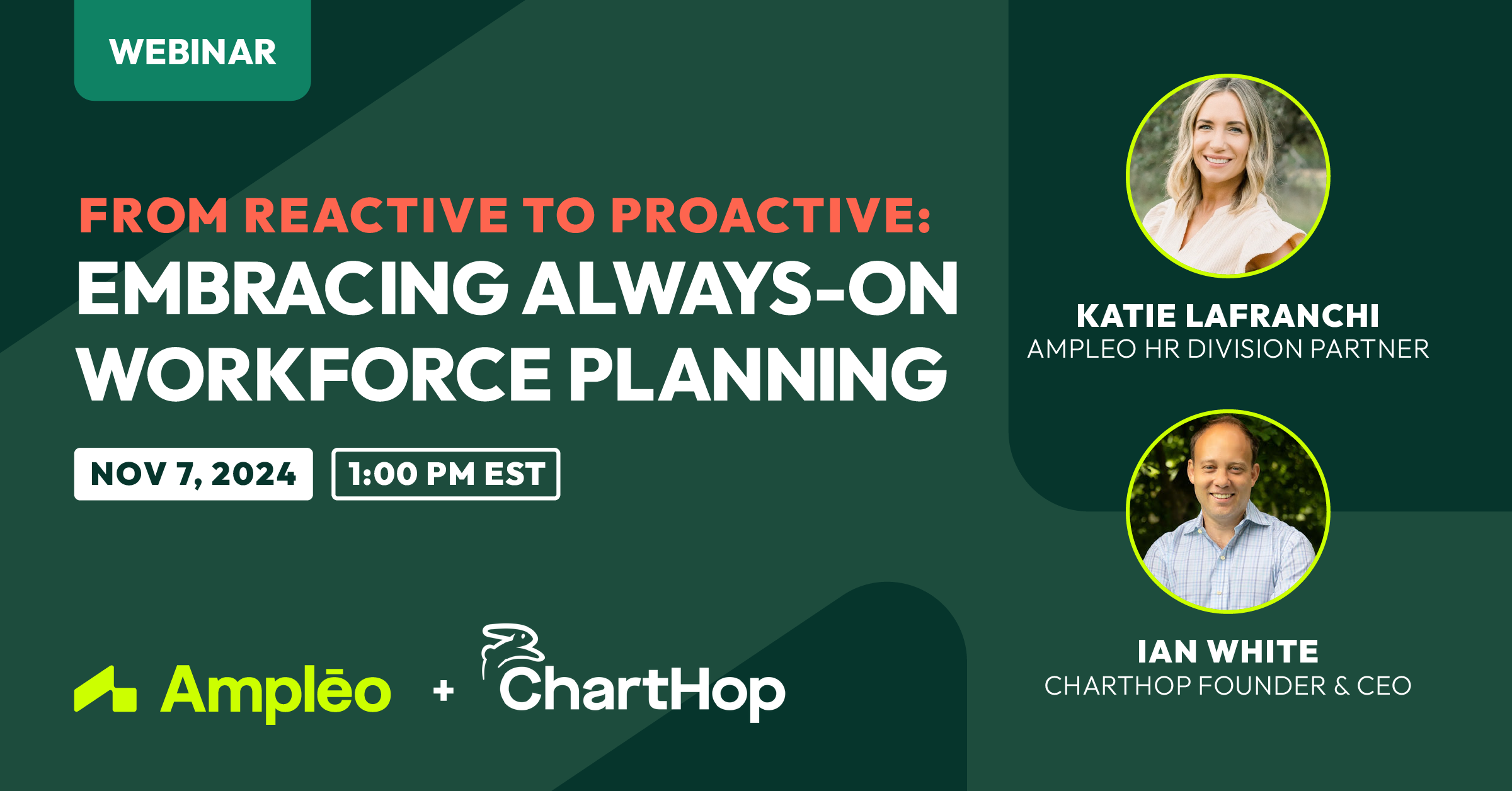
From Reactive to Proactive: Embracing Always-On Workforce Planning
Ready to unlock the full potential of workforce planning?
Watch our webinar, “From Reactive to Proactive: Embracing Always-On Workforce Planning,” hosted by Ampleo and ChartHop.
This webinar will introduce you to the benefits of agile, data-driven workforce planning. Katie LaFranchi, partner at Ampleo’s HR division, and Ian White, CEO of ChartHop, explore how always-on planning can help you stay ahead by optimizing staffing, preparing for future talent needs, and driving team productivity.
What You Will Learn
- Forecasting talent demands in real time
- Analyzing workforce supply and demand to reduce skills gaps
- Using proactive planning for recruitment, training, and succession
Fill out the form to watch the webinar and download the handout.

The Power of Executive Collaboration in Marketing
As a CMO, my goal is always focused on how to drive ROI for the organization. Every day, I dive deep into what marketing strategies will drive revenue for the business. I consider the initiatives that will deliver a strong ROI, and I research the channels that will reach our desired audience. While my role as a CMO is vital to the growth of the organization, so is the role of the CFO and other C-suite leaders. Knowing how to collaborate with other C-suite executives is key to organizational alignment and marketing success.
Let’s talk about the C-suite and CMO dynamic, including how to build trust, how to speak to the team to drive growth, what are important metrics that matter to everyone, knowing when to experiment in your marketing strategies, and more.
How to Build Trust as the CMO
In a study focused on marketing and the CMO, CEOs trust their CFO the most, followed by the COO, CSO (Chief Strategy Officer), and finally, the CMO. Interestingly, CMOs have the shortest tenure of all the C-Suite members. Is this because of lack of trust between the executives or lack of insight into the real return on investment of marketing?
Historically, marketing has traditionally owned creative and storytelling, finding the best story for the customer. Today, marketers are more involved with driving business and growth and certain metrics can help quantify the success of those efforts.
Marketing analytics should shine a light on how marketing efforts are generating revenue for the company and leading to more sales. There are many metrics a marketing team can track (see section below). Most C-suite executives are willing to spend money in marketing when they know how marketing efforts are helping grow revenue.
Traditionally, CFOs and many CEOs come through similar programs—an MBA with an accounting or finance focus. Because of the overlap in the education path, these groups tend to speak the same language, whether it’s using the same deck to present information or looking at financial spreadsheets in the same way.
If you are struggling with building trust with the rest of the C-suite as a CMO, learn to speak their language. If you can do that and get on the same page as everyone on the executive team, it makes it easier to build trust and align on marketing plans. The CEO, CFO and CMOs all want one thing–to generate revenue and profit. As the CMO, you can build trust with the team when you report on the specifics of your marketing efforts, how the budget is being spent, and how your campaigns are helping the business reach ist overall revenue goal. Communication is key and knowing which goals and metrics your CEO and CFO care about can help you prioritize where you spend your time as a CMO.
Collaborating with the CFO
Interestingly only 44 percent of C-suite members say they trust one another. The CFO is one of the executives CMOs should be communicating with the most. Because your CFO is managing every dollar, what you do affects each other. It’s important to nurture this relationship.
In finance, things change quickly.
“What was true 12 months ago for marketing must be totally different 12 months in the future in order to grow quickly,” said Rachel Hofstetter. “Maintaining an ongoing relationship allows you to quickly analyze your efforts.”
Working with the CFO, you can pull customer acquisition numbers on a given day, put them through your forecasting model, and determine how that trend will leave you at the end of the month.
If everyone is on the same page, and if you know early what the forecast will be, you can pull back and change things, or you can lean into something that’s a great trend. As you discuss these outcomes and forecasts with your CFO, you can ask questions like, “What will this do to our cash?” and “What can we play with here?” Especially during high growth, having strong financial knowledge and the ability to pivot quickly is what can drive exponential growth. This can only occur when executive members are on the same page and speaking the same language.
Shared Metrics and KPIs Between Finance and Marketing
According to Rachel, “There are no vanity numbers among executive team members.” So what numbers truly matter?
Let’s talk through an important metric called customer acquisition cost (CAC).
The general idea is “What did it cost to acquire a customer?” and if you want to get really in the weeds, you can break that down to “What does it cost across all of our channels?” or “What does it cost on any individual channel?” Every CMO should know on any individual channel—and probably two levels deeper than that—what it costs to acquire a customer because they’re comparing all the different options of where to deploy their resources.
Customer Acquisition Cost (CAC)
CAC on its own does not tell you a whole lot unless you’re going to make decisions on a margin. Some costs you may consider when developing your margin:
- Marketing and advertising costs
- Sales and marketing salaries
- Technology and tools
- Content creation and management
- Market research
Ultimately you’re answering the question: “What does it cost—all in—to acquire a customer?”
Let’s run through an example. Say your fully loaded sales and marketing budget for a month is $100,000 and you acquire 100,000 customers. You would say your fully loaded CAC—or your all-in CAC—is $1. However, that isn’t the complete picture. For instance, if you acquired a customer for $1, but they only spend one penny per month, or say they spend two pennies per month, but your gross margins are 50 percent, what you net from that customer is one penny per month. Based on those numbers, it will take 100 months to pay back the cost of acquiring that customer.
CAC Payback
To go deeper, let’s focus on CAC payback, which is the entire cost it takes to get a customer with the consideration of how much money you actually get back. Ask yourself, “What do I get in my pocket after the marginal costs for that customer have been paid for?”
Let’s focus on another example. Say a customer gives you $1, but you have to spend $5 providing them a service. At the end of the day, you have $5 left in your pocket. If you paid $40 for that customer, all in, it will take you eight months to get all that money that you outlayed to acquire that customer back in the door. That is CAC payback.
CAC payback is an important metric to discuss with the CFO to show how much ROI you are getting on your marketing spend.
The Power of Post-Purchase Survey
The holy grail for marketing is when you get to the channel-level CAC, and you’re evaluating which channels are driving growth efficiently. This is often very difficult. CEOs, CMOs, and CFOs are all trying to figure out “How do I fund more of what’s working and driving efficient growth, and how do I stop all of the other 50 percent of spend that looks great but doesn’t drive customer acquisition.” Full-funnel attribution is the pinnacle for a marketing leader, and it should be the holy grail for a CFO too.
The question is how do you tackle attribution across channels?
Rachel Hofstetter said during the 2023 Growth Summit “After spending many millions of dollars and working through all the attribution strategies, the thing I found that gave us the most clarity into what was really working—and by that I mean if it told us that something was working, and we put more money and more resources into that channel—is a postpurchase survey.”
When you ask customers how they learned about you, this is a strong indicator of channel success. A survey can highlight channels you might not have realized were being successful, such as PR, or help you better map the customer journey.
Post-purchase surveys are most effective when they are conducted soon after purchase. Providing the findings of your survey to the other executives will help them understand which channels are working.
Knowing When and How to Experiment with Marketing Dollars
Much of marketing is “business as usual,” or doing the things you know are working. Finding the balance between business as usual (BAU) and when to experiment can be challenging. CFOs and CEOs may question experimental tactics, but without testing you cannot determine underdeveloped channels, develop stronger messaging, or find new customers. For a high-growth company, a split of 70 percent of your resources going to BAU and 30 percent going to experimental strategies can be the way to go.
“The reason we experimented so heavily on experimental is because the world changes, and things may work but then stop working, or new, better things become available,” said Rachel.
With a defined amount for both BAU and experimental marketing, there is less friction between executives over new marketing strategies. Rather the focus is on the BAU accomplishments with experimental strategies serving as the icing on the cake.
Finding the right mix for your business will depend upon your organization’s size, business goals, and everyone’s buy-in. However, most of your budget should go toward things that you know are going to perform.
Experimental Marketing Strategies
Like venture capital, you only need a couple of wins to make it all worthwhile. Success can be measured via the metrics set up by the CMO and executive team.
How long should you test an experimental strategy? Again, this can vary depending on your resources, budget, and goals. It will require evaluating the channels you are using and the time it typically takes for a response on that channel. It will also require a deep dive into your sales cycle, and win closed rate cycles.
Your experiment may include the following:
- Trying new messaging
- A/B testing
- Using a different channel
- Scheduling during different times of the year
The key is to continue to collaborate with your CFO to understand the success of your campaigns and know when to pivot. Staying agile will allow you to make changes quickly when necessary.
When a Marketing Strategy Doesn’t Work
611 billion dollars are wasted on poor marketing efforts in the U.S. each year. There are many factors that can contribute to the failure of a marketing campaign:
- The wrong channel
- Not enough money was spent
- The wrong creative for the audience
- Incorrect messaging
- Timing
Before starting any new campaign, build a business case. Research and forecast the following:
- Assumptions from cost per lead to the conversion rate
- The traffic that hits the website
- The eventual cost of acquisition as the customer moves through the funnel
- Any additional details or metrics that will help you determine if this campaign is worth it
By starting with a business case, you can identify aspects you may have missed at the end of the campaign. Was the traffic too low? Was the cost for a unique visitor too high? Was the cost per lead too much? Could it be a conversion problem? Were the leads garbage?
Rachel said, “The times where we found the greatest success is when finance understands that . . . we’re speaking the same language.”
By studying your business case, you can explain to the C-Suite where your assumptions were wrong. And the next time you go test a similar channel, you can review your report and adapt so you’re not just repeating the same mistakes over and over again. Even if a marketing campaign is less successful than you planned, learning together and keeping communication lines open strengthens trust between all members.
Building collaboration between the CMO and other C-Suite executives is vital for building trust and developing strategies that deliver. This requires speaking the same language as the CFO and CEO. It also requires the CFO to hold CMOs accountable to mutually agreed upon metrics. It requires the elimination of suspicion and a relationship in which information is shared openly. When CMOs learn to work collaboratively with the rest of the team, their efforts are better appreciated, their wins are highlighted, and they are awarded additional resources for future marketing campaigns that drive growth. Afterall, growth is everyone’s goal.
This article features information from the “The Power of Marketing and Executive Collaboration When Driving Growth” session at the 2023 Ampleo CFO & Growth Summit.

How to Buy and Transition a Founder-Owned Business
Mergers and acquisitions (M&A)—specifically, those involving a founder-owned business—can be a very difficult process with many potential pitfalls and opportunities for both buyers and sellers. According to Harvard Business Review, approximately 80 percent of M&As fail, justifying the need for extensive collaboration and negotiation before business deals close.
Let’s discuss the intricacies of buying and selling founder-owned businesses, including some of the strategies one must employ, regardless of which side of the transaction one is on. From sources of capital and preclosure considerations to financing options and postclosure considerations, here is a powerful framework for successful mergers and acquisitions.
Sources of Capital
Before diving into the steps needed for successful M&As, it is important for business leaders to understand the sources of capital available to them. When referring to businesses in general, sources of capital can be categorized into internal and external sources. Here are some of the primary sources:
Internal Sources of Capital
- Revenue: The income generated from normal business operations and sales of goods and services. Retained earnings, which are profits reinvested in the business rather than distributed to shareholders, fall under this category.
- Cost Management: Efficient management of costs can free up capital. This includes reducing operating expenses, improving productivity, and optimizing supply chain management.
- Asset Sales: Selling off non-core or underperforming assets can generate capital for reinvestment in core business areas or other opportunities.
External Sources of Capital
Equity Financing
- Stock Issuance: Selling shares of the company to raise capital. This can be done through initial public offerings (IPOs) or secondary offerings.
- Private Equity: Raising capital from private equity firms or venture capitalists in exchange for ownership stakes in the company.
Debt Financing
- Bank Loans: Borrowing money from banks or financial institutions, typically with a fixed repayment schedule and interest rate.
- Bonds: Issuing corporate bonds to investors, which the company must repay with interest over a specified period.
Mergers and Acquisitions (M&A)
Mergers: Combining with another company can create synergies and access to new capital sources.
Acquisitions: Acquiring other companies can provide access to cash flows and assets.
Grants and Subsidies
Funding from government agencies or other organizations that does not need to be repaid. This is often available for specific purposes, such as research and development or sustainability initiatives.
Trade Credit
Delaying payments to suppliers to free up short-term capital. This is essentially an interest-free loan provided by suppliers.
Factoring and Invoice Discounting
Selling accounts receivable to a third party (factoring) or borrowing against them (invoice discounting) to access cash quickly.
Crowdfunding
Raising small amounts of capital from a large number of individuals, typically through online platforms.
In summary, sources of capital can be divided into one of the following categories:
- Internal Sources: Revenue, cost management, and asset sales.
- External Sources: Equity financing (stock issuance, private equity), debt financing (bank loans, bonds), M&A (mergers, acquisitions), grants and subsidies, trade credit, factoring and invoice discounting, and crowdfunding.
Preclosure Considerations
Buyers are in a very strong position in the M&A market, with an abundance of capital, up to $500M, ready to back privately owned businesses. Sellers should leverage their position to find a partner whose goals align with their own rather than just the highest bidder.
For buyers, standing out requires more than just capital. It is crucial to show unique value and establish trust with potential sellers by being honest, asking appropriate questions, and creating value.
Viewing these early negotiations like “dating” to ensure a mutually beneficial relationship can be valuable for buyers trying to acquire additional business entities. Both parties ought to exercise their due diligence to confidently align strategy and vision, setting up a successful partnership.
For a seller, there are several important steps one must take to ensure that they are getting a good deal:
- Leverage a corporate attorney or certified exit-planning advisor. These professionals can do a thorough evaluation of your company and help business leaders understand the fairness of an offer.
- Work closely with an investment banker (or a qualified and experienced business broker for smaller deals) to handle the negotiations. Sellers do not need to accept the first deal offered to them, and a banker can help business owners find the right fit and assist in the financial elements after the deal is closed.
- Utilize a real estate planning attorney. This can minimize any end-of-deal surprises and help business owners receive deserved compensation for the value of their assets.
- Consult with a wealth planner. They’ll help to ensure personal financial planning as well.
Structuring and Financing
When structuring and financing the sale of a business, there are four approaches to consider: cash, seller equity (or “roll”), debt, and earnouts. Each of these options has pros and cons, and both parties need to carefully consider which works best for their transaction.
1. Cash
For sellers nearing retirement and wanting a clean exit, cash transactions are straightforward and provide immediate liquidity. For buyers, however, cash-heavy transactions can limit flexibility and increase opportunity costs.
2. Seller Equity
When a seller wants to retain some level of ownership, seller equity is a potential structuring option. Leaders maintaining this ownership can help align the interests of both parties and foster long-term collaboration. Though oftentimes advantageous for the seller, this can result in reduced ownership for the buyer.
3. Debt Financing
Leveraging debt can be beneficial for the buyer, as it minimizes the initial cash needed to close a deal. However, it can increase the financial burden on the business after the acquisition because of debt repayment obligations.
4. Earnouts
Earnouts link part of the purchase price to the future performance of the business. While this can align incentives, it can lead to complex disputes between parties if performance targets are not being met and may require further deal restructuring.
In addition to these considerations, understanding the difference between an asset purchase and a stock purchase is crucial when making a deal. An asset purchase, often favored by buyers, involves acquiring specific assets and liabilities, offering tax benefits, and reducing exposure to previous liabilities. Conversely, a stock purchase is usually more favorable for sellers as it simplifies the transaction and may offer better tax treatment. The right mix of these two options depends on the goals of both the buyer and the seller, and they both must understand the terms of their agreement to make sure strategic objectives are aligned.
Postclosure Considerations
Shortly after buying or selling a business, ensuring that both parties are aligned on responsibilities and incentives is crucial for success. It is important to have open discussions about compensation, bonuses, control, and other factors before and after finalizing the deal.
One strategy to do this is using a framework like the RACI model (responsible, accountable, consulted, and informed). This framework can help eliminate any confusion about accountability or decision-making and establish clear expectations. Effective alignment on these fronts can facilitate smooth operations and pave the way for shared success.
This article features information from the speakers and presenters at the 2023 Ampleo CFO & Growth Summit.

3 Phases to Successfully Transition and Grow a Family-Owned Business
Over 90 percent of small businesses today are family-owned. Often, companies begin with one generation, and as the original founders prepare to retire, they must make decisions on how to transition the business to a management-led organization.
Navigating through the transition-consideration and implementation stages of a company transition smoothly requires an understanding of how family-owned businesses work. Let’s talk about the heart of a family-run business and the three phases of transitioning a business.
The Heart of a Family-Owned Business
At the core of any family owned businesses are founders who built the company from scratch. Their initial goals, values, and mission are reflected in the employees who helped them grow the business. It is also the connection between their business and the clients they serve. Understanding that transitioning a business requires more than just saying, “Here is your new leadership” will help founders make the transition easier and more successful for the entire company.
As founders begin to think about the possibility of stepping down, it’s important to meet with trusted, key stakeholders who have a foundational understanding of the business and company culture. It’s also important to meet with employees to get their take on what should happen next. Achieving consensus in how to proceed can help ensure the success of the company’s continued growth.
Phase 1: Implementing the Plan and Building Trust
According to a recent study, 40 percent of family-owned businesses are planning to transition in the next five years. However, transitioning a business takes time and doesn’t happen overnight. The first phase of transitioning a business should focus on gaining the team’s trust. Putting employees’ needs first and thinking about how changes will affect their careers will help gain the respect of team members.
This is often the first big hurdle to transitioning the business: building trust. While family issues and business issues intertwine all the time, it is important to separate those issues and make sure that there are decision-makers who are empowered to help move decisions forward.
Here are some ways you can implement the first phase of transitioning your family business:
1. Love what you do.
Employees can sniff out which family members in the business are in it for the paycheck and which ones are in it because they love what they do. It’s important for all of the family stakeholders in the business to truly want to do the jobs they have. This builds a stronger culture of trust within the organization.
2. Be real.
If you’re not real, then your team—who watched the business grow from a single truck 50 years ago to what it is today—will see that. Be honest, transparent, and open with your employees so they know what’s going on and can buy in to change.
3. Be aligned.
Family members may disagree when it comes to making decisions for the business. One person may want to grow, and another might not. It’s important for all family members and the employees to be on the same page. Work together to achieve alignment on decisions.
4. Stay humble.
Never forget where you came from. That sounds very simple. However, often in family-owned companies, family members get caught up in the benefits that the family company can provide. Don’t forget what it actually took to get where you are. Recognize the hard work your employees put into the business to help it get to where it is today. Never forget the contribution of your customers, vendors, and partners that went into the success of the business. Keeping this in mind will help you appreciate what you have and where you’re going.
5. Identify your founder mentality.
In order to move from a family-owned to a management-run organization, employees need to understand the founder’s original goals. Ask yourself, “How will these principles be engraved into the next generation of leaders?” Over time, you may find that your key principles evolve and end up looking slightly different from what your founders originally started with. That’s not a bad thing; you can still be aligned with their original intent.
Implementing your transition plan will come with bumps in the road. Keeping these “rules” in mind will help your team to gain the trust and respect of your stakeholders as you continue to grow and transition the business.
Phase 2: Growth and Restructuring
In this phase, companies are typically facing growth challenges. If your business has become too large to have everyone report to the core leadership team, it’s time to consider restructuring the company with a management team to allow for decentralized decision-making.
On average, only 30 percent of family-owned businesses survive the first-to-second generation succession. A successful transition requires a strategy that will ensure success. Moving decision-making from the founders into the departments and areas that are affected will help your business grow.
In this phase of transitioning your business, here are some key concepts to keep in mind:
1. Stay lean.
As a company performs and does better, it is easy to get excessive and forget those lean days when every paper mattered and every item on the invoices was reviewed. Understanding the importance of being lean can help you accelerate catapulting the business to the next level. Stay tight to help manage growth and expansion sustainably.
2. Take risks.
As the family and business grow, that growth puts stress on the organization. By taking risks and growing the company, you can support additional family members, employees, and changing needs. Be willing to take risks that match your company values, goals and mission.
3. Keep the identity and culture of the business intact.
The culture of a family business is woven into everything that business does. If someone steps in and tries to be an innovative leader doing the latest and greatest thing, there may be pushback from the team. Make sure that those traditional elements that the business was built upon don’t change so much that you lose your cultural identity. There is a reason why your company is successful—make sure you don’t fix things that aren’t broken.
4. Facilitate dreams.
Your employees have the same dreams and aspirations as you do. Your employees want to take care of their families and provide for their own kids and grandkids. Be a facilitator of that. Make that happen. As you build your family-owned business, keep this in mind.
5. Implement a decision-making framework.
As the organization continues to grow, it’s important to know who will make certain decisions. For family organizations, this is one of the areas that can make or break a company. The right decision-making structures with the right team will empower you to make educated decisions as you evolve as a company. Don’t become handicapped by not having this kind of structure in place. Many companies fail because they can’t make the decisions or they don’t know who is going to make those decisions. Ensuring that leaders and employees have the skills to navigate challenges will be a big part of your success.
If you’ve already begun transitioning your business, you’re likely experiencing some growing pains. Keeping these five principles in mind will help you better navigate any challenges that occur.
Phase 3: Ongoing Growth and Transition
As the company grows, it is super important to identify the core leaders. Who is running the day-to-day operations? These are the people who make the boots-on-the-ground decisions every day. These employees need to be aligned with the founders to ensure that decisions match the organizational goals and strategies. Key decision-makers who aren’t aligned with those goals will create roadblocks for future growth. To maintain growth and continually improve the transitioned business, you’ll want to create a pool of core leaders to support change.
Here are four ways to identify and leverage your core decision-makers:
1. Find a good fit.
Here are some questions you might ask yourself as you consider people for your core decision-makers: Do they want similar things in their careers? Do they like how the organization is run? Do they like scrappy and crazy or structured boundaries and frameworks? Being fanatical about fit is so important. When leaders don’t fit, it can cost the company time and money.
2. Promote from within.
There are people in your business who have gone through everything with you. These employees are aware and committed to your organization and don’t have any ulterior motives. When you have the opportunity, choose to promote leaders from within. These workers fundamentally know the organization, and their strategies will better align with the company’s goals.
3. Look for evangelists.
When rolling out something new, sometimes employees may give pushback. By including one of your evangelists (one who really believes in what you do) in the initial discussion, they become the cheerleader for the change, and adoption is insane. A senior leader who can relate to the operator in the plant helps champion your changes better than even you can. Leverage these employees’ talent for helping others recognize the good in change.
4. Build up a team of specialists.
As you build your core team, look for blind spots and gaps and find specialists to fill those roles. These experts will execute on a level that will make things happen. If you can’t hire from within, use the “good fit” strategy to see if a new hire will work well with your existing team. Attracting the right talent for your team can enhance your success.
Focusing on these four items will help you be successful in your move from a founder-led company to a company led by a management team. A core team with the power to make decisions without leadership controlling them or micromanaging them will help the organization grow. This will be vital as you continue to transition the business.
Transitioning a family-owned business to a management-led company is more than just a structural shift: It’s a sensitive transformation that requires a thoughtful and empathetic approach. The legacy of the family, the values that have shaped the business, and the personal relationships with employees and customers all contribute to the company’s unique identity and success. A transition that follows the guidelines above can help build trust, preserve the company culture, and ensure a smoother handover, leading to a thriving business even in the hands of new leadership.
If you are thinking about transitioning your business, reach out to Ampleo. Our experts can help you through each phase as you navigate the financial and HR challenges that go along with it.
This article features information from the speakers and presenters at the 2023 Ampleo CFO & Growth Summit.

How to Define the Right Compensation Strategy
Creating compensation packages for employees requires an understanding of motivational psychology, the talent market, and the company’s goals and resources. Companies need to offer pay and benefits that attract and keep top talent while staying within budget and reflecting individual contributions. However, only 23 percent of companies report having a mature compensation structure. The challenge grows as employee expectations shift and the company expands. To stay competitive, organizations must craft packages that are not only fair but also dynamic.
Let’s define what compensation really is, what motivates employees to perform, and some of the key factors you should consider when creating your compensation packages.
What Is Compensation?
A common misnomer about compensation that many business owners have is that salary alone drives employee satisfaction and retention. “Compensation” refers to the reward you give someone for something they’ve lost.
While some owners believe that salary alone is the reason an individual will work for a company, it’s not the only reason that keeps employees engaged and committed. Other aspects—like benefits, work–life balance, professional development opportunities, company culture, and recognition—also play significant roles in overall job satisfaction. Overemphasizing salary without addressing these other elements can lead to high turnover and lower employee morale, as workers require more attractive rewards in their careers.
Counterbalance in Compensation
Nearly 50 percent of employees are considering leaving their jobs in 2024. Compensation is critical, and retaining valued talent can be costly and complex. However, for every decision you make about compensating employees, there are organizational reverberations to consider.
To identify the right compensation package that will keep your team happy, you’ll need to have some knowledge of the strategy, leadership, management, human motivation, company culture, and financial resources of the organization. Each time you consider how you will compensate an employee, you should ask yourself, “What is the downside of this move?” Every reward has both its strengths and its weaknesses. Let’s discuss this a bit more as we talk about what motivates workers.
Categories of Compensation and Motivation
There are two main types of compensation: remunerative and nonremunerative. Remuneration refers to financial compensation. This can be salary, stock options, bonuses, and other payouts that have financial benefits. On the other hand, nonremunerative compensation contributes to an employee’s overall satisfaction and well-being. This could be receiving a title, flexible hours, a company gym, or training opportunities.
As you consider how to compensate your employees, you will need to understand their motivations. Will they perform better with remunerative or with nonremunerative rewards? Or do they prefer a combination of the two?
Beyond financial versus nonfinancial compensation, employees are also motivated by both intrinsic and extrinsic rewards.
Intrinsic Motivation
Intrinsic rewards are intangible benefits that employees gain from their work, often related to personal satisfaction, achievement, and growth. Here are examples of intrinsic rewards employees might seek:
- Career advancement
- Autonomy over work tasks
- Contributing to society
- Positive feedback
- Being part of a team
- Making a difference
- Opportunities for creativity
- Developing skills
- Sense of pride
Intrinsic rewards magnify energy, effort, output, and strategic thinking in employees. Employees who are intrinsically motivated are 32 percent more committed to their jobs. But too much emphasis on intrinsic rewards can feel transactional and reduce self-regulation for your team. These types of rewards work best in a complex, innovative, creative, and rapidly changing environment.
Extrinsic Motivation
Extrinsic rewards are tangible, external incentives provided by an employer to motivate employees. These rewards typically offer direct, measurable benefits and can significantly influence an employee’s satisfaction and performance. Here are examples of extrinsic rewards employees might seek:
- Salary/wages
- Bonuses
- Commissions
- Profit sharing
- Stocks
- Insurance benefits
- Gift cards
These kinds of rewards can help with recruiting the right talent and encouraging competitiveness among employees. However, they reduce creativity and energy in complex problem-solving environments. These types of rewards work best in a mature environment that are simple-task based with a focus on efficiency.
Timing for Compensation Disbursement
Failure to reward employees for performance is one of the top five reasons why employees are leaving companies. The timing of when to compensate is an important factor when rewarding these employees. Pay out a reward too quickly and it can reduce motivation. Drag out compensation and employees feel disconnected to the task they were rewarded for. Finding that sweet spot for the timing of disbursement depends upon the complexity of the task and the working environment.
A delayed disbursement can reduce productivity in employees who have simple tasks such as laying cement. If you wait too long, they feel their efforts were wasted and won’t connect the compensation to the work they completed. However, in a complex task environment such as a rocket launch for NASA, a delayed reward keeps the team on task with a long-term view of their vision and goals.
Understanding the timing of disbursement is an important factor to consider when building your reward strategies. Plan your timing accordingly so employees feel valued but also feel motivated to continue to work on future tasks or long-running projects.
Individual vs. Team Compensation
While every employee wants and deserves to be compensated individually for their hard work, there are environments in which it is more strategic for leaders to consider compensation that motivates employees to work as a team. This works well for sales, product development, long-term projects, and service departments. These packages reward the team’s overall performance and encourage cooperation, shared goals, and mutual support among team members. Here are examples of team-oriented compensation packages:
- Project completion bonus
- Team performance bonus
- Group achievement award
- Team outing
- Celebration parties
As you consider what you are trying to motivate your employees and teams to do, ask yourself the following questions:
- Will this create competitiveness between members? Is that a good thing or a bad thing?
- Will this drive innovation or stifle creativity?
- Will this improve accountability or cause team members to pass the buck?
Again, remember that each decision you make has a counterbalance within the organization. Be sure to consider all sides before implementing a new compensation structure.
Designing the Perfect Compensation Structure
Companies that have the right compensation plan see a 53 percent decrease in their employee turnover rate. What is the perfect compensation strategy? It’s the one that fits your organizational culture, doesn’t strain your financial resources, recruits the best and brightest talent, and motivates employees to give their best. The moment you hire a new employee is the best time to understand what motivates them. What drew them to you in the first place? Was it the salary? Did they request additional vacation time as part of their offer? Did they ask about your company culture? Did they ask about potential for growing with the organization? These are strong indicators of what will motivate them in the future.
A company with a strong compensation strategy will consider both financial rewards and nonfinancial rewards, pairing a fair salary with a positive employee experience. To attract new talent from a competitive pool, focus on differentiation, whether it’s offering employees more opportunities to make an impact in their community, work with a fun-loving, hardworking team, or access to fun company perks like a soda machine and ping-pong table.
You cannot align your rewards if you don’t know your people. Understanding what motivates them both intrinsically and extrinsically, knowing when to reward them, and recognizing when to motivate the team or the individual will ensure that you’re delivering compensation that keeps attrition rates low and delivers strong performances from team members.
This article features information from the speakers and presenters at the 2023 Ampleo CFO & Growth Summit.

3 Levers to Boost Enterprise Value
Prioritizing a company’s enterprise value is key to all aspects of the business—including enhancing its financial condition, influencing culture, driving sustainable success, and maximizing the future selling price. However, boosting enterprise value is easier said than done—not to mention how time-consuming it can be. It’s a common question in entrepreneurship: How can business owners create value for their business in the most effective, profitable, and beneficial way?
In this article, we’ll summarize some of the takeaways Jeremiah Jewkes presented at Ampleo’s 2023 CFO and Growth Summit for why a merger and acquisition strategy is a powerful tool that can supercharge enterprise value, as well as three key levers that can help you boost the value of your M&A plan: utilizing debt in your favor, creating revenue and cost synergies, and developing a valuation multiple. Let’s dive in.
Why Use M&A to Increase Value
Deploying a merger and acquisition strategy is one powerful way business owners can create value for their companies, especially in middle-market businesses. According to EY-Parthenon, there is a strong positive correlation between M&A and enterprise value and total shareholder return. Frequent M&A activity can not only generate tremendous value quickly but also provide an alternative to slower growth strategies, such as hiring new sales reps and sales teams.
For example, let’s say Business A has $1M EBITDA and a value of $10M. Business A acquires a smaller company, Business B. If Business B has $0.5M of EBITDA for 4x and a purchase price of $2M, it would generate an additional $3M of value for Business A. After the acquisition, in total, Business A would have a value of $15M, all generated by buying one company.
Beyond simply making acquisitions, business owners can capitalize on mergers and acquisitions to accelerate their enterprise value by strategically using three additional levers. Here’s how.
1. Use of Debt in the Acquisition
Companies can accelerate the value of an acquisition by using debt to fund the purchase price. Instead of using cash from operations or equity, using debt can help you generate more value without using the capital of your business. This is a cheaper option for a company than equity, partly because it doesn’t require issuing shares.
Imagine that Business A either partially or fully funds the $2M purchase price of Business B with debt. In this case, if Business A decides to sell the business five years later, it can generate arbitrage value without deploying its own capital.
2. Revenue and Cost Synergies
Similarly, making strategic acquisitions that fit your vertical and complement your business can help you create revenue synergies that boost enterprise value. In this case, your company can offer value at every stage of the cycle to find new customers, increase the cost of your services, and generate revenue.
When you achieve this, each dollar of sales is enhanced by scale, pricing power, and cross-selling other products, driving more value than you originally paid for. Revenue synergies are often seen in healthcare. For example, dental practices often aggregate to increase the value of the fillings they offer, enabling them to charge more for their services because they are a bigger organization.
Cost synergies can work in a similar way as revenue synergies to reduce costs and increase the value of acquisitions. Identifying and eliminating duplicate systems, contracts, and employees is a powerful way to dramatically increase EBITDA and maximize the benefit of your acquisition.
3. Valuation Multiples
This is the holy grail of value creation. Multiples compare a company’s earnings and cash flow to its enterprise value, providing a great measurement to concentrate on throughout the M&A process. With valuation multiples, every dollar of earnings could be worth 11 or 12 times more, all depending on the value your business offers to the buyer.
For example, a combined business may be worth more than 10x EBITDA due to its scale, strategic relevance, scarcity, or influence. Scale has value in the marketplace, as big companies are often worth more than smaller businesses. Similarly, strategically offering more service lines or changing the competitive landscape can multiply the value of your business, enabling you to utilize a valuation multiple increase. That is multiplicative in terms of the impact on the business.
Maximizing the value of a merger or acquisition to drive the most enterprise value for your company requires careful consideration and expert guidance. At Ampleo, our team of seasoned consultants is equipped to help you navigate through the complexities of enterprise value and M&A, driving your business toward explosive growth.
Reach out to us to start increasing your enterprise value today.
This article was written based on the session conducted by Jeremiah Jewkes at Ampleo’s 2023 CFO & Growth Summit.

Unleashing the Power of AI: Transforming Your Business for Success
You can’t watch the news, have a discussion at the company watercooler, or browse articles online without hearing some talk on AI (artificial intelligence). What is AI? A basic definition is machines perceiving, synthesizing, and inferring information. Much of the discussions centered around AI these days is focused on generative AI, which outputs information in a way that feels convincingly human. One reason for all the increased chatter about AI is the quality of output from these platforms. What once felt clunky now feels much more real.
As AI becomes more intelligent and its outputs become more human, organizations need to carefully consider whether implementing AI into their business strategies makes sense. To understand this conundrum a little more, let’s talk about what you need to know when making this decision, including how AI works, what it can do, the challenges you may face as you consider AI, and some steps to take when implementing.
What Can Generative AI Do?
Today, generative AI can do many things, including the following:
- Generate code or open text
- Generate images
- Generate music
Organizations are using AI to generate code for website designs, compile images for marketing, write music for reels, and create copy for content purposes. Some popular generative AI options include ChatGPT, Gemini, Midjourney, Stable Diffusion, and MusicLM. These tools are improving efficiency and driving creativity in business, with 89 percent of employees saying that implementing one of these tools can improve their workload.
How Does Generative AI Work?
Understanding how AI works is imperative to understand how to leverage it within your business. At its core, AI platforms are complex statistical models designed to predict what’s next. For instance, if you input a prompt into ChatGPT that says, “Finish the sentence ‘I like to eat,’” the response generated might be “I like to eat a variety of cuisines from around the world.” The platform predicts what it thinks you might want the response to look like.
What makes AI so powerful is that it has access to incredible amounts of information. It is estimated that the training data for platforms like ChatGPT have billions to trillions of words in their database (about 570 GB). They also have incredible computational power, allowing AI to get smarter and make better suggestions. With ongoing human feedback, these platforms are constantly refining their models, implementing rules to help block harmful responses, and improving responses that better match input requests.
What Are the Challenges of AI?
AI seems very shiny and new and can be very enticing to businesses looking to improve efficiency, drive creativity, or enhance their competitive edge. However, AI comes with a unique set of challenges that you need to understand before moving forward.
- Hallucinations. These are AI-generated responses that are untrue or misleading, such as a ChatGPT response that indicates you gave a TedTalk or have been quoted in the New York Times. AI models are often compared to an incredibly eager intern who doesn’t know how to say, “I don’t know.” This means a human must review outputs to ensure the authenticity and accuracy of information.
- Bias. Because the data in AI is trained, societal biases can be built into the data. Again, the human eye is required to remove any bias in outputs.
- Data Governance. One of the most worrisome things about AI is what is done with the information we put into the software. While inputting our favorite breakfast dishes might not require privacy protection, sensitive customer data does. Understanding how our data is stored and used needs to be more clearly understood.
- Computing Power. Smaller startup AI platforms will have less computing power and less capital to improve training of their AI. This can cause issues with incorrect outputs and problematic data. Consider this when choosing an AI tool for your business.
- Unknown Future Costs. Currently, most AI platforms are offering their software at low prices, but because of the capital required to generate information, those costs may skyrocket at some point. Who will bear the burden of those costs in the future? We don’t yet know.
These challenges should not deter you from embracing AI but rather help you make a more informed choice about which AI may work for your organizational goals. Let’s take a closer look at some of the organizations currently in the AI landscape.
Who Is Designing AI Platforms?
If you’re considering implementing AI in your business, there are four categories you’re likely to run into.
- AMG (the Clouds). These are the major cloud service providers like AWS (Amazon Web Services), Microsoft Azure, and GCP (Google Cloud Platform) that are implementing AI. The advantage of this option is the size of information they have access to. The disadvantage is that these organizations seek to lock you into their platform, making it difficult to move data from one cloud to another.
- Meta. Meta is an open-source AI platform that allows you to integrate with other platforms you might be using. The challenge here is that you need to have a team of experts who understand integration or who can leverage the existing code with any new code you need written.
- Legacy SaaS. These are ERPs (enterprise planning tools) like Epicor and CRMs (customer relationship management tools) like Salesforce. Through AI, many of these platforms can now help you mine additional information from your data, helping you make more informed decisions. The disadvantage is that moving that information and those insights into a competing platform can prove difficult, leaving you locked in.
- Startups. You likely hear of new AI players entering the market on a daily basis. While this breeds creativity and agility, the challenge is that AI requires a great amount of capital and talent, and many of these new companies fail before they even get started. This makes it challenging for organizations that implemented their software early and are left hanging.
What does this mean for your organization? It means that you need to carefully consider which tools are right for you and your business goals. We’ll talk more about that in a bit.
How to Build AI into Your Business
In 2024, 77 percent of companies are either implementing AI into their business or are considering it. For C-Suite executives and decision-makers, it’s not about finding the perfect tool—it’s about asking the right questions. Let’s discuss some of the important questions you need to answer before implementing AI.
1. Should Your Organization Restrict AI?
To answer this question, you’ll need to understand the following:
- Legal implications. Does your industry have specific compliance requirements that will force you to restrict AI? If yes, then help your employees understand this as you restrict AI.
- Employee compliance. How likely are restrictions to actually work? Does your workforce need additional training to understand the importance of compliance?
- AI tools with guardrails. Are there AI options that you can leverage to meet your employees’ desires for creativity but that have some limitations or built-in restraints?
- Leveraging creativity and efficiency. Can our employees implement AI to improve efficiency in their workload?
Unless you have to meet strict compliance regulations, keep an open mind when it comes to implementing AI. The popular saying goes, “I choose a lazy person to do a hard job. Because a lazy person will find an easy way to do it.” Use your employees to find those efficiencies. They have a ground-level view of productivity pain points you might not see. AI can often answer those inefficiencies.
2. What Should We Do with AI?
So you’re thinking about implementing AI but not sure how to use it. Consider the following to determine how you might leverage AI in your business:
- Think outside the chatbot. As you review your tech stack, are there core problems not being addressed? Is there an AI answer for that issue?
- Narrow scope, clear goals. For stronger buy-in from employees and key stakeholders, consider how you can prove the value of the AI you implement whether through reports, ROI, etc.
- Iterable. Avoid spending capital on dead ends. Rather, promote AI projects that have promise.
- Integrate with strategy. Select AI that is closely aligned with core business strategy and tied to revenue or AI really won’t help you.
The key is to be agile and consider the tools that align with your industry and your goals. AI should not be a one-off tool that does little to improve your bottom line or efficiency.
3. How Should We Integrate AI?
Now that you’ve identified your AI project, let’s talk about putting it into action and some things you need to watch out for:
- Identify your risks. It’s imperative to keep a pulse on the reglatory environment. Will you be liable if something you share has a copyright issue or includes a bias? Some AI platforms will take responsibility while others may not—leaving you holding the bag.
- Understand your data. Output is only as good as the inputs. Make sure your data is clean, organized, in the right place, and ready to be fed into the AI model you’ve chosen. If you’re not currently collecting the data you want to analyze, start now!ostp/ai-bill-of-rights/
- Build vs. buy. Knowing when to build your AI system and when to buy it will depend upon your resources, how much risk you want to take on, and who owns the data. Do your homework before landing on a solution.
- Plan to fail. Failure can be a powerful learning experience. Define what failure may look like and how you can ensure you learn from those mistakes.
Now that you’ve prepared for implementation, let’s talk about what’s next to put AI to work for your business.
4. What’s Next?
By now you should feel more confident in your decision to implement AI. AI can be a great ally in executing your strategic plan. There are a few key things you’ll want to remember as you add AI to your technology stack:
- Humans required. While AI is becoming increasingly powerful, you still need a human eye to ensure you are getting the quality outputs you desire. Whether it’s a chatbot response to a customer request or an AI-generated image for a company video, it’s up to your team to maintain the tone of voice, authenticity of the brand, and accuracy of the information shared.
- Minimize anxiety. Gallup reports that 22 percent of employees are concerned that AI will replace their jobs. Make sure you are open about your AI strategies with your employees. Convey to them that you aren’t replacing humans with AI but that you’re improving their workload by implementing AI.
- Stay abreast of trends. The landscape of AI is ever changing. Stay ahead of those trends! Those who learn and adapt to AI quickly will have a competitive edge with first-mover advantage.
AI can be a powerful tool for organizations that understand what it is, how to implement it, and how to overcome the challenges that come with it. If you’re wondering when a good time is to start implementing AI, the answer is now! Educate yourself on the current AI landscape, determine what AI tools may alleviate your company’s efficiency or creativity roadblocks, and then determine if AI is right for your business.
This article was written based on the session conducted by Nick Pelican at Ampleo’s 2023 CFO & Growth Summit.

Do You Really Need a CMO? The Surprising Truth for Businesses on the Rise
In the bustling corridors of the business world, the allure of executive titles often seduces companies into believing they need a full suite of full-time C-suite officers from the get-go. Among these coveted roles, the chief marketing officer (CMO) stands out as a beacon of brand growth and market penetration. However, for many early and growth-stage companies navigating the choppy waters of expansion, the conventional wisdom dictating the necessity of a CMO might just be overkill.
Before you make the call to hire a CMO, let’s dive into the nuances of the idea that a full-time CMO is the only option. By taking a closer look at the options for marketing leadership and challenging the status quo to explore smarter, cost-effective alternatives for businesses, you ensure you hire the right person with the right amount of expertise and experience for your company.
The CMO Conundrum: A Closer Look
Before you rush to post that CMO vacancy, pause and reflect. The decision to appoint a CMO should not be taken lightly, given the significant financial and strategic implications. The average annual salary for a CMO sits at $350,000, not to mention the added expenses of benefits, bonuses, and equity packages. For many burgeoning businesses, this investment could represent a disproportionate chunk of their budget, diverting crucial funds from other vital areas.
Key Questions to Gauge Your CMO Needs
In a study conducted by McKinsey & Company, 30 percent of CEOs believe that marketing is the “North Star” in defining a brand and its reputation. To determine if your organization would benefit from a CMO who can point the business to that “North Star,” consider the following questions:
- What are your current marketing needs and goals?
- Do you have a comprehensive marketing strategy that requires high-level, executive oversight?
- Can your marketing objectives be met through other means or roles?
- What is the size and complexity of your market and product line?
- Are you prepared for the financial commitment of a full-time CMO?
These are powerful talking points for deciding if and when you are in need of a full-time CMO. To help you understand if your company is ready, let’s dive a little deeper into some options for engaging a CMO.
The Fractional CMO: A Game-Changer for Growth-Stage Companies
For many young companies in the $3–40 million revenue range, the concept of a fractional CMO can be a game-changer. This model allows businesses to leverage the expertise of a seasoned marketing executive without the full-time price tag. A fractional CMO can provide vital strategic direction, mentorship to your marketing team, and oversight of critical projects, all while keeping your overhead cost in check.
The Cost-Benefit Analysis
Hiring a full-time CMO can be a hefty financial commitment, but opting for a fractional CMO can significantly reduce costs while still injecting your marketing efforts with high-level expertise. This approach not only makes financial sense but also offers flexibility, allowing your company to scale marketing efforts up or down based on actual needs and growth phases.
Alternative Paths: Marketing Directors and VPs
As of 2024, the average Marketing Director salary in the US is around $186,000, while a CMO salary ranges around $357,000. For many companies on the rise, the smart money is on hiring a marketing director or vice president (VP) of marketing rather than a full-fledged CMO. These roles can offer more bang for your buck, providing hands-on leadership and strategic insight without the C-suite price tag.
Why Marketing Directors and VPs Can Be Your Best Bet
Not sure about leveraging a marketing director or VP? Here are some benefits to consider:
- Cost Efficiency: They command lower salaries than CMOs but can deliver substantial strategic value.
- Flexibility and Focus: These roles can adapt quickly to changing market conditions and company needs, focusing intensely on execution and results.
- Building from Within: Promoting to these positions internally can boost morale and retain talent by offering clear career progression paths.
Still mulling over whether a CMO is a good fit for your organization? Let’s discuss organizational structures a bit to understand how they might look under different scenarios.
Organizational Structures
Let’s visualize how your company’s marketing team could look with and without a CMO:
- With a CMO: The marketing team is led by the CMO, with VPs or directors of specific areas (such as digital marketing, product marketing, and communications) reporting directly to them. This structure is typically suited for larger, more complex organizations with diverse product lines and global markets.
- Without a CMO: The marketing team is led by a VP or director of marketing who oversees various managers responsible for specific marketing functions (SEO, content marketing, social media, etc.). This leaner structure can be highly effective for growth-stage companies, focusing efforts on strategic growth areas without the overhead of a CMO.
The Verdict: When to Consider a Full-Time CMO
Hiring a full-time CMO should not be a knee-jerk reaction but rather a strategic decision made at the right time under the right circumstances. Here are the conditions that make sense for a full-time CMO hire:
- Your company operates in a highly competitive, global market requiring sophisticated, multichannel marketing strategies.
- Your business has reached a revenue threshold where the return on investment (ROI) from a CMO’s leadership justifies the cost.
- You have a complex product line or service offering that necessitates high-level brand positioning and customer segmentation strategies.
As you look toward your future, consider your marketing goals. This will largely determine the type of CMO you will need to achieve those aspirations.
Conclusion: A Bold Move Forward
Rather than buying into the idea that every company should have a full-time CMO in order to achieve its marketing objectives, take a step back to review your current business plan and your goals for the future. In many cases, the roles of marketing director or VP of marketing, supplemented by a fractional CMO approach, can provide the strategic oversight and execution prowess needed to propel businesses forward.
By challenging the conventional wisdom and embracing a more nuanced approach to marketing leadership, companies can navigate their growth phases more effectively and sustainably. Rather than being seduced by titles, let’s choose to be driven by strategic, cost-effective decisions that bolster our businesses for the long haul.
Speak with One of Our Incredible Fractional CMOs
Is your business ready for growth and looking for a fractional CMO? By opting for an Ampleo fractional executive, you eliminate ambiguity, enhance accountability and transparency, and implement a strong business strategy to propel your ambitious marketing objectives. Instead of investing significant time and resources in searching for a full-time employee—which can be time-consuming and costly with potential missteps—consider engaging a leader with decades of experience on a part-time basis. Contact us to speak to an Ampleo Partner today!

The CMO Revolution: Steering Companies into the Future
In today’s rapidly changing business environment, the role of chief marketing officer (CMO) is evolving. Expanding far beyond the smoke-filled meeting rooms depicted in Mad Men, where men in suits strategized ads for print, radio, and TV, the role of the CMO has grown into something much more pivotal.
As marketing initiatives and approaches become more customer centric, the role of the CMO must also change. It’s not just small changes for these C-Suite executives. Ninety percent of CMOs report seeing a significant change in their roles. No longer just the head of marketing, CMOs now lead out in enhancing brand perception, driving strategic direction, and even supporting the survival of the company.
As we consider what it takes to build the Don Drapers of the future, it’s important to understand how the CMO’s responsibilities have evolved, why they must learn to work with other C-suite executives, and what it takes to lead. In this article, we’ll discuss this evolution and why the CMO might just become the most crucial player in the C-suite.
Beyond Marketing: The Expanding Realm of the CMO
Traditionally, CMOs were seen as the leaders of the marketing team, tasked with managing budgets, crafting advertising campaigns, and, perhaps most importantly, making sense of market research. However, this view is rapidly becoming outdated. In a recent study performed by Deloitte, 50 percent of the survey respondents indicated that they lead 11 or more areas of marketing. That is an insightful glimpse into the expanding role of the chief marketing officer.
The CMO of the future navigates four critical arenas:
- Leading the marketing team and managing resources: While this remains a core responsibility, the scope and complexity of what this entails have expanded exponentially.
- Market and customer research and insight: This is no longer just about understanding who the customer is but predicting what they will need, often before they know it themselves.
- Defining the marketing strategy and plans: Today, this involves a blend of art, science, technology, and psychology.
- Working with the rest of the C-suite in leading the company: Perhaps the most significant evolution of the role, CMOs are now vital in steering company strategy alongside CEOs, CFOs, and CTOs.
The New CMO: A Bold Vision for the Future
To understand the future role of the CMO, it’s essential to recognize the transformative forces at play in the global business environment. Digitalization, data analytics, artificial intelligence, and changing consumer behaviors are not just influencing marketing strategies but are reshaping entire business models. In this context, CMOs are not just marketing leaders—they are business visionaries.
Strategic Visionaries and Data Wizards
The CMO’s role is becoming increasingly data-driven. With access to vast amounts of data, CMOs are expected to glean insights that can inform product development, customer experience, and even operational efficiencies. The average spend on data analytics within the marketing budget hovers around 6.5 percent. Leveraging the information from analytics requires a deep understanding of data, consumer psychology, and technology trends. The CMOs who can master this trifecta will not only predict market shifts but will also play a crucial role in leading their companies through them.
The CMO as the Customer’s Champion
Consumers are 3.5 times more likely to purchase goods or services from a business after a positive customer experience. In a marketplace where customer experience can make or break a company, CMOs are increasingly taking on the role of the customer’s champion. This involves a deep dive into customer needs, behaviors, and expectations, often leveraging advanced technologies like AI to personalize experiences at scale. It’s about creating a customer-centric culture within the organization, ensuring that every decision is made with the customer in mind.
Bridging the Gap Between Technology and Humanity
As technology becomes more integrated into our lives, there’s a growing need for companies to maintain a human touch. With 94 percent of marketers implementing some form of AI in their marketing efforts, this is where a CMO shines. They are uniquely positioned to bridge the gap between technological advancements and human experiences. By understanding the human element behind the data, CMOs can ensure that technology serves to enhance rather than detract from the customer experience.
The CMO–C-suite Symbiosis
One of the most significant shifts in the role of the CMO is their increasing involvement in overall business strategy. The lines between marketing strategy and business strategy are blurring, with CMOs now playing a key role in product development, market expansion, and even mergers and acquisitions. In fact, organizations that align marketing and product functions achieve 19 percent faster revenue growth and 15 percent higher profitability. This requires a new level of collaboration with other C-suite executives, blending marketing insight with financial, operational, and technological perspectives.
Not Just Support, but Leadership
The traditional view of marketing as a support function is outdated and can leave potential revenue on the table. How much performance improvement can a CMO bring to a company? How about 15 percent better than companies who do not have a CMO? In the future, businesses that treat their CMO as merely the head of a support department will likely find themselves outpaced by competitors who recognize the strategic value of this role. CMOs are not just supporting the business: They are critical to its strategic direction and, ultimately, its success or failure.
Conclusion: The Future Is Now
For businesses looking to thrive in an uncertain future, reevaluating the role of the CMO is not just advisable—it’s imperative. The CMOs of the future will be visionaries, technologists, strategists, and, above all, leaders. They will not only predict the future—they will create it. For business owners, the message is clear: empower your CMO, integrate them into the strategic heart of your company, and watch your business transform.
The future of business is not just about selling a product: It’s about creating value, understanding customers on a deeper level, and navigating the complex interplay between technology and humanity. In this future, the CMO is not just a role—it’s a revolution.
Speak with One of Our Incredible Fractional CMOs
Is your business ready for growth and looking for a fractional CMO? By opting for an Ampleo fractional executive, you eliminate ambiguity, enhance accountability and transparency, and implement a strong business strategy to propel your ambitious marketing objectives. Instead of investing significant time and resources in searching for a full-time employee—which can be time-consuming and costly with potential missteps—consider engaging a leader with decades of experience on a part-time basis. Contact us to speak to an Ampleo Partner today!
The Earlier You Call, the More Options You Keep.
Some of what's here you can act on today: run the 13-week cash flow forecast, open the conversation with your lender, figure out where you actually sit on the insolvency continuum. Some of it will tell you it's time to bring in outside help. Either way, the goal is the same: a clear, credible plan in place before creditors, your board, or the court build one for you.
Dealing with more than a cash crisis? Amplēo's Finance, HR, and Marketing teams publish their own resource libraries, worth a look if your business needs to stabilize more than one function at once. For definitions of terms like receivership, insolvency, or Chapter 12, see our glossary.
Common questions about these resources.
Free guides, checklists, and case studies for business owners, lenders, and attorneys navigating financial distress.