



Real advice from people who've done the work.
Advice grounded in experience from the experts inside 13,000+ businesses.
Everything we publish comes from people who are actually doing this work. You won't find generic business advice here. You'll find specific, useful content from finance leaders, HR directors, marketing experts, and turnaround specialists who bring real experience to businesses like yours.




All Insights
Explore by Category

Access to Capital
THE BEST OF TIMES, THE WORST OF TIMES
This variation of the well-recognized phrase applies not only to Dickens’ comparison of the conditions in London and Paris in his classic novel A Tale of Two Cities but also to a comparison of the two vastly different “markets” present in the startup ecosystem in Utah (and nationwide).
On one extreme, some technology companies are growing at double and triple-digit rates, raising mounds of equity at insanely high valuations and basking in the attention and adoration of the national business news media. A select few have even magically transformed themselves into bona fide “unicorns”, with $1 billion-plus valuations and celebrity status that rivals or exceeds that of the State’s top performers or professional athletes. These businesses have little trouble attracting top talent, even within the disciplines that are in high demand and hard to find, with their offers of higher-than-average comp plans, valuable stock options, free meals, flexible schedules, and numerous other perks.
At the other end exist myriad entrepreneurs with talent, great ideas, passion, and a burning desire to be a successful business owner, even the next unicorn. If you ask them what they need, most will reply with one word, “capital” – the fuel to propel their “rocket” into orbit. History, however, teaches that there is more lacking than just capital. The truth is that many suffer from “unconscientious incompetence” (Chuck Coonradt’s apt moniker for “they don’t know what they don’t know”) and in some cases; they aren’t willing to acknowledge it or ask for help. Without the right acumen and experience, the capital (almost regardless of the amount) will not lead to success – rather it will lead to a series of starts, stops, pivots, and strategy & product modifications until there is too little left to fund a successful strategy that may have been discovered in the preceding months/years of trial and error.
In the middle are businesses that actually have a product, are gaining or are trying to gain customer traction, and have a reasonably clear pathway to growth and profitability. However, like the would-be startup entrepreneurs, many will tell you that they lack the capital to take their business to the “next level” but by now, many have realized that they need help and are looking for the talent to augment their team, but here again, capital comes into play because in many cases they cannot afford all of the talents that they need when they need it.
The lure of entrepreneurism and the imagined success has spawned multiple incubators, accelerators, shared office spaces, and entrepreneur groups promising training, mentorship, business acumen, and access to capital among other things to improve the chances of success for a small cost and, in some cases, a bit of your company’s equity. We’re not being critical of these groups, in fact, we think that they can offer real value but they typically are not the “end all” solution for start-up success – especially for those businesses slogging through the “middle” stages of the spectrum.
So now we ask, what is an entrepreneur to do? Great question and one for which we don’t claim to have all of the answers but we do have a few ideas based on our observations over the years.
First and foremost, in my humble opinion, the attitude of the entrepreneur is key. One of the ways to quickly evaluate one’s attitude is to observe how she/he views challenges or constraints – they can either be seen as the roadblock that we cannot overcome without outside help (i.e., capital) or they can stimulate us to achieve more and can be an impetus for a better outcome by framing how we view them. I read a great example of this recently in a story about Audi’s desire to win LeMans.
“In the mid-2000s, Audi’s focus was on winning the 24 Hours of Le Mans, but the engineering teams, like their competitors, had already focused on the speed of their cars and conducted endless wind tunnel experiments to create vehicles so fast they exerted two tons of downward thrust. Rather than frame the challenge in terms of speed, the question posed by the chief engineer was “How can we win Le Mans with a car that can go no faster than anyone else’s?” That question couldn’t be answered with wind tunnel experiments. Instead, the engineers realized that it is possible to win Le Mans in those circumstances if you pull into the pits less often, and the solution they found was diesel technology. The resulting R10 TDI went on to win the 2006 24 Hours of Le Mans, and was the first diesel vehicle ever to win the race.”
Let’s relate the reframing process to a typical startup’s constraint or challenge of having insufficient capital to engineer and manufacture or program a “minimal viable product (MVP)”. If we only look at the problem as a lack of capital, we may never find a solution. On the other hand, if the problem is reframed as, “how do we achieve MVP status without extra capital?” it opens our eyes to other opportunities such as strategic partnering with another company, using equity to compensate a freelance programmer, learning to code during my off hours and relying on other lean startup concepts to find a way to “bootstrap” to a solution.
I call this kind of attitude being “scrappy” and we love scrappy entrepreneurs. I’ve worked with many of them – Rick Alden (Skullcandy), Jason Ellis (Spring Mobile), Greg Warnock (vSpring / Mercato), Dusty Zundel (Signature Products Group), Michael Sneddon (MultiLing), Paul Allen (Ancestry.com) and Jeff Kearl (Stance) to name a few. All of them faced seemingly insurmountable challenges at some point during the early stages of their businesses, including a lack of sufficient capital to grow the business. The common thread is that each of them found creative ways to reframe and overcome the constraints and ultimately, built highly successful businesses with their teams.
The experiences of these and other successful current and former clients have taught us that entrepreneurs/founders control more than they usually realize and you don’t always need outside capital to solve your problems (Spring Mobile, Signature Products Group, and MultiLing did not raise outside capital until they had achieved significant growth and profitability and if/when they did, it was to accelerate growth).
The next (and final for this post) essential attribute is humility (aka the antithesis of pride). By this, I mean the ability and willingness to admit when you are wrong or have made a mistake or when you don’t know what to do and to ask for help. This singular character trait gives an entrepreneur (or employee or partner, etc.) immediate credibility in our book and is essential for me to consider any kind of partnership (hiring, investing, etc.) Such entrepreneurs are not afraid to expose their weaknesses, and look for ways (and people) to solve their constraints that they are not able to do on their own. They surround themselves with people who are smarter and better than they are in specific areas and by doing so, they encourage everyone to make suggestions and try new and unusual solutions. As a result, they spend less time traveling down dead-end strategies and less money to achieve their ultimate goals.
If you’ll do a little research on many of the businesses described in the first paragraph, we believe you will find at some point in the entrepreneur’s journeys – either in this business or in a previous life – they found themselves on the “crowded, other end” but found a way to navigate to their current success by overcoming their obstacles and constraints. Even they will tell you that the entrepreneurial path is not easy and it is not for everyone. But by learning to reframe the challenges that you will inevitably face and by having or developing the attributes of scrappiness and humility, we believe that your chances of success will be greatly increased.

The Right CFO for Early Stage Financing – An Entrepreneur’s Checklist for Raising Early Stage Capital
Are you hoping to secure capital to properly fund your business? If so, you need to know how to prepare to maximize your opportunity for success. Obtaining financing is a complicated process, but below are elements that the right CFO can help identify and execute to successfully raise early-stage capital.
Understand short-term and long-term financial needs of the company
While insufficient funds may prevent your company from realizing its true growth potential, raising too much capital too soon may generate costs that far outweigh the benefits intended for financing growth. Thus, an accurate understanding of the short and long-term needs of the company, based on accurate and timely financial information and modeled projections, is essential to successful early-stage financing.
Provide accurate forecasts of revenue, market share, and margins
Adequate financial information is also crucial in obtaining financing. Timely and accurate reporting of key financial and non-financial information tells lenders and investors that your company understands its business model and is able and ready to act on key information to keep the business on track. Advanced planning is important to avoid financial statements becoming the impediment to a successful capital raise.
In addition, accurate forecasts of revenue and related costs can provide a roadmap for determining the now and future value of your company. An accurate forecast will have major consequences for your company and its current and future investors. A valuation set too low devalues the existing investors’ equity and overly dilutes their ownership percentage. On the other hand, a valuation that is set too high may cause investors and observers to doubt the company’s credibility, make it difficult for initial investors to sell their holdings and exit, and make it difficult for the company to deliver on its projections.
Have clear milestones for development
Creating a business plan with clear milestones for development is also crucial to your company’s progression and attracting the right investors. Your company’s business plan is often the first and only introduction to a potential investor. It must drive the assumptions and the direction of your company’s projected financial activity. The milestones described in your business plan need to be clear and achievable.
Understand competition and market trends
As recent history has shown, the markets for public and private equity can change dramatically in a very short time. Your company needs to ensure that team members understand the current market trends. All potential consequences should be weighed when making decisions related to forming an entity and seeking an equity partner.
Understand the financing options available
Obtaining financing is not a one-size fits all operation. There are several sources of equity capital available, including angel investors, private equity firms, strategic partners, and the newly surfaced social investors commonly known as “crowdfunding.” It is also important to understand applicable statutory and regulatory schemes affecting each kind of financing. For example, Jumpstart Our Business Startups Act (JOBS Act) was enacted in 2012 and provides private companies with additional avenues to raise capital without registration with the SEC. Understanding the ins and outs of available financing options is essential to increasing the company’s chances of successful financing.
Focus on the team
Finally, it is vital that your company focus on developing a quality team to carry out these important objectives as well as to attract investors. Your company must show investors and lenders that its team has the experience and knowledge to manage the investment wisely with a high probability of generating the desired ROI. Having highly-qualified, experienced team members who have demonstrated success will go a long way to helping the company secure the investor’s trust and then their money.

One Smart Way to Manage Cash
Pre-orders. I know what many of you may be thinking…’that won’t work in my business.’ And while that may be right in some cases, we are seeing more and more business launch, or cover cash shortages, with pre-order strategies. For example, Johnny Cupcakes, a pop-culture t-shirt company, uses the occasional pre-order strategy when they notice a quick trend they want to take advantage of, but which they’d not seen coming. They can secure the order while the idea is hot, but before they’ve secured the product. You can see Johnny discuss this in this 1-minute clip on Inc.
One client of ours is using the pre-order strategy to launch his company. The founder had a brilliant idea but simply did not have the resources to launch quickly and secure market share without taking capital from somewhere. His solution was to create a killer product video with a working prototype that went viral. Several million dollars later, and before he’d begun production, he had great product feedback, the capital he needed to launch, and significant attention from future investors. He opted for a direct model rather than certain sites of growing popularity like Kickstarter. However, Kickstarter can be an effective tool for launching products.
The authors of a book called The Entrepreneurs Guide to Finding Your First Customers share some of the advantages and strategies of pre-selling in one of their chapters. Their 5-step formula for pre-selling includes the following:
- Product co-creation: customers, real-paying customers and not just those that suggest that they’ll buy, are an invaluable source of feedback. They, in the act of purchasing, are providing validation of the product. However, these evangelists are frequently also willing to engage in a dialogue with you and give you great insight into the product and why they bought it.
- The Early Investor Narrative: while you won’t give your first customers an equity stake, you can convince them that they’ll receive early adopter benefits. As an example, you can offer early adopter discounts.
- Scarcity: as you limit availability, whether real or artificially created, through a period of time in which they can order or a limited amount, you will create an urgency to buy.
- Social Proof: Generating some social proof will maximize the effectiveness of the pre-sell campaign. Find a ‘big name’, or generate chatter through a variety of social strategies. Then utilizing social proof effectively will assist in convincing the buyer to buy.
- Status Indicator: a status indicator is some social reward that will indicate to the social sphere in which your buyer lives that they were “first”. Most do not buy only for a status indicator, but a special badge in your product forum or a t-shirt is a motivator to get a buyer across the line in many cases.
There are a few cautionary items to consider around pre-selling as well.
- This should be intuitive, but don’t take a customer’s money, unless you’re sure you can deliver a product. This is a surefire way to end up in significant legal trouble.
- A pre-sell, by its nature, is not a sale – as defined by generally accepted accounting principles. You haven’t delivered the product, so it isn’t a sale. It shouldn’t be shown as a sale on your income statement.
- Unless you have a working prototype, your campaign will likely be perceived as a fund-raiser, rather than a pre-sale, and therefore less effective.
Pre-selling can be a terrific strategy for raising early funds in a product life-cycle, or for taking advantage of a current trend ahead of your ability to deliver, or simply for generating cash during seasonal cycles of your business. If you stop and think creatively about your business, you may find there are hidden opportunities for pre-selling that can generate needed capital.

Stock Options 101
Consider joining a startup offering stock options…or considering offering them to your employees? Not all startups use stock options as an incentive for employees and officers, but if you are thinking about the possibility, here are a few basic questions you should ask and consider before jumping in.
Questions to ask:
- Do I trust this team? Is it the right company?
- What is my percentage ownership?
- What is the market rate for salary and equity compensation?
- Do I need a lawyer or accountant to review my option grant?
- What is the vesting schedule?
- What are the tax implications?
Discussion
1. The Team
As with any investment, the capabilities of the team are crucial. Have they done this before? Do they have a track record of turning startups into profitable companies? Are they trustworthy? The team must feel they can trust one another and those at the helm.
2. Ownership
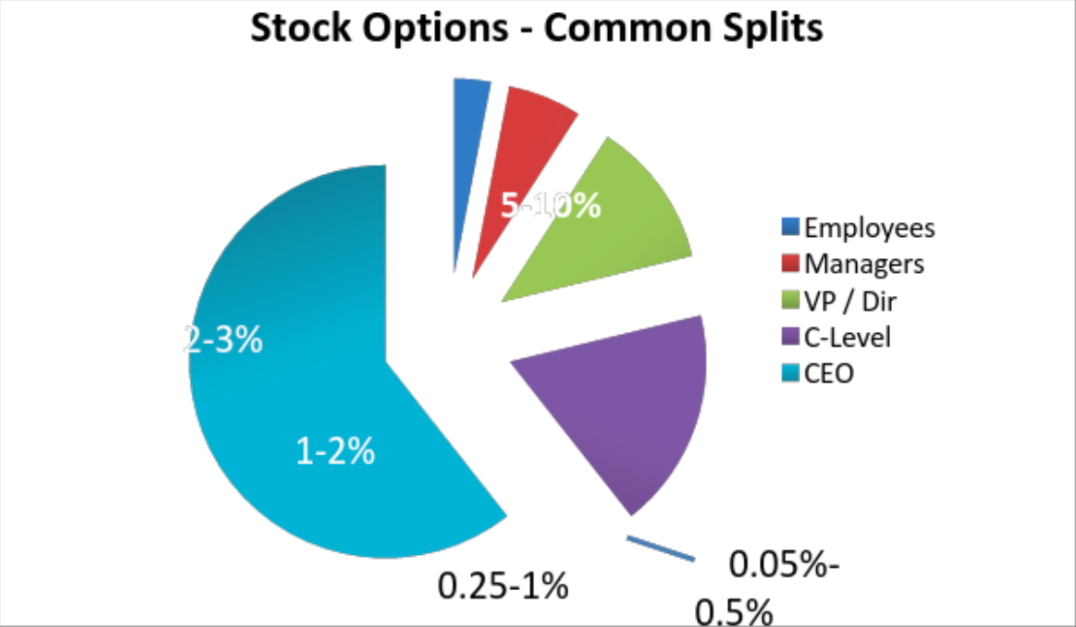
Most companies split up ownership when they take on their first outside money. At that time a stock option pool will be set up as an incentive for executives and employees. The pool is frequently between 10% and 20% of the company. Here is a table of common splits within that pool:
3. Value
The value of the stock options has to be established by an outside third party according to IRS rule 403(b). In some instances, the company will establish the value of the stock, but it has to reflect fair market value. If a company has had a financing transaction with an outside party, the economics of the deal can be used to set a value stake in the ground.
4. Tax and Legal Help
If you are receiving a stock option you really should talk to your tax advisor about how it can impact your tax situation. Those offering options should encourage recipients to seek appropriate advice. There are a lot of potential tax implications for the employee, especially if they are receiving ISO (incentive stock options) versus NSO (Non-statutory Options). ISO’s have some very favorable tax implications, but they should understand long-term capital gain versus ordinary income.
5. Vesting
Most options vest over a period of time. Vesting means employees actually receive the right to the option. The company may grant options, but if it vests over 3 to 5 years, the recipient really doesn’t have the right to exercise those options unless they stay at the company over the entire vesting period. Common vesting schedules are 3-year vesting where you earn 1/3 per year. Often a “cliff” is employed, where the recipient doesn’t vest in anything unless they remain with the company for 1 year and then they vest a full year’s worth of options, with ongoing monthly vesting thereafter.
6. Taxes
ISO’s are not taxable to the employee until the options are sold. NSOs are compensation to the employee or consultant when granted. ISO’s can be exercised as they vest and that will begin the long-term capital gains clock ticking, but it is often hard for employees to exercise the option and actually pay for the stock, so often they are exercised when a company has a liquidity event. The resulting tax implication then is a function of being ordinary income instead of capital gains. Consider carefully whether the options are tied to milestones. If they are, the options then become contingent compensation and tax consequences are incurred as the options vest. Consider whether options can be exercised early. This starts the long-term gain clock ticking early and the recipient vests in the stock over time. They can also make an IRS 83b elections, which allows for some significant tax savings. Again, however, it is recommended that all parties talk to their tax advisor.
Conclusion
Stock options are a great incentive for employees in companies that are:
- Growing
- Have the possibility of stock values becoming significant
- A likely liquidity event in the future
Equity compensation encourages each employee to act like an owner if it is managed properly by using them to align everyone’s interests in the future of the company.

What Character Traits a CEO wants from their CFO
Hello. My name is Dave C. I…am a CFO. That’s what I do well. I fancy myself as meriting a few other monikers like Strategist, Leader, and Adrenaline Junkie. Are these appropriate qualities for a CFO? If so, am I focused on the right output the CEO and the business need to thrive? Recently we asked our top CEO clients what information THEY want from their CFO. 130 of them eagerly responded, anxious to let us know what output they value from their CFO and the character traits they expected them to have.
What CEOs Expect from their CFOs
1. Accurate, reliable, and timely financial statements
It shouldn’t come as a surprise for a CFO that number one is accurate, reliable, and timely financial statements. Years ago when I got my first shot at the CFO role I read a Deloitte & Touche pamphlet that should have been entitled, “Training wheels for the CFO”, but was actually called, “Breathing Lessons.” They agreed with the CEO and labeled solid financial statements as the “dial tone”. Frankly, without it nothing else a finance team does really matters.
2. Cash Flow Forecast
Secondly, our CEOs wanted a good Cash Flow Forecast. Note I didn’t say, “Cash Flow Statement.” Very few senior financial personnel would have ranked this #2. They’d have ranked it as important, but #2?…not likely. Too many of us focus on the income statement and the balance sheet and forget about cash flow. To use my mother’s words, “Shame. Shame.”
3. Budget to Actual Comparisons
4. Key Metrics
Take note that three of the four explicitly (and truth be told, all four in reality) require analysis. CEOs fully expect that we interpret the information we are feeding the organization.
And the fact that the other work we do is much lower in the rankings doesn’t mean that it is irrelevant. A more proper interpretation would be that without these four deliverables, we aren’t delivering the basics of what the CEO wants from us.
Character Traits a CEO wants from their CFO
I’m glad to hear that Honesty places high enough above all others that it is clearly the winner. Headlines these past few years have led me to wonder how much people really value this timeless trait.
I interpreted from their #2 ranked trait, Attention to Detail, that they didn’t necessarily want us buried in the details, but rather, they were saying, “Please don’t miss something important because you’re flying too high.”
The third most valued trait was being a Strategic Thinker. It wasn’t long ago that few people expected the CFO to think about much more than the numbers. This has very clearly changed. The CFO must contemplate what the numbers mean and relate them to the ongoing operations and strategy of the organization as much as they focus on their accuracy.
Our request to our CEO clients was a forced ranking. Don’t make the mistake of believing that the remaining 9 traits are low in importance. On the contrary, they cannot be neglected either. Consciously devoting a little time to develop in all these key areas will make you a stronger CFO.

Bootstrapping isn’t Dead
While lending is easing again, the lessons and reminders from a difficult borrowing environment these past few years should be remembered. Savvy entrepreneurs realize that the most readily available and cheapest sources of capital are to be found inside their businesses…aka “bootstrapping”. Finding, developing strategies for, and managing wisely the cash already in your business can carry you through difficult periods in your business driven by either constriction or growth.
In short, these strategies usually amount to the following:
- Actively managing the collection of the cash owed to you by customers, rather than passively letting it come in
- Minimizing the amount of inventory you carry
- Carefully analyze and control the payments you make to your vendors
Each of these very general strategies has many options to consider, but some are more impactful than others.
The available information on the internet to help educate entrepreneurs on the strategies to manage their cash for growth is almost endless. Nevertheless, here is a source that holds a tremendous repository of articles to help guide entrepreneurs to manage their cash on Inc.com.

Understanding the Basics of Loan Covenants
Understanding the purpose of covenants and which are common or expected is the key to securing the most favorable covenants you can when you negotiate your company loan. Below are common questions we hear and a listing of the common covenants we’ve observed in the market recently.
What are loan covenants and why is the bank asking me for them?
When banks loan companies money, they want assurances that they’ll be paid back. And you, as a company, want assurances that when you commit to a purchase of inventory or equipment, for example, the funds will be there.
Banks are primarily finished with their commitments when they give you the money. You, on the other hand, have a lot to do, or in some cases, not to do. The assurances your company will make to the bank are referred to as “covenants.”
Types of Common Loan Covenants
There are as many different covenants as there are banks. The three categorical covenants listed below, along with examples, are those we are seeing as the most common in the market today.
Affirmative Covenants
These are used to remind the borrower that there are certain actions they should be taking to ensure the long-term health of their business. Many of these are intuitive and natural but are meant to be triggers for warnings to the bank if not performed. These include:
- Operational Covenants like keeping compliant with GAAP, paying taxes timely & complying with stated laws.
- Reporting Covenants like quarterly financial statements and annual audits…each of which should be performed in a proscribed time frame.
Negative Covenants
Banks use these to create boundaries for owners and the company. The goal is to keep the company from radically reducing the underlying company value or its ability to pay the bank back. These usually include most of the following:
- Investment – limiting non-standard purchases, E.g. mergers/acquisitions, without bank approval
- Asset Sale – restricting the sale of valuable assets outside of the “ordinary course of business”
- Cash Payout – preventing distributions to owners or other shareholders
- Financing – limiting additional indebtedness of any kind without prior bank approval
Financial Covenants
These covenants are based on the specific balance sheet or income statement items or ratios of those items. The ratios are generally set according to how the business said it’d perform (via projections provided to the bank by the company during negotiations). Then they are used to measure how the business lives up to its performance commitments. They may also be used to restrict the amount of available funds to borrow, as in the case of a line of credit. Common covenants used here are:
- Borrowing Base. Usually applied to lines of credit, this is usually defined as a portion (often between 50-75%) of “eligible Accounts Receivable plus a portion (often between 30-50%) of “eligible inventory”. Here, the goal of the bank is to be assured they’re loaning less than what they could liquidate AR and inventory for, if necessary.
- Interest Coverage Ratio. This ratio is always higher than 1, is typically 1.5-2.5, and may move up over the life of the loan. It is defined as Annual EBITDA / Annual Interest Expense. Banks prefer this ratio to test whether current year earnings are in excess of current year interest expense.
- Debt Service Coverage Ratio. Typically the same as Interest Coverage Ratio, but the denominator includes other debt items such as the Current Portion of Long Term Debt.
Why is it important for me to monitor them?
If one of your covenants is violated, or “tripped”, the banks can declare the company in default which usually results in a formal letter of default from the bank.
However, if you’re doing a proper job monitoring your covenant compliance, see a potential “trip” coming, AND make the bank aware in advance, they are far more likely to react cooperatively.
But if the day does come that you receive a letter of default, don’t let this cause a panic attack because it is usually coupled with a solution offered by your bank. Your bank is generally willing to work with your company because they want to give themselves the greatest chance they’ll collect their debt …and that usually comes from cooperation rather than immediately calling the loan. Frequently, these solutions will already be spelled out by the “remedies” in the agreement. Other actions may include, in order of most to least frequently enacted:
- Increasing the interest rate to the “default rate”
- Ceasing to advance new funds
- Prohibiting distributions to subordinated debt (debt lower in priority than theirs)
- Calling the loan (asking for full repayment)
- Repossessing collateral
- Legal action against the borrower
Banks can be wonderful partners as you grow your business. But as partners, they should be treated equitably. If you have a loan, the more you monitor and understand your covenants, the better your relationship and cooperation will be with the bank. Be sure to ask the right questions of your CFO or controller to see that they’re monitoring these properly.

Trend Analysis
Trend analysis is a critical, and all too often overlooked, element of understanding what is happening in one’s business. Far too often we see that companies are looking only at the unformatted, current period financial statements. By doing so, they are missing a valuable opportunity to be educated by their financials statements about the current period performance, but also the likely near-term performance of their business.
Business cycles vary widely by industry, but typically, a one-year look by month (graphically where possible) at the key financial metrics of a business is ideal. Identifying the key financial metrics to measure is a critical step as well that shouldn’t be glossed over. In addition to a one-year look, a more detailed trend analysis of the past 3 months and a comparison to the same period from the prior year are two other great comparators and teachers. Below are some examples:
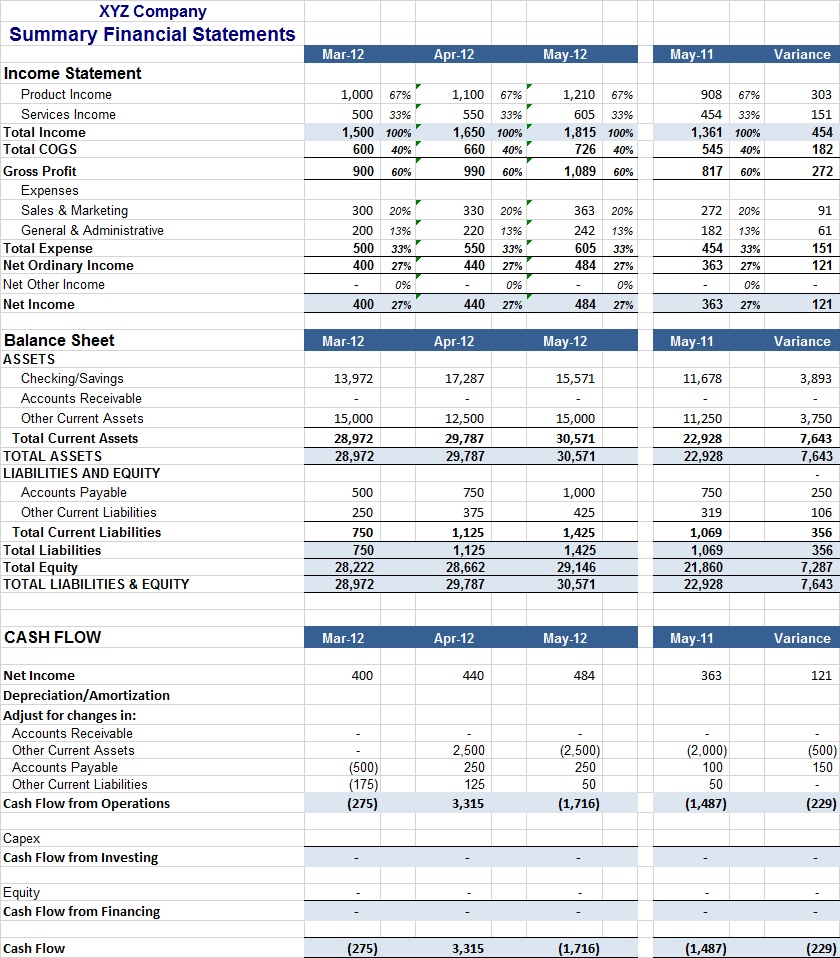
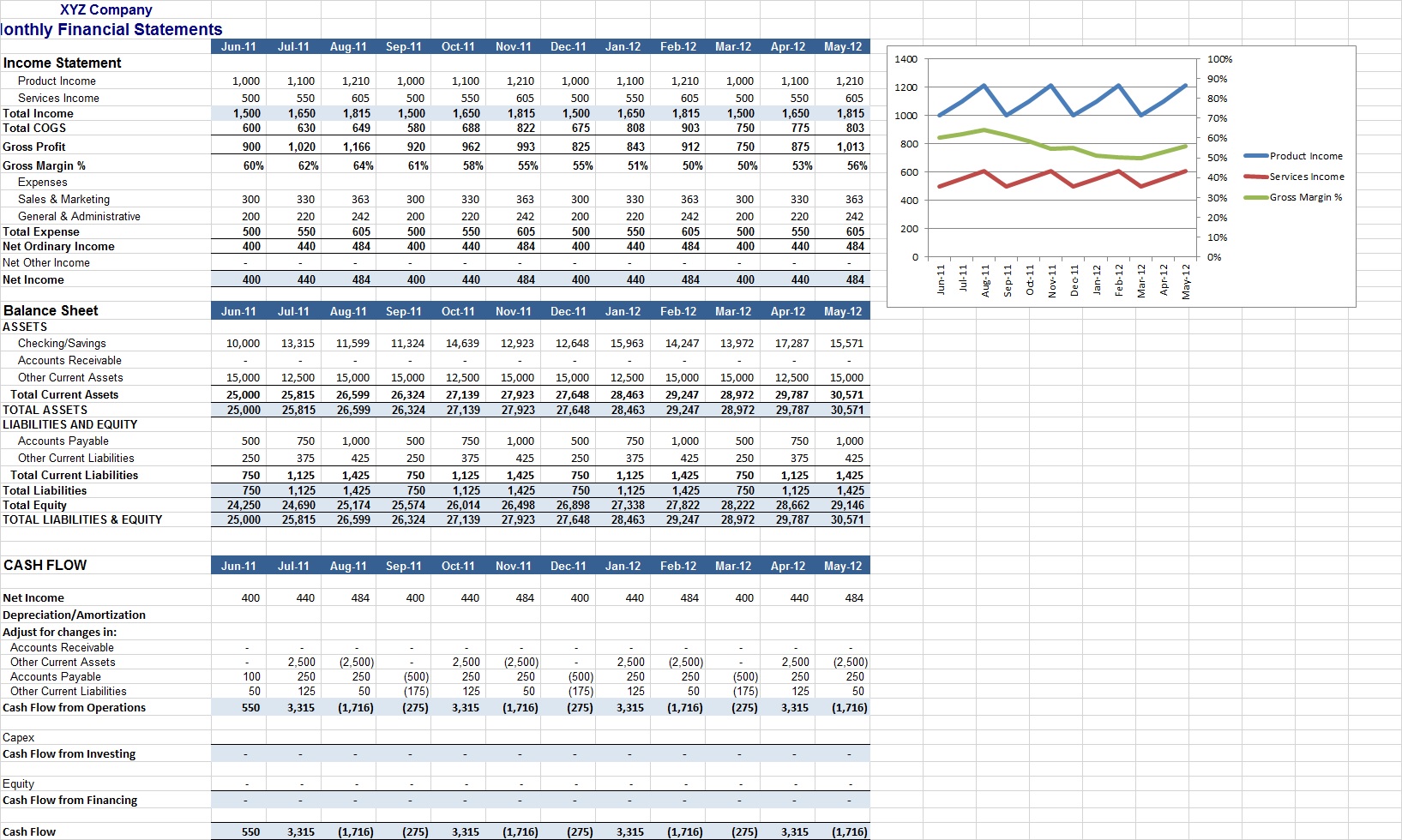
There are many ways to accomplish and view these trends including: reporting software packages (local or in the cloud), accounting software, or simply excel, to name a few. Some are better than others, but as long as you’re looking at the data in the right way, you’re learning. Here is a brief but helpful ehow.com treatise on the subject.

4 Reasons You Know You Need a New Accountant
Financial statements have high value when they are timely and accurate and when they are presented in such a way as to lead to good decision-making. The ROI of any investment, including producing those statements, is clearly increased when the cost to produce them is reduced. Your accountant holds the keys to the value you are getting out of your investment in financial statements. How do you know whether they are truly performing or whether it is time to find a new accountant?
Ask yourself the following questions.
Timely Financial Statements
Begin by asking yourself if you are constantly asking for reports that weren’t delivered when promised. There are always a million reasons why reports might be late. Your accountant may try to put the blame on faulty processes, bad information, or even you in some way. There are no good reasons why accounting transactions can’t be maintained in nearly real-time. If your accountant isn’t making progress or can’t figure out how to work around the obstacles that stand in the way of timely financial statements, it’s time for a change.
Accurate & Reliable Financial Statements
Next, once you have the financials, do you have faith in them? Or rather, do you find yourself doubting their veracity? Perhaps you even find yourself asking to review the detailed financial statements to ensure all expenses are being coded properly. Rest assured, this is not the best practice. These activities are time-consuming and a waste of your valuable time. While some of this may be necessary at the beginning of your relationship with your accountant, if it is happening on an ongoing basis, it’s time for a change.
Proper Analysis
Thirdly, reflect on how often you look at a financial statement, glance at a couple of relevant numbers like gross margin and net income, and then simply set them aside until next month. Are you getting more and better information than this? A good accountant is regularly digging deeper into WHY things are happening. They review trends and analyze sales and costs by channel, segment, region, customer, etc. Their purpose is to seek and understand the drivers of success or failure. In turn, they should be presenting those learnings to you in ways that lead to good decision-making. If your accountant is leaving this kind of analysis up to you, it’s time for a change!
Streamlining Technologies
Finally, ask yourself if your accountant is keeping up with the latest technologies and ways of automating transaction processing. Frequently even good accountants get busy and get stuck in the ruts of doing things the way they were done last month. There are so many new low-cost accounting systems that make it easy to integrate with outside data sources (such as banks, merchant processors, website shopping carts, EDI data sources, CRMs, etc.) that a little investment now could cut down on manual processing substantially. Is your accountant standing in the way of making these changes happen? If so, it’s time for a change!

Too Many Spreadsheets – Is your company in trouble and you just don’t know it yet?
I met with the management team of a client yesterday that we have been working with for about two months. Initially, we performed an assessment of their accounting personnel and procedures, prepared a short-term cash flow forecast, and advised them on modeling and securing the financing for their expansion plans. During our work, we found an overworked controller who had allowed himself to get caught up in the activities of “accounting” and, as a result, had not done a good job of designing good procedures or controls or learning the Company’s ERP (Enterprise Resource Planning) system well enough to set it up and use it to its fullest capacity. We found that he and the company’s accountant had created several “manual work-rounds” and used over 20 individual spreadsheets to track, manipulate, manage and process transactions that could and should be done within the ERP system.
The work of the accounting department was, in fact, eventually getting done each month and usually with reasonable accuracy so you might ask, “what’s the problem?” Well, there are problems here – major problems – please allow me to explain just three.
Wasting time making sure information is accurate
First, the controller has been spending 12 – 15 hours per day in the “weeds” of the company’s accounting. He is so preoccupied with details, transactions, and making sure that the information is accurate that he has not spent time:
- Building an infrastructure that will scale with the company’s planned growth, as a result, his only solution for managing increasing transaction volume is to add people to follow the flawed procedures now in place. Increasing volume in this situation will lead to errors and breakdowns that could have a major impact on the Company’s ability to process and invoice orders correctly and to manage and collect customer accounts receivable.
- Analyzing & understanding the Company’s results because the systems & procedures were not set up to capture and report important profitability or contribution margin information (e.g., by customer, product, channel, etc.). As a result, any reporting and analysis take hours because the controller has to export data to Excel and perform time-consuming manipulation of the data each time it is completed and he rarely has time to do this.
Transaction and processing transparency is non-existent
Second, any information that is stored and managed in MS Excel, is, by definition not in the ERP system and, therefore, is not available to anyone who does not have access to the spreadsheet(s). As a result, transaction and processing transparency is non-existent – this increases the potential for fraud or theft and means that potentially critical information is hidden from those who most need to know that it exists and who could best determine what it really means to the company and/or its customers. This means that decisions are likely being made without the benefit of information that may change the ultimate decision if management had access to the data and could properly analyze it.
Spreadsheets are easily susceptible to errors
Third, MS Excel spreadsheets are easily susceptible to errors – intentional or unintentional and typically no one is auditing the spreadsheet in sufficient detail to uncover the error(s). A recent study by the Institute of Internal Auditors found error rates from 45% to more than 90%. In addition, when KPMG Management Consulting audited spreadsheets from over 21 major UK banking and financial organizations, they found that 92% of the spreadsheets dealing with tax issues had significant errors, 75% had significant accounting errors, and 59% were judged to have a poor design. If your company’s spreadsheets have errors (and they undoubtedly do), you may be making decisions based on flawed information and analyses.
I have worked with companies with more than $100 million in annual revenue who have these exact problems – they have called for help because the accounting “house of cards” will eventually fall under its own weight and that is not a pretty sight – it can destroy your business! These problems are not difficult to resolve when approached with the right knowledge and expertise. If any of this sound familiar to you, please don’t ignore the reality, you need to take charge and demand changes – now! Reach out to Ampleo for help.

What is Your Strategy?
Many people believe that a mission statement is a strategy. Let’s not beat around the bush…it is not. A strategy governs how a company is going to reach its Big Hairy Audacious Goals. For instance, are you a low-cost leader, or are you different enough that you can charge a higher price than your competition? Your strategy is your high-level path to achieving your goals.
Nearly 10 years ago W. Chan Kim and Renee Mauborgne wrote a fantastic book called Blue Ocean Strategy. They talk about how so many companies are trying to fight competition in a competitive ocean. Companies fight over price, market share, and customers. The fight becomes very bloody and the “competitive” ocean becomes very red with blood very quickly. They suggest that the best strategy is to create an idea that has very little competition. Companies can succeed by not battling competitors, but rather by creating ″blue oceans″ of uncontested market space. They assert that these strategic moves create a leap in value for the company, its buyers, and its employees while unlocking new demand and making the competition irrelevant. The strategy sounds great, but it isn’t so easy to implement. You may already be in a blue ocean, but don’t know how to grow your business. You may be in a red ocean, but have a new idea that is in a blue ocean and you don’t have the money or the organization to get to the blue ocean. Money will ultimately follow good ideas, but good ideas have to be led by strong management with the experience and the fortitude to see the idea through to that blue ocean.
If you believe you are in a red ocean, how should you compete? How do you create a blue ocean strategy? Ask yourself: Do I have the ability to create something that is valuable, rare, difficult to imitate, and have the organization to manage that new idea? Many companies have something valuable and or rare, but it is easily duplicated or simply doesn’t have the management organization to take the company to the next level. As our founding partner, Kent Thomas has said many times, you need to know what you don’t know. If, for example, you don’t have a management team, you must bring in the right talent to help you execute. So, part of your strategy setting is to look for a Blue Ocean or a space to create one. But it also includes how you intend to implement the strategy.
Your strategy is your all-encompassing plan to achieve your goals. It is the goal and the path. This is true whether your goal is a blue ocean, to be a low-price leader, to own a large portion of the market, or to exploit some point of differentiation where you can charge a premium. As the leader of your company, ensure your team is spending adequate time determining where you want to be (your goal), whether you can reach it via a blue ocean strategy or more effectively competing in a red ocean, and your path to reach the goal.

Does Your Company Have & Use the “Right” Technology?
A recent survey by CFO Research and Big 4 accounting firm KPMG revealed that “nearly 40 percent [of those participating] reported that their existing information systems could not support analysis of financial and performance information well. Further, they admitted that the financial and performance information that management uses for decision making is not as accurate as it could be.”
At Ampleo, our experience with existing and prior clients supports these findings. In fact, historically small businesses have not had access to the kind of technology that they needed in order to get access to timely and accurate financial and operational information so that management could make decisions based on good information. This has primarily been due to the sheer cost and difficulty of implementing enterprise resource management (ERP) systems that could provide it to them. In addition, most small businesses don’t have the kind of financial expertise to really analyze and understand the information or to marry it with critical operational data to create measures of their company’s critical success factors or key performance indicators.
Fortunately, that is no longer the case! Technology is affordable and more great new software, features and apps are being introduced all the time. Now the smallest companies can have a robust ERP system with complementary and integrated “add-on” web-based apps that provide excellent workflows and improved controls over information and assets. In addition, if a company has competent finance staff, documented procedures, and well-conceived controls, it can generate a dashboard of key metrics that provide real-time (or near real-time) feedback for owners and managers to monitor and utilize for decision-making.
The other critical element that still eludes many small businesses is having a sufficient budget to build a finance team with the expertise to provide strategic value to management (i.e., someone to interpret the data, help management understand what it means, and provide suggestions on how to fix problems or take advantage of opportunities). This too is now available to and affordable for small businesses since the process of outsourcing controller and CFO-level services has come of age.
In the survey, the majority of respondents were interested in technologies that would boost their insight into the company’s performance. If you have a need for better systems resulting in better information flow, don’t wait any longer. Begin by exploring some new technologies that can open your mind to what is possible such as Tableau, Expensify, and Bill.com, all of which are easily integrated with most financial systems.
You've Got the Vision.
We've Got the Fractional
Team to Build It.
A fractional CFO who knows your numbers. A fractional CMO driving your pipeline. An HR leader building your people systems. Sales tax specialists keeping you compliant. Valuation experts ready when you need them. All embedded. All executing. All backed by Ampleo Intelligence, our AI platform.

You've Got the Vision.
We've Got the Fractional
Team to Build It.
A fractional CFO who knows your numbers. A fractional CMO driving your pipeline. An HR leader building your people systems. Sales tax specialists keeping you compliant. Valuation experts ready when you need them. All embedded. All executing. All backed by Ampleo Intelligence, our AI platform.
You've Got the Vision.
We've Got the Fractional
Team to Build It.
A fractional CFO who knows your numbers. A fractional CMO driving your pipeline. An HR leader building your people systems. Sales tax specialists keeping you compliant. Valuation experts ready when you need them. All embedded. All executing. All backed by Ampleo Intelligence, our AI platform.
You've Got the Vision.
We've Got the Fractional
Team to Build It.
A fractional CFO who knows your numbers. A fractional CMO driving your pipeline. An HR leader building your people systems. Sales tax specialists keeping you compliant. Valuation experts ready when you need them. All embedded. All executing. All backed by Ampleo Intelligence, our AI platform.