



Real advice from people who've done the work.
Advice grounded in experience from the experts inside 13,000+ businesses.
Everything we publish comes from people who are actually doing this work. You won't find generic business advice here. You'll find specific, useful content from finance leaders, HR directors, marketing experts, and turnaround specialists who bring real experience to businesses like yours.




All Insights
Explore by Category

Unleashing the Power of AI: Transforming Your Business for Success
You can’t watch the news, have a discussion at the company watercooler, or browse articles online without hearing some talk on AI (artificial intelligence). What is AI? A basic definition is machines perceiving, synthesizing, and inferring information. Much of the discussions centered around AI these days is focused on generative AI, which outputs information in a way that feels convincingly human. One reason for all the increased chatter about AI is the quality of output from these platforms. What once felt clunky now feels much more real.
As AI becomes more intelligent and its outputs become more human, organizations need to carefully consider whether implementing AI into their business strategies makes sense. To understand this conundrum a little more, let’s talk about what you need to know when making this decision, including how AI works, what it can do, the challenges you may face as you consider AI, and some steps to take when implementing.
What Can Generative AI Do?
Today, generative AI can do many things, including the following:
- Generate code or open text
- Generate images
- Generate music
Organizations are using AI to generate code for website designs, compile images for marketing, write music for reels, and create copy for content purposes. Some popular generative AI options include ChatGPT, Gemini, Midjourney, Stable Diffusion, and MusicLM. These tools are improving efficiency and driving creativity in business, with 89 percent of employees saying that implementing one of these tools can improve their workload.
How Does Generative AI Work?
Understanding how AI works is imperative to understand how to leverage it within your business. At its core, AI platforms are complex statistical models designed to predict what’s next. For instance, if you input a prompt into ChatGPT that says, “Finish the sentence ‘I like to eat,’” the response generated might be “I like to eat a variety of cuisines from around the world.” The platform predicts what it thinks you might want the response to look like.
What makes AI so powerful is that it has access to incredible amounts of information. It is estimated that the training data for platforms like ChatGPT have billions to trillions of words in their database (about 570 GB). They also have incredible computational power, allowing AI to get smarter and make better suggestions. With ongoing human feedback, these platforms are constantly refining their models, implementing rules to help block harmful responses, and improving responses that better match input requests.
What Are the Challenges of AI?
AI seems very shiny and new and can be very enticing to businesses looking to improve efficiency, drive creativity, or enhance their competitive edge. However, AI comes with a unique set of challenges that you need to understand before moving forward.
- Hallucinations. These are AI-generated responses that are untrue or misleading, such as a ChatGPT response that indicates you gave a TedTalk or have been quoted in the New York Times. AI models are often compared to an incredibly eager intern who doesn’t know how to say, “I don’t know.” This means a human must review outputs to ensure the authenticity and accuracy of information.
- Bias. Because the data in AI is trained, societal biases can be built into the data. Again, the human eye is required to remove any bias in outputs.
- Data Governance. One of the most worrisome things about AI is what is done with the information we put into the software. While inputting our favorite breakfast dishes might not require privacy protection, sensitive customer data does. Understanding how our data is stored and used needs to be more clearly understood.
- Computing Power. Smaller startup AI platforms will have less computing power and less capital to improve training of their AI. This can cause issues with incorrect outputs and problematic data. Consider this when choosing an AI tool for your business.
- Unknown Future Costs. Currently, most AI platforms are offering their software at low prices, but because of the capital required to generate information, those costs may skyrocket at some point. Who will bear the burden of those costs in the future? We don’t yet know.
These challenges should not deter you from embracing AI but rather help you make a more informed choice about which AI may work for your organizational goals. Let’s take a closer look at some of the organizations currently in the AI landscape.
Who Is Designing AI Platforms?
If you’re considering implementing AI in your business, there are four categories you’re likely to run into.
- AMG (the Clouds). These are the major cloud service providers like AWS (Amazon Web Services), Microsoft Azure, and GCP (Google Cloud Platform) that are implementing AI. The advantage of this option is the size of information they have access to. The disadvantage is that these organizations seek to lock you into their platform, making it difficult to move data from one cloud to another.
- Meta. Meta is an open-source AI platform that allows you to integrate with other platforms you might be using. The challenge here is that you need to have a team of experts who understand integration or who can leverage the existing code with any new code you need written.
- Legacy SaaS. These are ERPs (enterprise planning tools) like Epicor and CRMs (customer relationship management tools) like Salesforce. Through AI, many of these platforms can now help you mine additional information from your data, helping you make more informed decisions. The disadvantage is that moving that information and those insights into a competing platform can prove difficult, leaving you locked in.
- Startups. You likely hear of new AI players entering the market on a daily basis. While this breeds creativity and agility, the challenge is that AI requires a great amount of capital and talent, and many of these new companies fail before they even get started. This makes it challenging for organizations that implemented their software early and are left hanging.
What does this mean for your organization? It means that you need to carefully consider which tools are right for you and your business goals. We’ll talk more about that in a bit.
How to Build AI into Your Business
In 2024, 77 percent of companies are either implementing AI into their business or are considering it. For C-Suite executives and decision-makers, it’s not about finding the perfect tool—it’s about asking the right questions. Let’s discuss some of the important questions you need to answer before implementing AI.
1. Should Your Organization Restrict AI?
To answer this question, you’ll need to understand the following:
- Legal implications. Does your industry have specific compliance requirements that will force you to restrict AI? If yes, then help your employees understand this as you restrict AI.
- Employee compliance. How likely are restrictions to actually work? Does your workforce need additional training to understand the importance of compliance?
- AI tools with guardrails. Are there AI options that you can leverage to meet your employees’ desires for creativity but that have some limitations or built-in restraints?
- Leveraging creativity and efficiency. Can our employees implement AI to improve efficiency in their workload?
Unless you have to meet strict compliance regulations, keep an open mind when it comes to implementing AI. The popular saying goes, “I choose a lazy person to do a hard job. Because a lazy person will find an easy way to do it.” Use your employees to find those efficiencies. They have a ground-level view of productivity pain points you might not see. AI can often answer those inefficiencies.
2. What Should We Do with AI?
So you’re thinking about implementing AI but not sure how to use it. Consider the following to determine how you might leverage AI in your business:
- Think outside the chatbot. As you review your tech stack, are there core problems not being addressed? Is there an AI answer for that issue?
- Narrow scope, clear goals. For stronger buy-in from employees and key stakeholders, consider how you can prove the value of the AI you implement whether through reports, ROI, etc.
- Iterable. Avoid spending capital on dead ends. Rather, promote AI projects that have promise.
- Integrate with strategy. Select AI that is closely aligned with core business strategy and tied to revenue or AI really won’t help you.
The key is to be agile and consider the tools that align with your industry and your goals. AI should not be a one-off tool that does little to improve your bottom line or efficiency.
3. How Should We Integrate AI?
Now that you’ve identified your AI project, let’s talk about putting it into action and some things you need to watch out for:
- Identify your risks. It’s imperative to keep a pulse on the reglatory environment. Will you be liable if something you share has a copyright issue or includes a bias? Some AI platforms will take responsibility while others may not—leaving you holding the bag.
- Understand your data. Output is only as good as the inputs. Make sure your data is clean, organized, in the right place, and ready to be fed into the AI model you’ve chosen. If you’re not currently collecting the data you want to analyze, start now!ostp/ai-bill-of-rights/
- Build vs. buy. Knowing when to build your AI system and when to buy it will depend upon your resources, how much risk you want to take on, and who owns the data. Do your homework before landing on a solution.
- Plan to fail. Failure can be a powerful learning experience. Define what failure may look like and how you can ensure you learn from those mistakes.
Now that you’ve prepared for implementation, let’s talk about what’s next to put AI to work for your business.
4. What’s Next?
By now you should feel more confident in your decision to implement AI. AI can be a great ally in executing your strategic plan. There are a few key things you’ll want to remember as you add AI to your technology stack:
- Humans required. While AI is becoming increasingly powerful, you still need a human eye to ensure you are getting the quality outputs you desire. Whether it’s a chatbot response to a customer request or an AI-generated image for a company video, it’s up to your team to maintain the tone of voice, authenticity of the brand, and accuracy of the information shared.
- Minimize anxiety. Gallup reports that 22 percent of employees are concerned that AI will replace their jobs. Make sure you are open about your AI strategies with your employees. Convey to them that you aren’t replacing humans with AI but that you’re improving their workload by implementing AI.
- Stay abreast of trends. The landscape of AI is ever changing. Stay ahead of those trends! Those who learn and adapt to AI quickly will have a competitive edge with first-mover advantage.
AI can be a powerful tool for organizations that understand what it is, how to implement it, and how to overcome the challenges that come with it. If you’re wondering when a good time is to start implementing AI, the answer is now! Educate yourself on the current AI landscape, determine what AI tools may alleviate your company’s efficiency or creativity roadblocks, and then determine if AI is right for your business.
This article was written based on the session conducted by Nick Pelican at Ampleo’s 2023 CFO & Growth Summit.

Do You Really Need a CMO? The Surprising Truth for Businesses on the Rise
In the bustling corridors of the business world, the allure of executive titles often seduces companies into believing they need a full suite of full-time C-suite officers from the get-go. Among these coveted roles, the chief marketing officer (CMO) stands out as a beacon of brand growth and market penetration. However, for many early and growth-stage companies navigating the choppy waters of expansion, the conventional wisdom dictating the necessity of a CMO might just be overkill.
Before you make the call to hire a CMO, let’s dive into the nuances of the idea that a full-time CMO is the only option. By taking a closer look at the options for marketing leadership and challenging the status quo to explore smarter, cost-effective alternatives for businesses, you ensure you hire the right person with the right amount of expertise and experience for your company.
The CMO Conundrum: A Closer Look
Before you rush to post that CMO vacancy, pause and reflect. The decision to appoint a CMO should not be taken lightly, given the significant financial and strategic implications. The average annual salary for a CMO sits at $350,000, not to mention the added expenses of benefits, bonuses, and equity packages. For many burgeoning businesses, this investment could represent a disproportionate chunk of their budget, diverting crucial funds from other vital areas.
Key Questions to Gauge Your CMO Needs
In a study conducted by McKinsey & Company, 30 percent of CEOs believe that marketing is the “North Star” in defining a brand and its reputation. To determine if your organization would benefit from a CMO who can point the business to that “North Star,” consider the following questions:
- What are your current marketing needs and goals?
- Do you have a comprehensive marketing strategy that requires high-level, executive oversight?
- Can your marketing objectives be met through other means or roles?
- What is the size and complexity of your market and product line?
- Are you prepared for the financial commitment of a full-time CMO?
These are powerful talking points for deciding if and when you are in need of a full-time CMO. To help you understand if your company is ready, let’s dive a little deeper into some options for engaging a CMO.
The Fractional CMO: A Game-Changer for Growth-Stage Companies
For many young companies in the $3–40 million revenue range, the concept of a fractional CMO can be a game-changer. This model allows businesses to leverage the expertise of a seasoned marketing executive without the full-time price tag. A fractional CMO can provide vital strategic direction, mentorship to your marketing team, and oversight of critical projects, all while keeping your overhead cost in check.
The Cost-Benefit Analysis
Hiring a full-time CMO can be a hefty financial commitment, but opting for a fractional CMO can significantly reduce costs while still injecting your marketing efforts with high-level expertise. This approach not only makes financial sense but also offers flexibility, allowing your company to scale marketing efforts up or down based on actual needs and growth phases.
Alternative Paths: Marketing Directors and VPs
As of 2024, the average Marketing Director salary in the US is around $186,000, while a CMO salary ranges around $357,000. For many companies on the rise, the smart money is on hiring a marketing director or vice president (VP) of marketing rather than a full-fledged CMO. These roles can offer more bang for your buck, providing hands-on leadership and strategic insight without the C-suite price tag.
Why Marketing Directors and VPs Can Be Your Best Bet
Not sure about leveraging a marketing director or VP? Here are some benefits to consider:
- Cost Efficiency: They command lower salaries than CMOs but can deliver substantial strategic value.
- Flexibility and Focus: These roles can adapt quickly to changing market conditions and company needs, focusing intensely on execution and results.
- Building from Within: Promoting to these positions internally can boost morale and retain talent by offering clear career progression paths.
Still mulling over whether a CMO is a good fit for your organization? Let’s discuss organizational structures a bit to understand how they might look under different scenarios.
Organizational Structures
Let’s visualize how your company’s marketing team could look with and without a CMO:
- With a CMO: The marketing team is led by the CMO, with VPs or directors of specific areas (such as digital marketing, product marketing, and communications) reporting directly to them. This structure is typically suited for larger, more complex organizations with diverse product lines and global markets.
- Without a CMO: The marketing team is led by a VP or director of marketing who oversees various managers responsible for specific marketing functions (SEO, content marketing, social media, etc.). This leaner structure can be highly effective for growth-stage companies, focusing efforts on strategic growth areas without the overhead of a CMO.
The Verdict: When to Consider a Full-Time CMO
Hiring a full-time CMO should not be a knee-jerk reaction but rather a strategic decision made at the right time under the right circumstances. Here are the conditions that make sense for a full-time CMO hire:
- Your company operates in a highly competitive, global market requiring sophisticated, multichannel marketing strategies.
- Your business has reached a revenue threshold where the return on investment (ROI) from a CMO’s leadership justifies the cost.
- You have a complex product line or service offering that necessitates high-level brand positioning and customer segmentation strategies.
As you look toward your future, consider your marketing goals. This will largely determine the type of CMO you will need to achieve those aspirations.
Conclusion: A Bold Move Forward
Rather than buying into the idea that every company should have a full-time CMO in order to achieve its marketing objectives, take a step back to review your current business plan and your goals for the future. In many cases, the roles of marketing director or VP of marketing, supplemented by a fractional CMO approach, can provide the strategic oversight and execution prowess needed to propel businesses forward.
By challenging the conventional wisdom and embracing a more nuanced approach to marketing leadership, companies can navigate their growth phases more effectively and sustainably. Rather than being seduced by titles, let’s choose to be driven by strategic, cost-effective decisions that bolster our businesses for the long haul.
Speak with One of Our Incredible Fractional CMOs
Is your business ready for growth and looking for a fractional CMO? By opting for an Ampleo fractional executive, you eliminate ambiguity, enhance accountability and transparency, and implement a strong business strategy to propel your ambitious marketing objectives. Instead of investing significant time and resources in searching for a full-time employee—which can be time-consuming and costly with potential missteps—consider engaging a leader with decades of experience on a part-time basis. Contact us to speak to an Ampleo Partner today!

The CMO Revolution: Steering Companies into the Future
In today’s rapidly changing business environment, the role of chief marketing officer (CMO) is evolving. Expanding far beyond the smoke-filled meeting rooms depicted in Mad Men, where men in suits strategized ads for print, radio, and TV, the role of the CMO has grown into something much more pivotal.
As marketing initiatives and approaches become more customer centric, the role of the CMO must also change. It’s not just small changes for these C-Suite executives. Ninety percent of CMOs report seeing a significant change in their roles. No longer just the head of marketing, CMOs now lead out in enhancing brand perception, driving strategic direction, and even supporting the survival of the company.
As we consider what it takes to build the Don Drapers of the future, it’s important to understand how the CMO’s responsibilities have evolved, why they must learn to work with other C-suite executives, and what it takes to lead. In this article, we’ll discuss this evolution and why the CMO might just become the most crucial player in the C-suite.
Beyond Marketing: The Expanding Realm of the CMO
Traditionally, CMOs were seen as the leaders of the marketing team, tasked with managing budgets, crafting advertising campaigns, and, perhaps most importantly, making sense of market research. However, this view is rapidly becoming outdated. In a recent study performed by Deloitte, 50 percent of the survey respondents indicated that they lead 11 or more areas of marketing. That is an insightful glimpse into the expanding role of the chief marketing officer.
The CMO of the future navigates four critical arenas:
- Leading the marketing team and managing resources: While this remains a core responsibility, the scope and complexity of what this entails have expanded exponentially.
- Market and customer research and insight: This is no longer just about understanding who the customer is but predicting what they will need, often before they know it themselves.
- Defining the marketing strategy and plans: Today, this involves a blend of art, science, technology, and psychology.
- Working with the rest of the C-suite in leading the company: Perhaps the most significant evolution of the role, CMOs are now vital in steering company strategy alongside CEOs, CFOs, and CTOs.
The New CMO: A Bold Vision for the Future
To understand the future role of the CMO, it’s essential to recognize the transformative forces at play in the global business environment. Digitalization, data analytics, artificial intelligence, and changing consumer behaviors are not just influencing marketing strategies but are reshaping entire business models. In this context, CMOs are not just marketing leaders—they are business visionaries.
Strategic Visionaries and Data Wizards
The CMO’s role is becoming increasingly data-driven. With access to vast amounts of data, CMOs are expected to glean insights that can inform product development, customer experience, and even operational efficiencies. The average spend on data analytics within the marketing budget hovers around 6.5 percent. Leveraging the information from analytics requires a deep understanding of data, consumer psychology, and technology trends. The CMOs who can master this trifecta will not only predict market shifts but will also play a crucial role in leading their companies through them.
The CMO as the Customer’s Champion
Consumers are 3.5 times more likely to purchase goods or services from a business after a positive customer experience. In a marketplace where customer experience can make or break a company, CMOs are increasingly taking on the role of the customer’s champion. This involves a deep dive into customer needs, behaviors, and expectations, often leveraging advanced technologies like AI to personalize experiences at scale. It’s about creating a customer-centric culture within the organization, ensuring that every decision is made with the customer in mind.
Bridging the Gap Between Technology and Humanity
As technology becomes more integrated into our lives, there’s a growing need for companies to maintain a human touch. With 94 percent of marketers implementing some form of AI in their marketing efforts, this is where a CMO shines. They are uniquely positioned to bridge the gap between technological advancements and human experiences. By understanding the human element behind the data, CMOs can ensure that technology serves to enhance rather than detract from the customer experience.
The CMO–C-suite Symbiosis
One of the most significant shifts in the role of the CMO is their increasing involvement in overall business strategy. The lines between marketing strategy and business strategy are blurring, with CMOs now playing a key role in product development, market expansion, and even mergers and acquisitions. In fact, organizations that align marketing and product functions achieve 19 percent faster revenue growth and 15 percent higher profitability. This requires a new level of collaboration with other C-suite executives, blending marketing insight with financial, operational, and technological perspectives.
Not Just Support, but Leadership
The traditional view of marketing as a support function is outdated and can leave potential revenue on the table. How much performance improvement can a CMO bring to a company? How about 15 percent better than companies who do not have a CMO? In the future, businesses that treat their CMO as merely the head of a support department will likely find themselves outpaced by competitors who recognize the strategic value of this role. CMOs are not just supporting the business: They are critical to its strategic direction and, ultimately, its success or failure.
Conclusion: The Future Is Now
For businesses looking to thrive in an uncertain future, reevaluating the role of the CMO is not just advisable—it’s imperative. The CMOs of the future will be visionaries, technologists, strategists, and, above all, leaders. They will not only predict the future—they will create it. For business owners, the message is clear: empower your CMO, integrate them into the strategic heart of your company, and watch your business transform.
The future of business is not just about selling a product: It’s about creating value, understanding customers on a deeper level, and navigating the complex interplay between technology and humanity. In this future, the CMO is not just a role—it’s a revolution.
Speak with One of Our Incredible Fractional CMOs
Is your business ready for growth and looking for a fractional CMO? By opting for an Ampleo fractional executive, you eliminate ambiguity, enhance accountability and transparency, and implement a strong business strategy to propel your ambitious marketing objectives. Instead of investing significant time and resources in searching for a full-time employee—which can be time-consuming and costly with potential missteps—consider engaging a leader with decades of experience on a part-time basis. Contact us to speak to an Ampleo Partner today!

Navigating the Hype: The Realities of Fractional Executive Fit for Your Business
Fractional jobs have risen by 57 percent since 2020. Many see the uptick in the use of fractional executives as a revolutionary option for companies seeking expertise without a full-time employee price tag. Because hiring costs can make up to 70 percent of a business’s spending, hiring part-time experts is an equitable solution for many organizations.
It sounds like a win-win for companies and executives, doesn’t it? However, the candid truth is that fractional executives don’t fit every company’s needs. Businesses must understand a nuanced decision-making process to determine if working with a fractional executive is the best fit for their organization. To understand if a fractional executive is right for you, let’s dive deep into the world of fractional executives, dissecting their ideal environments, and unveiling situations where a full-time hire might just be the better path.
What Is a Fractional Executive?
Fractional executives—be they a chief financial officer (CFO), chief marketing officer (CMO), or chief human resources officer (CHRO)—offer their seasoned expertise to companies on a part-time or project basis, saving an organization 69–81 percent of a full-time employee’s salary. This model allows businesses to leverage high-level strategic guidance without committing to the financial and logistical burdens of a full-time executive. While it sounds like a win-win, the catch is in the compatibility.
The Ideal Company Profile for Fractional Work
Small to medium-sized companies with annual revenues between $3 million and $40 million often find themselves in a unique growth phase. They are too large to operate on the fly but not quite ready to bear the weight of a full executive suite. This is the sweet spot for fractional executives. Such businesses can benefit immensely from the strategic foresight and experience these executives bring to the table, complementing existing teams and propelling growth.
For instance, a tech startup scaling rapidly in the SaaS space might not have the resources to hire a full-time CMO but could significantly benefit from a fractional CMO’s guidance to hone its marketing strategy, identify new market opportunities, and optimize its ad spend for growth.
Ideal Scenarios for Hiring a Fractional Executive
You might find some of these scenarios familiar to you. If so, then a fractional executive would be a great fit for your business:
- Specialized Expertise on a Budget: Sometimes, startups and small to medium-sized enterprises (SMEs) need specialized knowledge or skills at the executive level but cannot afford or justify the cost of a full-time executive. In that case, they might find a fractional executive to be the perfect solution.
- Growth Phases and Transitions: During periods of significant growth or transition, a fractional executive can provide the necessary leadership and expertise without a long-term commitment. This is particularly useful for companies navigating scale-up challenges or restructuring phases.
- Project-Based Initiatives: When the company is undertaking a specific project that requires executive oversight but does not necessitate a permanent role, hiring a fractional executive can offer the leadership needed for the project’s duration.
- Filling Temporary Gaps: If an executive leaves unexpectedly, a fractional executive can fill the gap, ensuring continuity in leadership and operations while the search for a full-time replacement is underway.
- Access to Broader Networks: Fractional executives often come with extensive networks and can provide valuable connections to suppliers, customers, and potential partners.
- Objective Perspectives: A fractional executive can offer an objective, fresh perspective on the business, unencumbered by company politics or culture, which can be invaluable in identifying and addressing issues.
Five Critical Questions to Determine Suitability
Before jumping on the fractional executive bandwagon, companies should ask themselves the following questions:
- What is the scope of the strategic gap we’re looking to fill? If the need is for ongoing, daily oversight, a fractional executive might not cut it.
- Can our current team manage with part-time leadership? Assess if your team’s structure and work ethic can thrive under less frequent guidance.
- How critical is industry-specific experience? In highly specialized sectors, finding a fractional executive with the deep expertise needed might be challenging.
- Are we prepared for the integration process? Onboarding a fractional executive requires clear communication channels and integration into the team for maximum effectiveness.
- What is our long-term strategic vision? If your company’s trajectory demands a dedicated person in the cockpit, reconsider the fractional route.
Conclusion: A Balanced View
The allure of fractional executives lies in their promise of delivering high-level expertise at a fraction of the cost. However, while this model is innovative, it isn’t a one-size-fits-all solution. The decision to choose a fractional or full-time hinges on a careful evaluation of your company’s specific needs, growth stage, and long-term objectives.
In the end, the choice between a fractional and a full-time executive should be guided by a strategic evaluation of what your company needs to flourish. Remember, in the quest for growth and success, it’s important to secure the right leadership fit for your business.
Speak with One of Our Amazing Fractional Executives
Is your business ready for growth and looking for a fractional executive? By opting for an Ampleo fractional executive, you eliminate ambiguity, enhance accountability and transparency, and implement a strong business strategy to propel your ambitious revenue objectives. Instead of investing significant time and resources in searching for a full-time employee—which can be time-consuming and costly with potential missteps—consider engaging a leader with decades of experience on a part-time basis. Contact us to speak to an Ampleo Partner today!

Attracting and Hiring the Right Talent for Your Business
Today’s hiring landscape is vastly different than in the past. So much so that 80% of organizations feel that hiring has become more challenging due to the competitiveness of the hiring market. With tight resources often in play, more and more companies are becoming hyper-focused on hiring the right talent.
Recruiting the best employee fit for your business starts well before you post a job opening. You must first understand what employees are looking for, build trust as an organization, leverage technology before and during the hiring process, and remain adaptable.
Whether you’re a small business looking for new talent or you’ve been around for a long time and want to fuel growth with the right people, the principles we’ll discuss in this article are sure to connect with you. Let’s talk about some insights provided during the Ampleo CFO & Growth Summit by Carl Sokia that can help you hire top talent for your company!
The Value of Trust
Merriam-Webster defines trust as “assured reliance on the character, ability, strength, or truth of someone or something.” Any relationship expert will tell you that trust is vital in a healthy personal relationship, but it is also crucial in the relationship between employees (or potential employees) and their employers.
“Trust defines an organization’s license to operate, lead and succeed. Trust is the foundation that allows an organization to take responsible risk, and, if it makes mistakes, to rebound from them,” says Edelman, a global communications firm specializing in brand reputation. “For a business, especially, lasting trust is the strongest insurance against competitive disruption, the antidote to consumer indifference, and the best path to continued growth. Without trust, credibility is lost and reputation can be threatened.”
So when should building trust with employees begin?
Building trust begins even before an employee is hired. With that in mind, leaders and recruiters must carefully determine the kind of company culture megaphone they are communicating to the outside world, using the following tactics.
Reflect Your Positive Company Culture
What lens is being used to view your business? While you may define your company culture in one manner, is what you are sharing publicly reflecting a tone that is dissonant to your overall mission and values?
73% of job applicants will only consider companies that have similar values to theirs. Because an employee’s first impression of you may be through the lens of social media messaging, the company website, or your leaders’ LinkedIn profiles, it is important to review the kind of messaging you put out into the world. That means leadership can no longer remain passive in sharing the right messages. There are two ways to go about this:
- Reactive messaging: An emotional (or forced) response to a situation that has already happened. This is often hectic and rushed, with little time for internal review and alignment.
- Proactive Messaging: A thought-out response to a situation that has not yet arisen. This allows time for internal alignment with all stakeholders and analysis of procedures and policies to achieve consistency.
With the heightened scrutiny of the digital world, communication and interactions with customers, current employees, and partners should not be reactive. Instead, anticipate and be proactive about the communication you share. Proactive messaging takes responsibility before a situation even occurs. If you do as you say you will, you can build trust that will entice future employees to work with your team.
Take an Individualized Approach
When building trust, you must consider each new hire as an individual and understand what motivates them. Focusing on the collective—“I’m going to do for you what I’m doing for everyone else”—will not work. Organizations must take an individualized approach that includes tailoring the total reward program to fit a person’s needs while maintaining equitability for the entire team. This approach takes a great deal of time and energy but is one of the biggest keys to success in the future of the workplace.
In Edelman’s study, 80 percent of employees consider personal empowerment “a strong expectation or deal breaker when considering a job.” Personal empowerment consists of the following:
- Regular communication
- Truthful information
- Easy employee input
- CEO embodies values
- Employees in planning
- Employee diversity
Knowing that, what can you offer to the individual person you are recruiting to help build trust? This consideration will go a long way with a person considering working with your organization.
Foster Experiential Relationships, Not Transactional Relationships
For far too long, companies have focused on building transactional relationships with their employees: “I’m going to do something for you, you’ll do something for me, and that’s the end of our interaction.” Reviewing Edelman’s research shows that it’s long past time to transition to experiential relationships.
As mentioned before, employees are prioritizing personal empowerment. In addition, they expect the following:
- Career Advancement (83 percent): Competitive wages, work experience, training, career opportunities
- Societal Impact (71 percent): Reflects my values, greater purpose, meaningful work, social impact, listens to employees, CEO takes a stand
Understanding these expectations will help you craft an experience that will satisfy your employees and leave them feeling fulfilled, a powerful draw for potential employees.
Lean into Technology
When it comes to attracting the right talent, you are competing against all the other organizations that are hiring for similar positions. Standing out from the crowd and appealing to the right kind of hires will require getting creative.
The movie Moneyball is an insightful look into how the Oakland Athletics found a clever way to compete with richer organizations in attracting talent. With the help of Peter Brand, an Ivy League graduate, General Manager Bill Bean sets out to find some diamonds in the rough. Leveraging sabermetrics and analytics technology, they identify overlooked players who have a great deal of potential. Billy faces some backlash from his organization, as his new approach is quite different from the 50 years of previous recruitment tactics. However, Billy quickly proves his theories correct as he builds a winning team.
The story of Bill and Peter and the Oakland A’s is a powerful one. By thinking outside the box and harnessing the power of technology, you can compete with other organizations looking for talent within the same pool.
As you consider individuals to interview, what kind of analytics are you reviewing? How are you implementing technology in your search for and analysis of potential candidates?
There are several recruitment apps on the market today. These apps can help you create screening questions, provide skills assessments, and analyze different applicants. They can also help you craft the perfect job description, ensuring you are interviewing the right kind of people.
Never before have organizations had access to so much information about their potential hires. With just a quick search, you can access LinkedIn profiles, review social media updates, and read through a blog article written by or featuring an applicant.
Understanding who you’re hiring will help you tailor the messaging for each potential employee. What a great way to build trust and stand out from the competition!
As you consider your hiring strategies, take a moment to assess how technology is supporting those efforts. Is there more that you could be doing to help attract the talent you’re looking for? Are there tools that can help you craft the right messaging, filter through the options, and better entice those individuals you believe will be great additions to your team? Where possible, lean into those solutions.
The Importance of Adapting
History is littered with stories of organizations who failed to adapt in changing economic landscapes, such as Blockbuster, who underestimated the demand for streaming services over DVD rentals, and Kodak, who didn’t embrace digital photography quickly enough.
It is often said that comfort is the enemy of progress. Those organizations that continue to employ the same recruitment tactics as they always have will no longer be able to attract the talent they are looking for. Only those businesses that understand the ever-changing landscape of employee motivations, use new and developing technology in hiring new team members, and set out to build trust will be able to land the right people for the job.
Remaining agile and staying ahead of trends will help you stand out in a highly competitive hiring market. Failure to adapt may mean talent you might have attracted will choose another company. Remember, a change in thinking can lead to immense growth for an organization. By implementing these strategies, you will find that you can more easily stand out from the hiring competition, attract the right people to your organization, and enhance the future success of the company, no matter the size of your business.
Speak with One of Our Amazing Fractional Leaders
At Ampleo, our fractional CHROs can help you play big by attracting, identifying and hiring the right talent for your current organizational landscape. Contact us today to speak to one of our executives.
This article was taken from a session conducted by Carl Sokia at Ampleo’s 2023 CFO & Growth Summit.

Steering Your Business Away from Disaster: 12 Steps to Avoid a Cash Crisis
Navigating a business through a cash crisis is like off-roading in a Jeep through a rugged national park. Imagine setting out in your trusty Jeep, the horizon vast, the terrain unpredictable. Just as the national park’s diverse landscape offers a mix of exhilarating highs and challenging lows, so does the business environment. Like maneuvering through a park in your Jeep, each turn and obstacle mirrors the unpredictable challenges businesses face—from managing cash flow dips to navigating unexpected financial hurdles.
According to a study by U.S. Bank, 82 percent of business failures are due to poor cash management. Avoiding a cash crisis requires foresight, agility, and an unwavering commitment to strategic financial management. Just as you would adjust your driving to match a rugged terrain, you must adapt your business strategies to maintain financial stability.
However, it’s not an easy path. In this article, we will explore 12 steps to help you avoid a cash crunch and maintain stability and agility in the face of considerable challenges.
1. Take Control of Your Cash
First and foremost, seize control of your cash flow—now! Not only should you monitor what’s coming in and going out, but it’s also essential to have a firm grip on every penny within your enterprise. Develop a comprehensive cash management process that identifies how much money is funneling into your business, where it is coming from, and where it is being spent in your organization.
The following tips can help you control and manage your cash flow:
- Establish discipline around how cash can be spent by the business.
- Forecast your cash position every week (see item # 2 below).
- Find hidden sources of cash.
- Shut off employee credit cards, and limit the number of signatories on company bank accounts.
In a world where cash is your business’s lifeblood, complacency and lack of visibility can lead to catastrophe.
2. Forecast Cash
Far too many business owners fail to forecast short-term cash needs and are then surprised when they don’t have enough cash to meet their goals, pay suppliers, or make payroll. However, by embracing the power of forecasting, leaders can predict potential cash crunches, and exert more control over their cash spending. A forecast allows you to anticipate cash flow challenges and adjust your sails before the storm hits. If you’re not forecasting, you’re navigating blind.
When implemented correctly, a 13-week cash forecast can be as easy as a 30-minute weekly check-in and offer a weekly view into the short-term liquidity of your business. Establish a frequency and process for forecasting your cash and stick to it. You won’t regret having that visibility into your organization’s stability.
3. Find Expense Savings
Dig deep for expense savings and cut costs where you can. This isn’t about pinching pennies—it’s about strategic cost management. Every dollar saved is a dollar that can be redirected toward stabilizing your cash flow. Think carefully about the critical tools and resources for your business, including their maintenance costs. Then, cut out the excess.
Challenge every expense, question its value, and don’t shy away from making tough decisions. Be ruthless in your consideration of every cost, and don’t be afraid to avoid upgrades, reduce travel, or restructure your org chart to be more efficient. When the cost-saving process is baked into your business, you can ensure that every expense is worthwhile.
4. Restructure Trade Payables
Revolutionize your approach to trade payables. The goal here isn’t to dodge your obligations but to restructure them in a way that aligns with your cash flow. Restructuring trade payables can convert them into manageable forms of debt outside of bankruptcy, allowing you to more effectively address financial obligations.
Negotiate terms that give you breathing room without compromising your relationships with suppliers. All companies should have oversight for processing trade payables, ensuring nothing is spent that the CEO or CFO doesn’t know about.
5. Eliminate the Organization of Deadwood
This might sound harsh, but in times of cash strain, you can’t afford to carry weight that doesn’t pull itself. Evaluate your assets, personnel, and operations, looking for underperforming or unproductive elements within your company. If it’s not contributing to your cash flow or bottom line, it’s time to let go.
Deadwood can create a negative atmosphere across the organization, draining resources and impacting overall morale. By eliminating those pieces and restructuring, not only can you become more efficient, but you can also create a culture of continuous improvement and a more dynamic workplace.
6. Accelerate AR Collection
Get aggressive with accounts receivable (AR) collection. It’s true that the squeaky wheel gets the grease. Don’t be afraid to be that squeaky wheel! Call your customers the day their invoice becomes past due, and continue to follow up until payments are received. You may also consider becoming more aggressive on credit terms offered or requiring cash on delivery (COD). At times, and for significant customers, it can be highly effective to have a senior leader participate in collection calls.
Your invoices aren’t just paperwork—they’re promises of cash. Tighten your terms, follow up relentlessly, and consider incentives for early payments. Your goal is to transform those promises into tangible cash as quickly as possible.
7. Don’t Forget about Factoring Receivables
Along those lines, don’t overlook the potential of factoring receivables. This isn’t a sign of weakness—it’s a strategic maneuver. Factoring receivables is one of the most popular ways for companies to grow their business and generate cash flow. Here’s how it works: A larger company can buy a business’s unpaid invoices for cash advances, helping businesses receive payment for any outstanding invoices. By selling your receivables at a discount, you can unlock immediate cash. This can be a game-changer in tight situations.
8. Sell Nonproductive Assets
Like eliminating deadwood, selling off nonproductive assets is key to generating cash flow and avoiding a crash. This is about recognizing when certain assets are more valuable as cash than as part of your business. From obsolete inventory to machinery, equipment, and fixtures that aren’t producing income, they can easily be turned into cash, and reduce the cost to maintain them. It’s a tough call, but remember, assets that aren’t directly contributing to your cash flow or strategic goals are a luxury you may not be able to afford.
9. Restructure Bank Debts
Rethink your long-term debts. The goal is to restructure these obligations in a way that alleviates immediate cash flow pressure and aligns with the current financial situation of your organization. This might mean renegotiating terms, interest rates, or repayment schedules. A good rule of thumb is that you should never ask your lender for more credit, more time, or expose your lender to more risk without being willing to give something up in return. Think about what you might be willing to give. This often includes additional collateral, a higher interest rate, a personal guaranty, or tighter operating requirements.
Restructuring bank debts can help you improve your chances of paying back your company’s obligations. It’s about creating a debt structure that supports, not suffocates, your business’s cash flow.
10. Restructure Long-Term Agreements
Don’t stop at rethinking your debts. Similarly, consider strategically renegotiating long-term agreements. This includes leases, service contracts, and any other long-term commitments. Renegotiating financial contracts can help you align contractual burdens with your financial obligations and infuse new capital into the business.
Your aim should be to align these agreements with your current financial reality, securing terms that are sustainable and supportive of your cash flow needs.
11. Consider Sale-Leasebacks
Sale-leasebacks are another creative cash flow solution to consider. This involves selling an asset and leasing it back for a period of time. It’s a strategy that converts equity into cash, providing an immediate boost to your cash flow while retaining the asset’s operational utility. For example, many users of sale-leasebacks are companies with high-cost fixed assets, like property, land, or expensive equipment.
Using sale-leasebacks could be a fit for you if your company needs to utilize the cash it has invested in an asset for another purpose.
12. Explore Alternative Financing
Finally, explore other sources of financing. Traditional bank loans are not the only option. Capital may come from many different sources, not limited to secondary b-tiered lenders, venture capital firms, crowdfunding, private investors, and friends and family. The landscape of financing is rich and varied. Be open to unconventional routes; sometimes, the path less traveled offers the liquidity your business desperately needs.
Steering your business out of a cash crisis requires a skilled turnaround consultant—like a seasoned off-roading expert—who can provide the essential guidance, strategies, and support needed.
At Ampleo, our team of seasoned consultants is equipped to help you navigate through the complexities of a cash crisis, driving your business toward recovery and growth. Reach out to us to begin the journey out of financial uncertainty and into transforming today’s challenges into tomorrow’s successes.

A Macro Look at the Current Economic and Market Outlook
As an investor or stakeholder, you are likely monitoring current economic trends in the United States and around the world. Understanding the market is important, as stock market performance can directly impact the value of company shares. Stock prices can also affect a company’s ability to raise capital or attract investment, and stock market trends serve as indicators of broader economic conditions.
In summary, it’s important to monitor stock market conditions and analyze economic trends because they directly impact various aspects of your company’s financial health, strategic decisions, and stakeholder relations.
At the Ampleo 2023 CFO and Growth Summit, renowned economist Martin Atkins shared his team’s insights on how the market has been performing over the last few years and what they expected to see in the future. His forecast has been in line with what we are seeing in economic conditions in early 2024.
Our objective in this article is to share some of those observations to help you make more informed decisions about your organization moving forward. First, we’ll discuss fixed-income markets. Then, we’ll dive into what’s team has seen in the market, if the economic situation is normalizing, and what we can look forward to in the future.
Fixed-Income Markets Observations
Fixed-income markets are a class of assets and securities that pay out a set level of cash flows to investors, typically in the form of fixed interest or dividends. The fixed-income market plays a crucial role in the global financial system by providing a means for businesses to raise capital and for investors to allocate their funds across a spectrum of risk and return.
What drives the fixed-income market? Macro trends. Whereas micro trends focus on small-scale, localized, or specific phenomena, macro trends highlight larger, broader, and more global phenomena.
As Martin reviewed the macro summary of the global economy, he pointed out that real growth is currently slow but positive. He also observed that inflation is high but coming down, and interest rates are coming off their peaks.
In this graphic, you can see that the US (in blue) is having a little more success in combating inflation than other countries. As a consequence, the pathway to lower rates is closer and a little more certain in the States. One negative Martin sees for the US, however, is lower long-term growth.
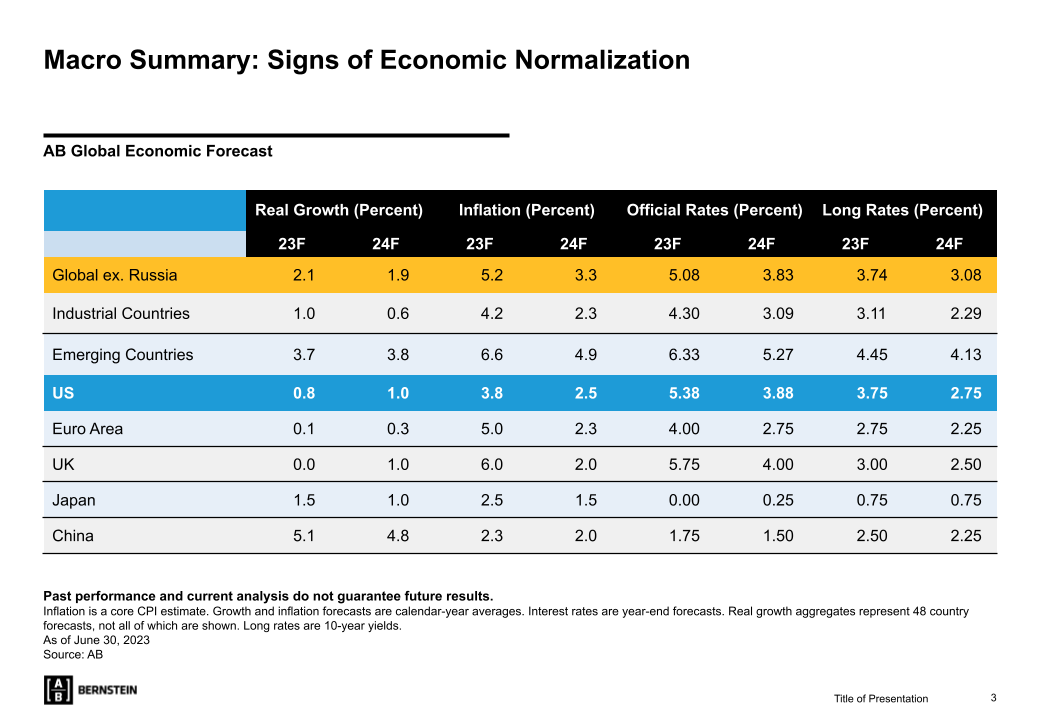
What do these macro trends indicate? Atkin’s team is seeing signs of normalization within the economy.
Signs of Economic Normalization
In 2022, markets were negative across the board because inflation proved itself to be both higher and more persistent than anticipated. Consequently, there was a massive policy response in the form of rising rates.
What Martin and his team observed in 2023 was a total reversal of 2022. Things were positive across the board because the markets indicated that inflation was moving behind us and that investors were going to get through this without a large recession.
If you look at the last three years, everything is positive. Based on this economic data, it appears that 2022 was an aberration.
In this graphic, inflation is shown through three measures: headline CPI, core CPI, and headline PPI. Within the headline producer inflation, Martin points out that inflation peaked in the fall of 2022.
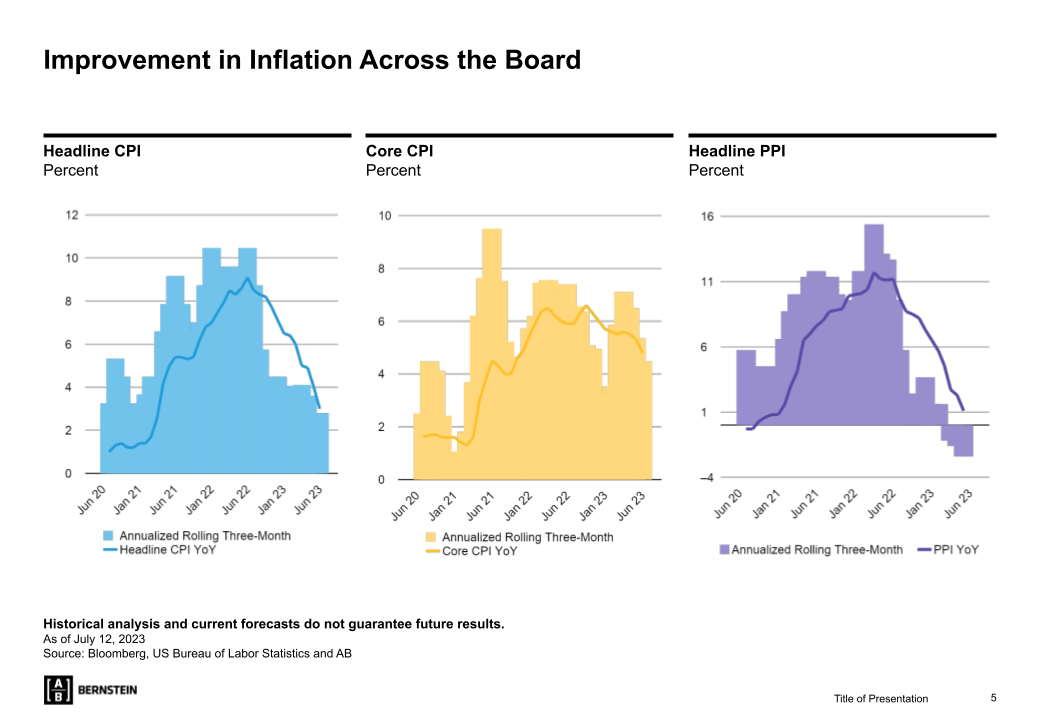
As Atkin’s economists went back and looked at every time of high inflation in the US and looked at what markets did prior to and after peak inflation, markets, in general, rallied after peak inflation. What this current rally tells us is that we’ve likely seen peak inflation and the worst is behind us. However, it won’t be all smooth sailing moving forward.
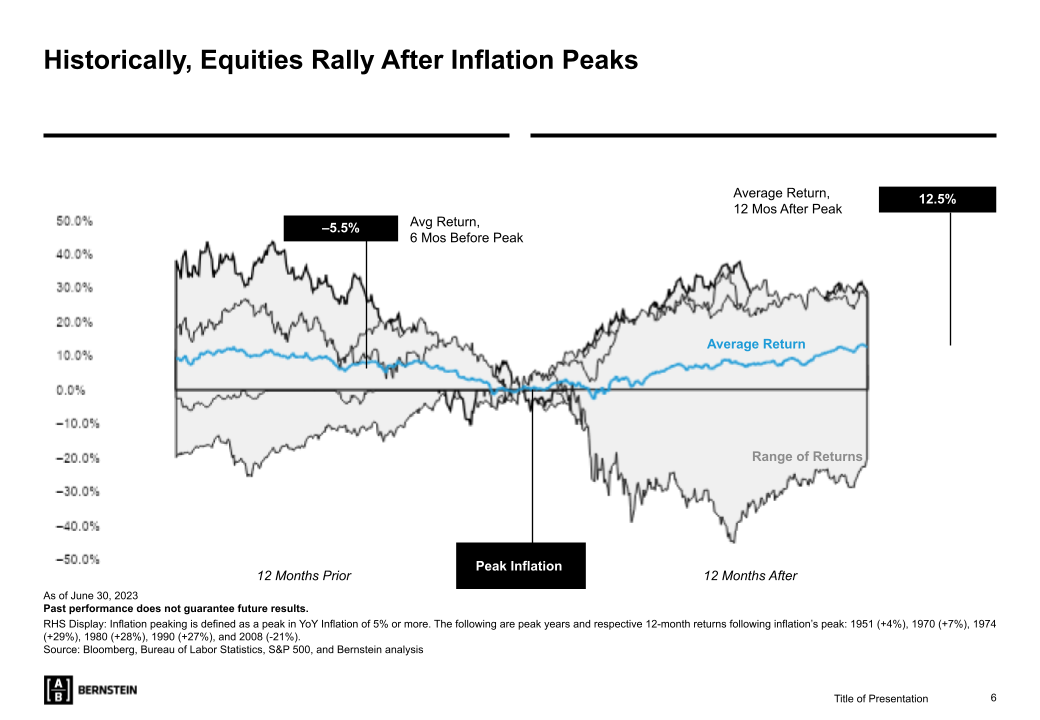
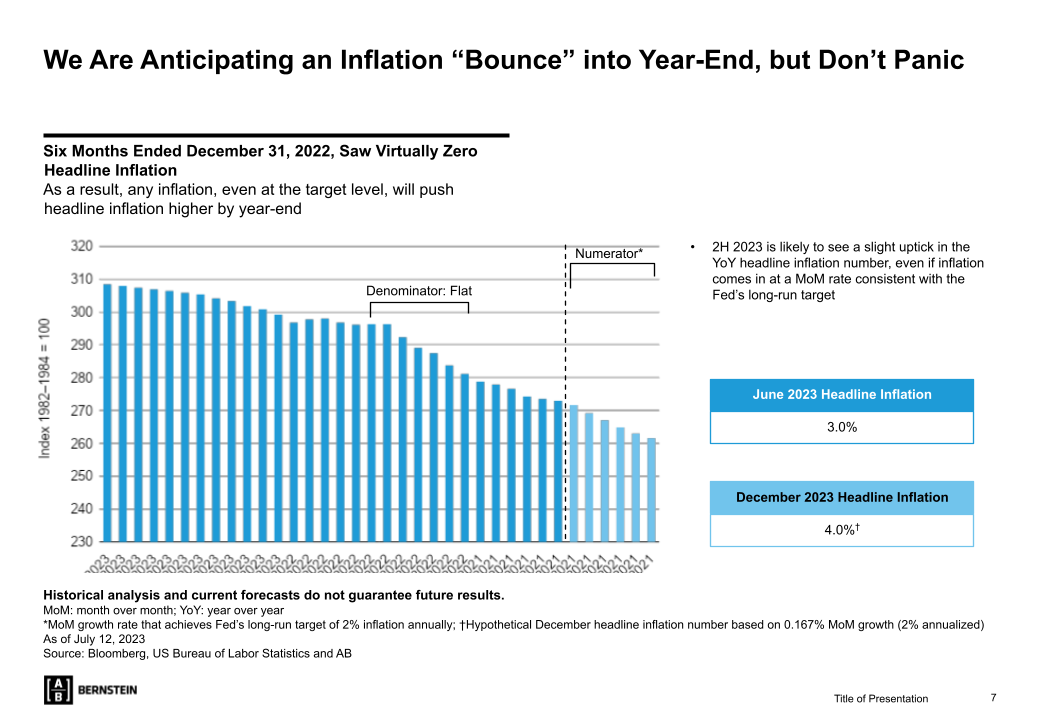
Inflation is calculated by year-over-year inflation, which includes a denominator and numerator effect. Inflation was set to rise at the end of 2023. Below is a technical calculation for year-over-year inflation. Month-over-month inflation is likely to continue to fall.
Many people doubt the data of inflation and feel it is a conspiracy of the government. However, inflationary measurements are individually based. That means there is no such thing as national inflation, as we all have different consumption paths. But the key to the way the government measures data is that it does so with a consistent calculation. The consistency of this calculation allows us to view market and economic trends. The trends are what economists are interested in rather than the absolute values of data.
What about the recession everyone was talking about in 2022? In 2022, the market indicated that the policy set by the Federal Reserve Board (FRB) (which was to raise rates fast and far) would lead to an inevitable recession in the United States. The FRB was fine with this as they have two mandates: price stability and full employment. Most of the time, these two mandates don’t conflict too much with one another. However, in times of very high inflation, the FRB decided to make it their number one priority to bring inflation down, relegating full employment to a lower priority. Due to these policy responses, many were expecting a recession.
As Martin observed what truly happened in 2022 and 2023, you can see that the Goldilocks Outcome—i.e., when inflation goes back to its long-term target, which, by the FRB’ standard, is 2 percent per annum—is highly likely. A Goldilocks economy includes consistent economic growth but not so much growth that inflation rises by too much. This helps prevent a recession. In this phase of the economic cycle, investing is typically ideal. Martin discussed what he believes the future will hold later in this article.
What does the FRB anticipate? As you can see in this graph, the FRB expects a soft landing. Projections for inflation are on the left (in blue), projections for growth are in the middle (in yellow), and unemployment projections are on the right (in purple). Based on these projections, the FRB believes inflation will come down more quickly, the real GDP will not be affected very much, and employment will stabilize.
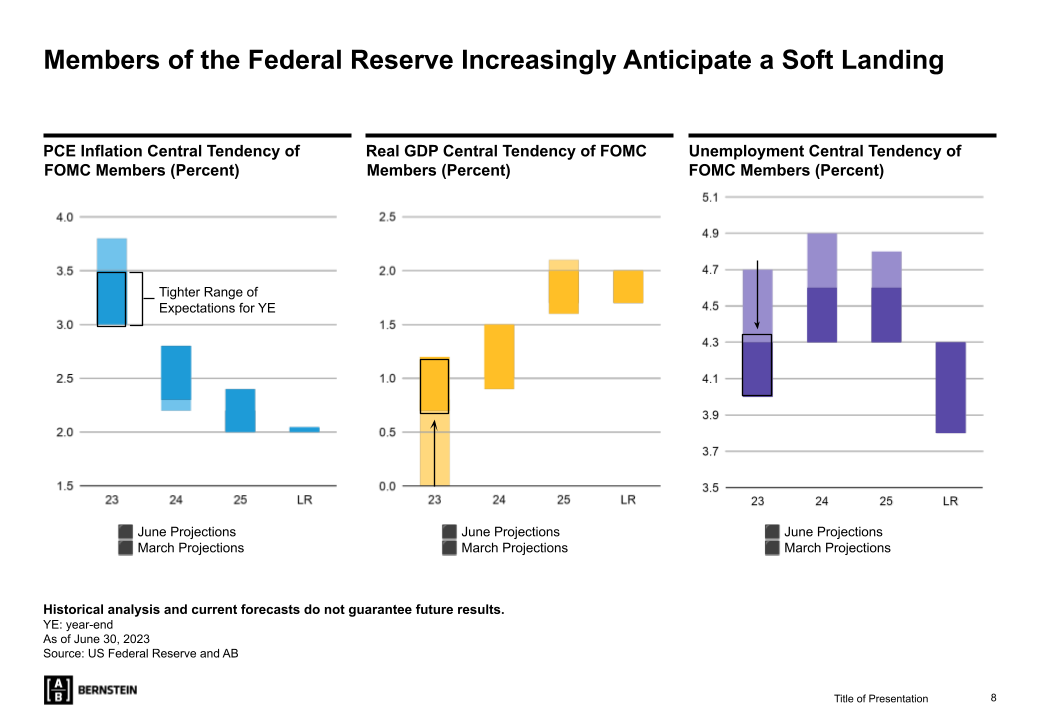
What Trends Do Economists See Based on Federal Reserve Projections?
In 2022, the market saw “good news” as “bad news.” Why was that? Every time an employment feed came through and showed that employment was robust in the US, it led to fears that inflation would continue at high levels, which led many to believe that interest rates would go up further. So good news was viewed as bad news.
In 2023, good news was good news. So when economists received impressions that employment was healthy, the market saw that as “good news” because the market was considering whether there would be a recession or not. Currently, employment data that is strong does not indicate a recession.
The Power of the US Consumer
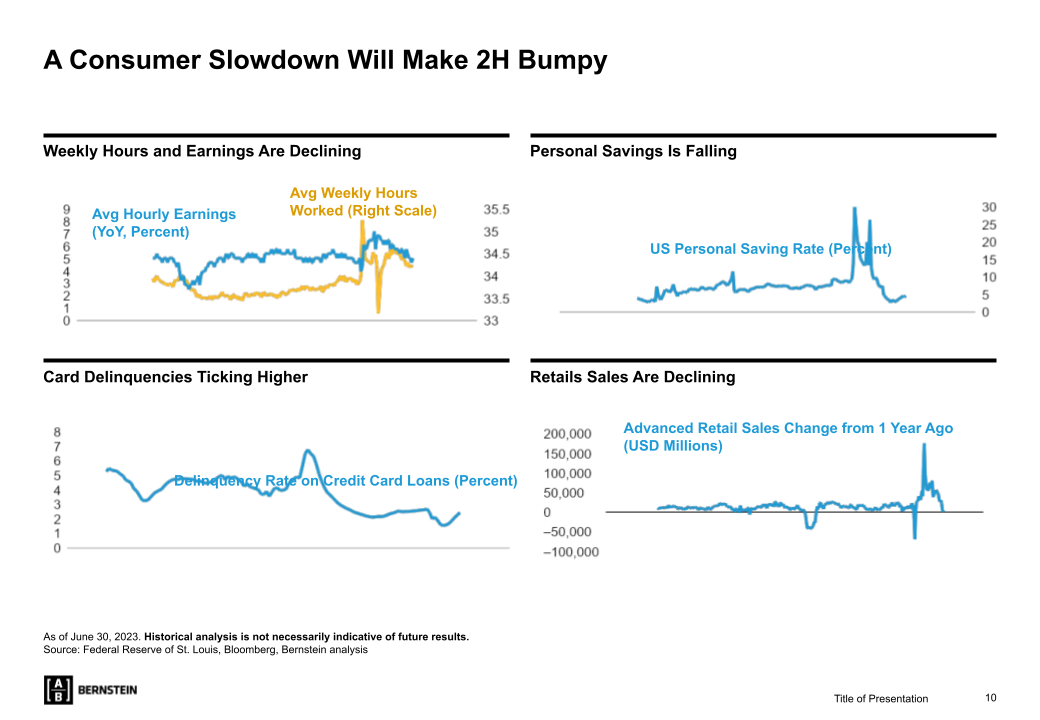
While economists are seeing trends that a recession is unlikely, some trends are less favorable. The US consumer is hugely powerful and drives the US economy, which drives the world economy. This is an important component for understanding trends. As Atkin’s team considered current trends, they are seeing some weakening in that power.
Savings rates grew massively in 2023 when the government wrote checks to stimulate the economy, and consumers began taking vacations and spending that money. Now economists are seeing retail sales coming down. From the data on this graphic, Martin pointed out that card payment delinquencies are rising but from an exceedingly low base. These trends show that the base for the consumer is very strong. Martin believes this will create a little bit more noise in the economy over the next six months or so.
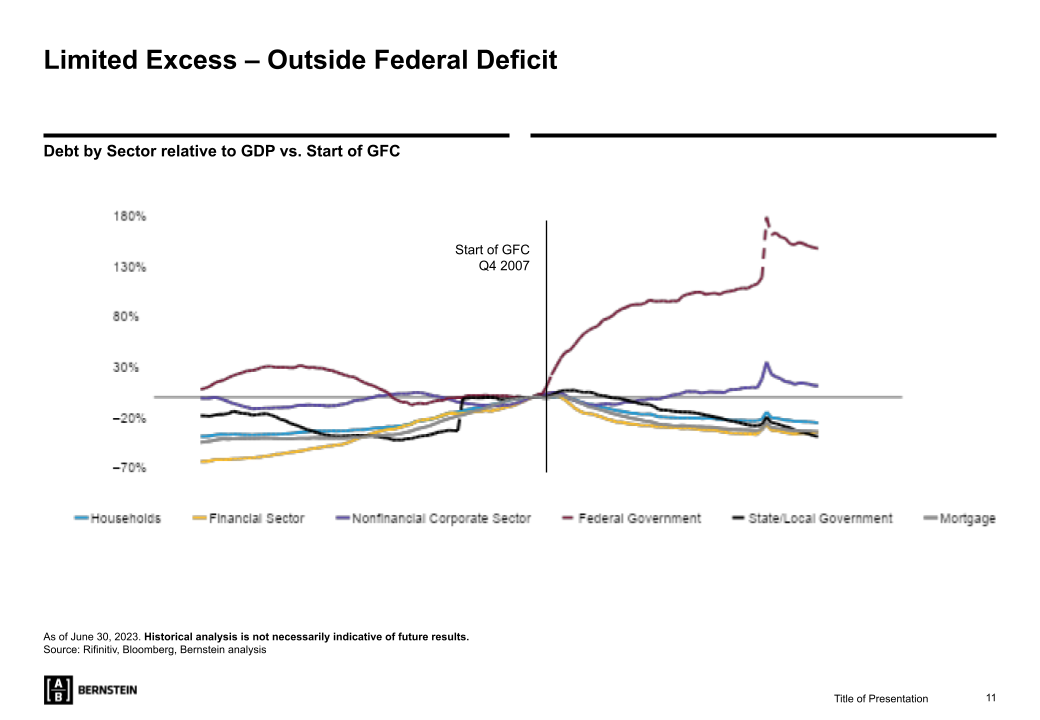
The Federal Deficit Outlook
Debt is the great financial crisis. You can see that, leading into the great financial crisis, all sectors of the economy were becoming more and more leveraged. This is not the case today. In fact, there has been a greater leveraging across the private sector. The financial sector has delivered, and state and local governments have delivered. Mortgages have come down in the US. There has been a lot of prudence in the private sector; however, not so much by Uncle Sam.
Economic Conclusions
What is the conclusion of all of this? On this graph, you can see various economic outcomes and their probabilities. Economists always weigh probabilities for the economy. The economic outcome outliers are 1) a hard landing and 2) no landing at all (we just cruise through and get inflation under control, and growth continues on a normal trend). However, it’s unusual for the economy to go to extremes. The economy tends to stay in the middle because there are many counter-balancing forces.
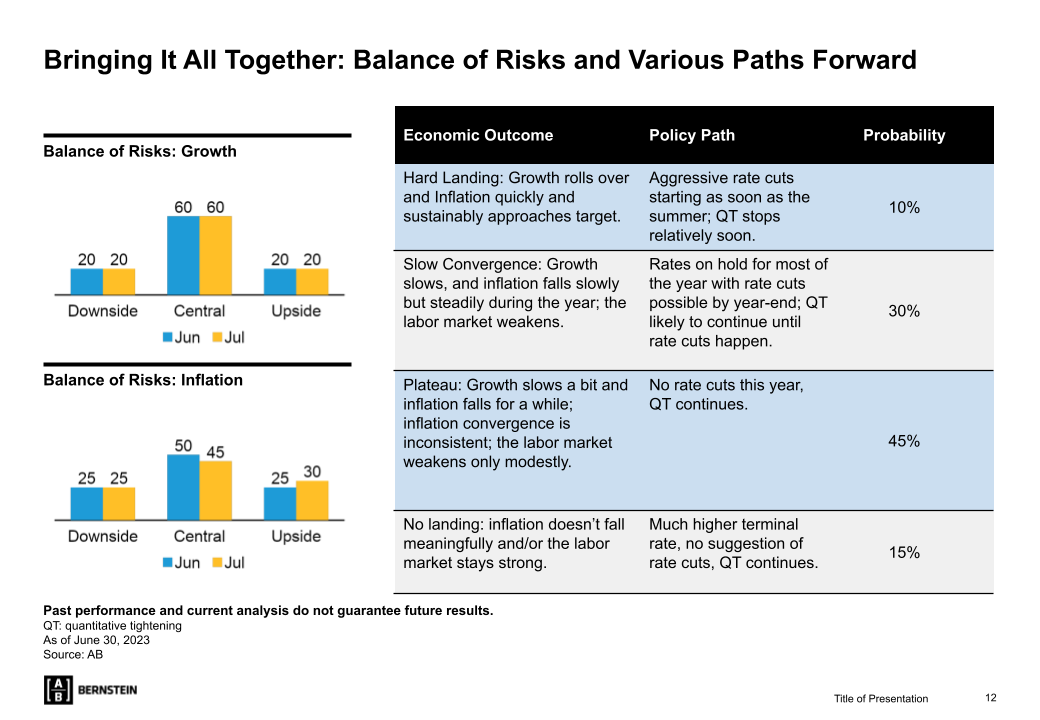
So, what is the middle of these probabilities? The middle is the things Martin described. It’s a slightly weakened job market, below-trend economic growth, and inflation falling (albeit a little slowly).
What does that mean to interest rates, which will really affect people? It means that official rates are unlikely to ease in 2024.
Based on our discussion thus far, let’s discuss how Martin believes the future will look.
Looking to the Future
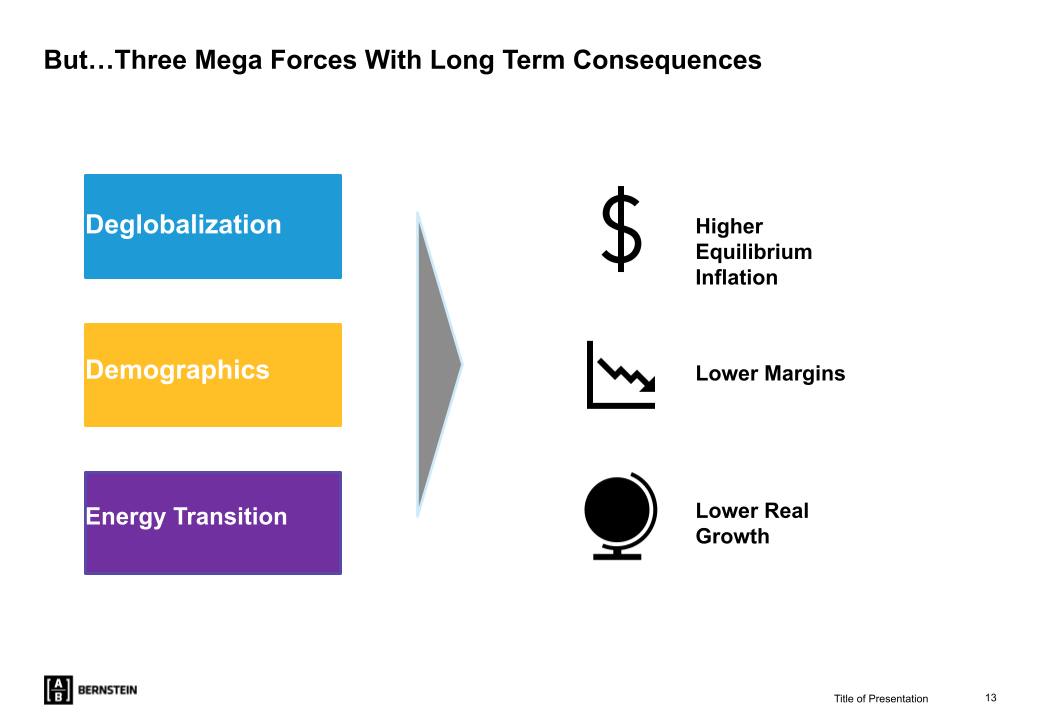
For a horizon that is five, 10, or 20 years out, economists consider three mega forces: globalization, demographics, and energy transition. Together, these three mega forces create higher equilibrium inflation than we’ve had in the past, lower profitability, and impact growth negatively (not negative growth—just lower real growth). Let’s explore these in turn.
Deglobalization
What is globalization? This chart shows world trade as a percent of global GDP. You can see that following WWII, it had a very fast, upward trajectory. As of today, however, it has plateaued.
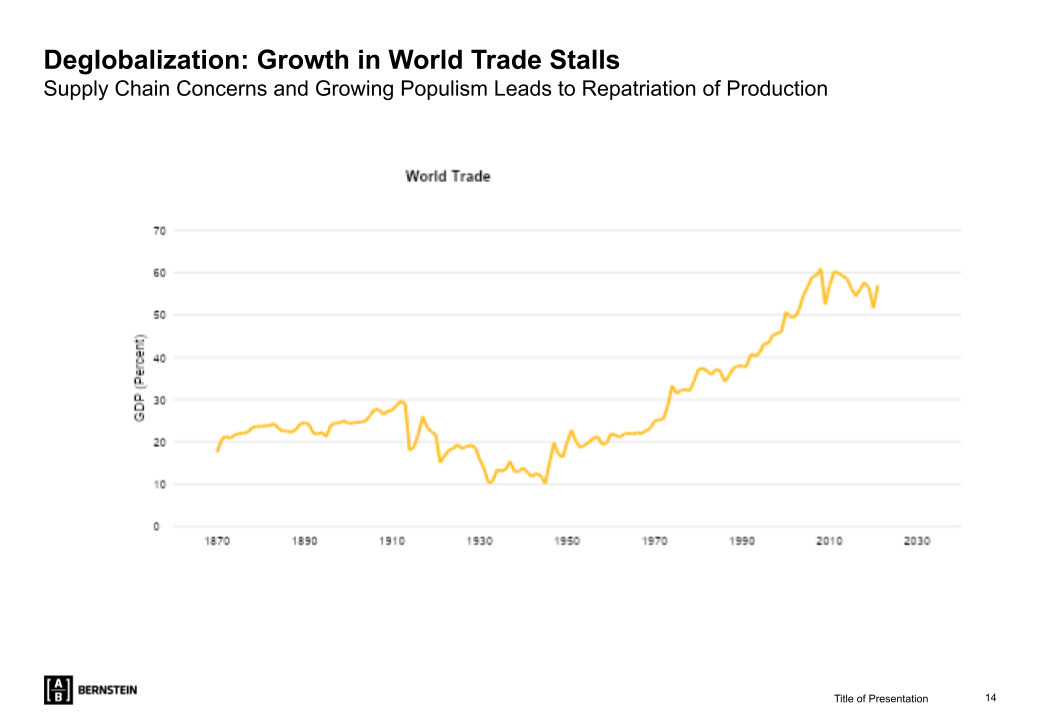
This is likely due to two big forces: First, the pandemic revealed to us that supply chains can be vulnerable. So, economists began to have less confidence in the idea of globalization. Second, there has been a rise in what economics refers to as populism, which is nations choosing to act more and more in their own self-interest rather than in the global interest. As a consequence, Atkin’s team has seen some patriatian production in world trade. Martin, as a Keynesian economist, believes this benefits all of us rather than serving as an antiproductive force.
Demographics
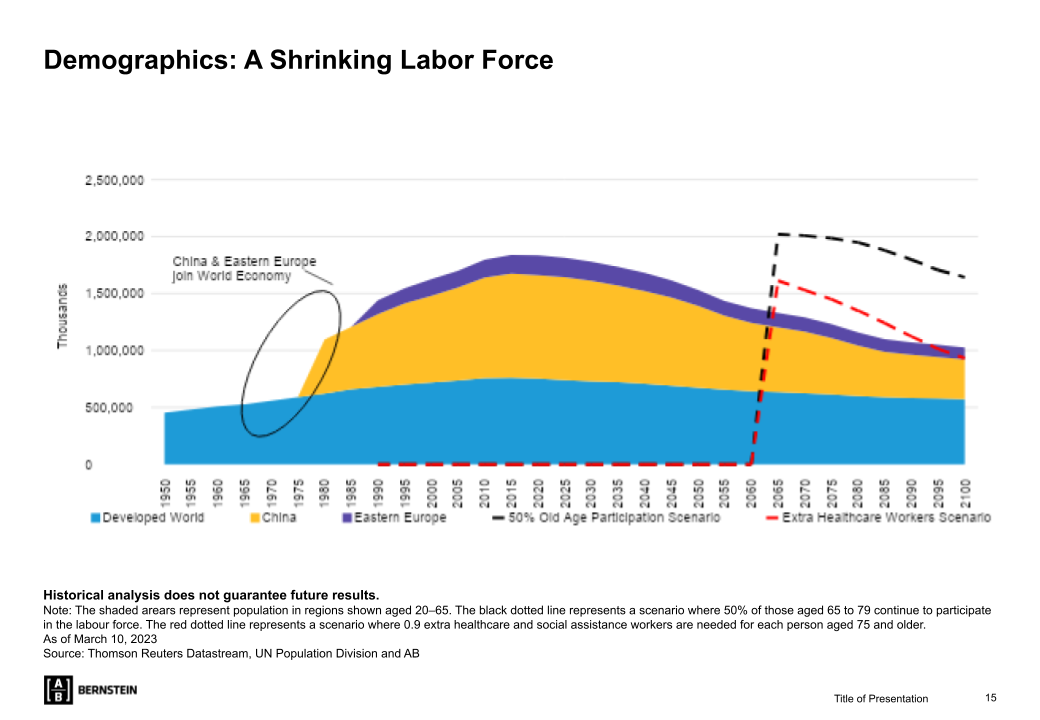
The second force is demographics. This graphic shows participants in the labor force. First, you can see that the labor force peaked in about 2010 as our population began getting older. Second, it shows a great surge of labor input flows, which began in the mid-70s when China and Eastern Europe (after the dissolution of the Soviet Union) began participating in the global economy.
As area populations age, the workforce is lost. That is antiproductive, and that causes scenarios: an upside and downside case. The black dotted case is the upside case where more people over the age of 50 participate in the labor market. That would be a favorable trend. An unfavorable trend is the red dotted line, which shows that more of the productive labor starts to look after the older generation rather than work. Again, this is a real antiproductive issue with no solution.
Energy Transition
There is a significant trend toward climate change mitigation. That means that we’re moving from an infrastructure of energy that was supported by fossil fuels to an infrastructure of energy that’s supported by renewables. No matter your stance on this move, it’s considered antiproductive because nations currently have a very useful infrastructure that works today that we’re replacing with another.
These three forces—globalization, demographics, and energy transition—lead to adverse consequences for growth and, therefore, the appreciation of assets over time. So what does the future hold?
Economic Outlook and Its Effect on Investment Decisions
As Atkin’s team considered trends starting with 2019 (pre-pandemic) and comparing them to 2023, they compared 10-year projections for returns for different asset classes: stocks, investment grade bonds, leveraged companies, high-yield bonds, and a moderately allocated stock/bond portfolio (60/40).
What are the conclusions here? The big conclusion is that the return to investment-grade bonds has significantly improved as a result of rising rates. The outlook for stocks 6 percent per annum mid-single digits is well below trend. And it’s well below long-term trends, which are about 10 percent per annum. Why is that? It’s because of the three mega forces that are restricting growth and, therefore, tightening profitability and returns to stocks.

This chart reflects the equity risk premium between the return to stocks and the return to the risk-free assets of government bonds.
In reviewing IG bonds (circled in red), the equity risk premium has narrowed very significantly. In other words, you, as an investor, are being paid less to take risks because the equity risk premium is narrow.
As economists have gone back and looked at all periods where the equity risk premium is narrow, they can conclude that that’s good for the bond investor but poor for the stock investor (tends to be more volatile and less absolute return). Economists can also conclude that it’s good for certain alternatives.
Advice Roadmap
What is Atkin’s advice? He is advising his clients that if they are modestly allocated, they have to make some decisions. They have to decide if they are satisfied with a lower outcome, mid-single digits, 5 percent per annum, or if they want more.
If they want more, they have to take more equity risk, which is not going to be hugely rewarding. This will require turning to alternative sources of return and accepting some of the drawbacks: illiquidity, uncertainty, and lack of transparency.
The general conclusion is this for investors and money managers: Move out of traditional assets—they are less rewarding than they were.
Speak with One of Our Amazing Fractional CFOs
An Ampleo fractional CFO can help you eliminate ambiguity in investing, enhance accountability and transparency, and implement a targeted financial strategy to propel your ambitious revenue objectives. Instead of investing significant time and resources in searching for a full-time resource—which can be time-consuming and costly with potential missteps—consider engaging a CFO with decades of experience on a part-time basis. Contact us to speak to a CFO today!
About Ampleo Partner Martin Atkin, Economist This article was taken from a session conducted by Martin Atkin, economist at Bernstein Private Wealth Management, at Ampleo’s 2023 CFO & Growth Summit.

Why Fractional HR Experts Trump PEOs: Unveiling the Secrets Behind Next-Level HR Management
In the realm of human resources management, the debate between utilizing a professional employer organization (PEO) or engaging a fractional HR expert has become increasingly prevalent. PEOs have long been hailed as a convenient solution for businesses looking to outsource their workforce management functions. In 2022, the PEO market size was valued at $59.62 billion, and it is expected to rise to $152.14 billion by 2031, attesting to its success. But are PEOs truly the best option?
Today, we unravel the misconceptions surrounding PEOs. Let’s discuss how adding a fractional HR expert to the mix is the most empowering combination for organizations striving for excellence in personnel management.
What Is a PEO?
A PEO is a company that provides comprehensive human resource solutions, including payroll, benefits administration, compliance assistance, and more. Essentially, they serve as an outsourced HR department for businesses, handling various tasks on behalf of their clients. For many businesses, especially small and medium-sized enterprises (SMEs), PEOs offer a convenient way to access professional employee management services without the need to hire in-house staff.
Beyond Administrative Efficiency: The Strategic HR Gap
PEOs undeniably bring operational efficiency to HR functions. But let’s be honest, their “one-size-fits-all” approach doesn’t exactly scream personalized guidance. Imagine bringing a unique organizational challenge to your PEO and getting a cookie-cutter response that ignores your company’s culture, goals, and specific needs. Not exactly the kind of solution that drives growth, right?
PEOs are built for efficiency, not strategic HR magic. They often take a reactive approach, waiting for issues to arise before offering support. For instance, 36% of HR leaders say they lack the resources to hire top talent.
But your employees deserve better. They deserve proactive solutions that anticipate challenges and unlock their full potential.
Think of it this way:
- PEOs are payroll ninjas, benefits wranglers, and administrative all-stars.
- Fractional CHROs are strategic partners, talent whisperers, and culture architects.
See the difference? Fractional CHROs don’t just handle the paperwork, they dive deep into your organization’s DNA to better understand your goals, values, and unique employee landscape. Does that mean you have to choose between a PEO or a fractional HR executive? Not necessarily.
Amplifying Your PEO: Introducing Fractional HR Expertise
Fractional CHROs are not here to replace your PEO. They supercharge it, offering a deeper level of expertise and customization that PEOs simply can’t match. Working seamlessly alongside your PEO, they can address gaps in strategic guidance and proactive problem-solving. They are specialized consultants who delve deeper into your organization’s DNA, aligning HR initiatives with your business goals, values, and employee demographics.
A Proactive HR Approach
While PEOs have a “wait and see” approach, fractional CHROs use a preventive approach, implementing policies and procedures to mitigate risks and foster a positive work environment. This proactive stance can save businesses time, money, and reputation in the long run.
Knowledge in Niche HR Areas
While PEOs can offer a wide range of HR services, they may lack the depth of knowledge in specific areas. Niche HR segments are on the rise, with some markets expanding as much as 11%. Fractional HR executives, on the other hand, often have extensive experience and specialization in niche areas such as talent acquisition, employee relations, or organizational development.
Flexible, Scalable HR Solutions
PEOs can be a great solution for smaller companies or those experiencing rapid growth who need basic HR support but want to save up to 40% of the cost of a full-time team. However, as your company matures or faces unique challenges, a fractional HR expert can elevate your PEO partnership and offer strategic guidance. Adapting to these changes seamlessly, they can provide on-demand support without the constraints of a fixed contract or service package.
Investing in Your People, Fueling Your Success
While PEOs may offer a convenient solution for outsourcing HR functions, they often fall short in delivering personalized solutions. At Ampleo, we believe that fractional CHROs are the superior choice for businesses seeking next-level employee management.
Are you ready to unlock the transformative power of a strategic HR approach? We’ll partner with you to cultivate a vibrant, engaged, and high-performing workforce that propels your business toward sustainable growth.
What sets Ampleo apart? Here’s a glimpse into what we offer:
- Proactive Approach: We anticipate and address potential HR issues before they escalate, saving you time, resources, and potential disruptions.
- Strategic Planning: We collaborate with you to create a customized HR roadmap aligned with your long-term business objectives.
- Bespoke Solutions: We don’t believe in cookie-cutter solutions. We tailor our approach to your specific challenges and opportunities.
- Diverse Expertise: Our team boasts extensive industry knowledge and diverse backgrounds, bringing fresh perspectives and innovative solutions to your table.
- Scalable Engagement: We offer flexible engagement models, ensuring you receive the exact level of support you need without over investing.
Contact us today and discover how our seasoned professionals can elevate your PEO partnership and unleash the full potential of your team!
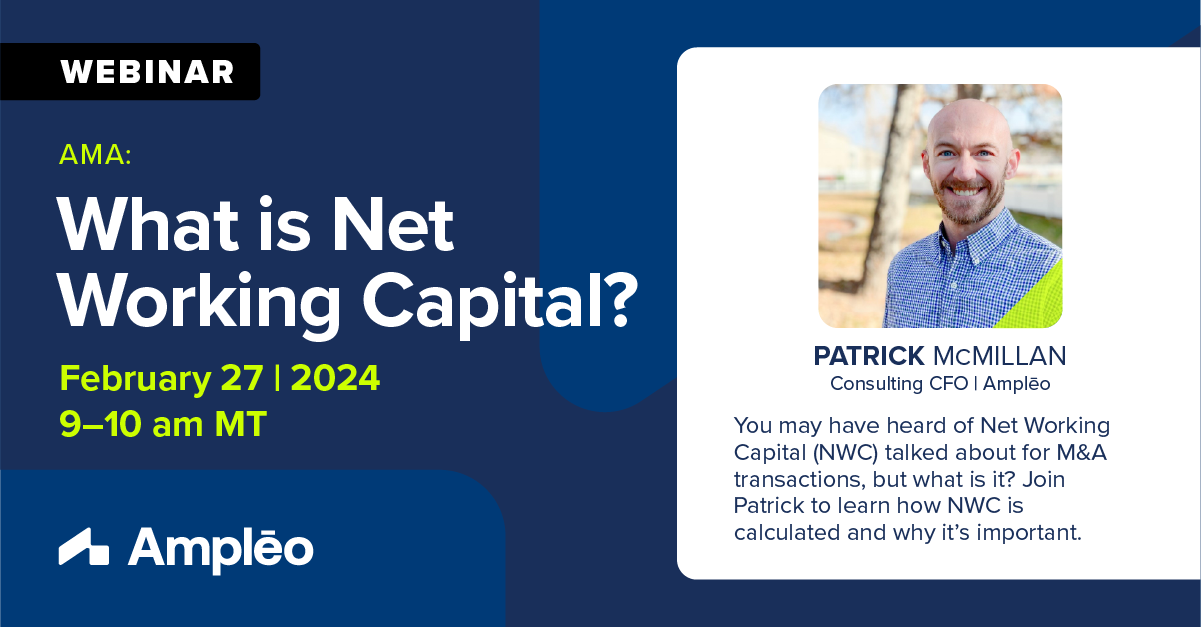
Webinar: What is Net Working Capital?
You may have heard of Net Working Capital (NWC) talked about for M&A transactions, but what is it? How is it calculated? Why is it important?
Patrick McMillan, CFO and Transaction Advisor of Ampleo discussed these questions (and others attendees had) during this webinar.
Fill out the form to watch the webinar and download the slides.
You've Got the Vision.
We've Got the Fractional
Team to Build It.
A fractional CFO who knows your numbers. A fractional CMO driving your pipeline. An HR leader building your people systems. Sales tax specialists keeping you compliant. Valuation experts ready when you need them. All embedded. All executing. All backed by Ampleo Intelligence, our AI platform.

You've Got the Vision.
We've Got the Fractional
Team to Build It.
A fractional CFO who knows your numbers. A fractional CMO driving your pipeline. An HR leader building your people systems. Sales tax specialists keeping you compliant. Valuation experts ready when you need them. All embedded. All executing. All backed by Ampleo Intelligence, our AI platform.
You've Got the Vision.
We've Got the Fractional
Team to Build It.
A fractional CFO who knows your numbers. A fractional CMO driving your pipeline. An HR leader building your people systems. Sales tax specialists keeping you compliant. Valuation experts ready when you need them. All embedded. All executing. All backed by Ampleo Intelligence, our AI platform.
You've Got the Vision.
We've Got the Fractional
Team to Build It.
A fractional CFO who knows your numbers. A fractional CMO driving your pipeline. An HR leader building your people systems. Sales tax specialists keeping you compliant. Valuation experts ready when you need them. All embedded. All executing. All backed by Ampleo Intelligence, our AI platform.